
Showing posts with label Bernanke. Show all posts

Tuesday, January 8, 2013

Which Way Forward American Man


Had I been a Republican Congressman, I wouldn't have given in to the fiscal cliff deal:  I would have let the tax hikes and spending cuts happen, and then proposed a bill to cut taxes afterwards. The bill wouldn't have passed the Senate, and even if it did, it would have been vetoed by Obama. But a bill would have shown the American electorate that the Republicans were still serious about cutting taxes.

Of course, this may have been bad politics (and one of the reasons why I wouldn't make a good politician). The Democrats, in this scenario, may have put forward their own tax cut bill - one which which would leave high rates on "the rich" (however they may be defined) but would cut rates for "the middle class" (however they may be defined). The Republicans then, were they to continue playing hardball, would be forced to adopt it or block it.

That's pretty much what happened anyway, and so far, we can say that the markets like the recent deal. After the passage of the bill, the DJIA climbed to 13,435 and gold fell to $USD1658 an ounce. The fact that the price of gold has dropped indicates a strengthening US dollar, and increased appetite for liquidity (i.e., an increased demand for US dollars to spend and invest). Gold doesn't respond to supply and demand that much, but US dollars - and all other currencies - do. Increased demand for a currency indicates a strengthening currency and falling prices (deflation); conversely, excess supply indicates a weakening currency and rising prices (inflation). To judge by the falling price of gold and the strengthening of the US dollar, the US is in a deflationary environment right now. But that's a good thing. Increased demand for liquidity (dollars) means increased demand to spend and invest in the US.

If we are to divide the DJIA by the current price of gold, we have a DJIA worth 8.10 ounces of gold. Which is good - probably a high for the past twelve months - but which only puts the DJIA to where it was in the very early nineties, as we see from this chart:

Or, as we can see from the chart, the DJIA was nearly this high back in September 2010. For most of 2012, the DJIA was bobbing around 7 ounces or so.

So why did the DJIA rally after the fiscal deal? Probably because, as Larry Kudlow suggests, the markets expected a real walloping from anything proposed by the Democrats and instead it only wound up with a smack on the backside. The capital gains tax has gone up from 15% to 23.8%, ditto the tax on dividends, and the estate tax has gone up from 35% to 40% with a $USD5 million exemption. But it could have been a lot worse. Dividend taxes could have gone up 43.4% without a fiscal cliff deal, and estate taxes could have climbed to 55%. And the loophole which allows American taxpayers to circumvent the dreaded Alternative Minimum Tax could have expired.

Rush Limbaugh shrewdly observed that, while income tax rates (which are applied to labour) have been raised to high levels, taxes on investment income (i.e., capital gains and dividends) were raised only a little. To Limbaugh, this is evidence of Obama's hatred for aspirational Americans: high rates on labour are designed to thwart them from entering the "middle class" (however it may be defined) and competing against the super-rich - the Romneys and Buffets. Indeed, it's well-known that Romney and Buffett hide their wealth using the low divided and capital gains tax rates. Any rich and clever American can do so, and this is part of the reason why so many wealthy Obama supporters - including Hollywood types, wealthy Jewish-Americans hedge fund and private equity managers and the like - continue to support him.

It's good to consider all this simply because US markets - and fiscal and monetary policy - are so intimately interconnected with the rest of the world's. When Herbert Hoover raised the top rate of income tax from 25% to 63% (Obama would have loved Hoover) in 1931, the rest of the world - including Europe and Australia - responded with its own super tax-hikes, and so began the Great Depression.

We can already see other countries following the Obama plan. Japan, under Shinzo Abe, will commence yet another round of Keynesianism: currency devaluation and massive "stimulus" deficit-spending on public works. Europe, meanwhile, has large deficits too, just like America, and Spain, France, Britain, etc., have introduced their own tax increases on "the rich". (Keynesians and liberals, however, dispute the efficacy of the European method. Tax increases on "the rich" are never contractionary: top rates on income, capital gains, etc., can be raised to 99% to little adverse effect. Tax increases on consumption are always contractionary, and some of these European countries have made the error of increasing their value-added taxes, which directly affects consumption. Some the belt-tightening "austerity" measures are bad, too, even though the budget-cutting hasn't really run that deep). On top of this, the Eurozone members can't print their own currencies, like Britain and America, and so can't devalue). No doubt all of this foreign aping of Obamism will enjoy the same success that it did in America - which is to say, no success at all.

Deep down, of course, the Keynesians - and Obama - know that they have stuffed things up. But the problems can be easily hidden. America's CPI doesn't count the cost of food and energy - the only two things which go up in price - which is why US CPI inflation figures have stayed more or less consistently low despite the extraordinary weakness of the US dollar (the US dollar has been devalued by 91.73% against gold in the past five years). US unemployment figures could be higher, but the participation rate is at record lows, meaning that the official unemployment rate stays down (most of the new jobs created every month, too, are going to immigrants, as the US Household Employment Survey shows). As for interest rates on US debt - Bernanke has aggressively intervened in the bond market to keep them at near zero. (It's for this reason that US debt won't see the same calamitous rise in yields as the Italian, Spanish, Greek and French). The US media, as a whole, has abnegated its position as a critic and watchdog of the US government, and has been extraordinarily supine with regard to Obama (as has the liberal establishment, which awarded him the Nobel Prize for Peace), and can be counted on not to draw attention to Obama's failures.

In short, there's no reason why Obama should change course: it's a case of another four more years of the same.

That's economic policy: what of social policy? Well, we can see a continuation of the massive transfer of wealth, via government spending and welfare transfers, from white Americans (especially "middle-class" white Americans) to an Afro-American and Hispanic underclass. This is Obama's socialism, but, because the socialism is racial, American conservatives dare not speak its name. On top of this, Obama wants inmagraciòn, lots more inmagraciòn - again, something the majority of American conservatives approve of - and probably legalisation of gay marriage and marijuana too.

Geopolitically and militarily, America has become something of a joke. Despite its superior weapons and equipment, its technology, its well-trained troops, the US army couldn't win wars in Iraq and Afghanistan. One of its elite units - the Navy SEALs - have been reduced to the status of play-actors: the Bin Laden "raid" and "assassination" most likely never happened. (One has to ask if, in thirty or so years time, whether or not the truth will come out and if the documents concerning the "raid" will declassified).

So what's the answer to America's woes? Secessionism. The United States has to break apart, along traditional cultural, historical and regional lines.

What I mean by those lines is described, brilliantly, in Colin Woodard's American Nations: A History of the Eleven Regional Cultures of North America (Viking Press, 2011), which is every bit as good as Hunter Wallace - the Southern nationalist - says it is. A succinct summary of its contents - including descriptions of the eleven "nations" - can be found here.
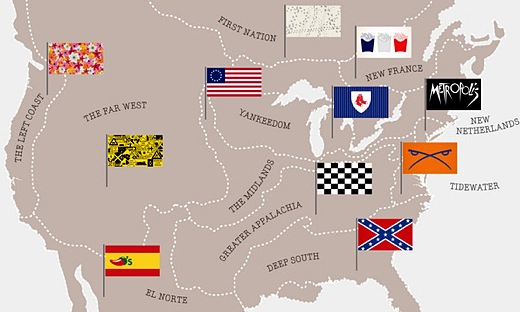


Some nations (like the former Yugoslavia or Czechoslovakia, or even Belgium, Spain and the United Kingdom today) are constructed on unstable, shifting tectonic plates, culturally speaking. North America is a continent of a similar character. There was no original, primordial unity, a unity constructed by the Founding Fathers, in American history: that is, a decision as to what sort of nation America would be. Instead, there were always warring nations within America: and the ten nations making up America have gone to war with one another, several times, and not just during the American Civil War. Secessionism, and political and cultural independence from an overweening (often Yankee-controlled) federal government, is written in to the American DNA. (From Woodard, we learn that the region of New Netherland (which contains New York and its surrounding boroughs) wanted to cede from the US and become a city-state).

The way to understand America, according to Woodward, is to see it divided up into nations which are almost like different planets - like the different civilisations the adventurers on the 1960s era Star Trek came across on their journeys. New Netherland is pure commerce, founded by Dutch, and bolstered by the presence of Jews and other European immigrants: this is the true 'nation of immigrants'. Yankeedom was founded by Puritans, who are communitarian, do-gooding and determined to interfere in other Americans' lives. The Midlands, founded by pacifist, easy-going Quakers, German Mennonites and Scandinavians, is a world populated by peaceful farmers who don't cause any trouble and indeed, are reluctant to take up arms to defend themselves against aggressors: they are the equivalent of Luke Skywalker's aunt and uncle on Tatooine in Star Wars. Tidewater was founded by English gentlemen who wore wigs and lived in English-style country estates, like out of a Jane Austen novel, and who were descendants of the Royalist English who had fled Cromwell after the end of the English Civil War. The Deep South is a slaver state, and really has more in common with the Caribbean - that is, the white Caribbean, the white West Indies slaver states - than anywhere else. Then there is the Greater Appalachian region, which is populated by the rambunctious, redneck, cracker 'Scots-Irish' and whose religion is Christian Revivalist Baptism and Methodism - of evangelicals, snake-handling and speaking in tongues.

Further afield is New France (New Orleans and Quebec), El Norte (northern Mexico) and the Left Coast, which is the coast of California, Oregon and Washington state - and contains the Pacific Northwest. The Left Coast is individualistic, idealist, and given to utopianism and self-actualisation - the true birthplace of beatnikism and hippie-ism. Missionary Yankees from New England attempted (unsuccessfully) to colonise it and save the inhabitants from themselves. I found this intriguing reference in Woodard:

The new Yankee "errand in the wilderness" got underway in fits and starts in the late 1820s. A delusional New Hampshire schoolmaster, Hall Jackson Kelley, tirelessly promoted an ambitious colonisation scheme for the Pacific Northwest, a region he'd never seen. His elaborate plans for a civic and religious republic never got off the ground, but his marketing effort - he plastered posters across New England, published books, and petitioned Congress for aid - did inspire others... [Woodard, p. 217]
Is the (purportedly schizophrenic) advocate of white colonisation of the Pacific Northwest, Harold Covington, the reincarnation of Hall Jackson Kelley?

The last of the eleven nations is the Far West, a sparsely populated, desolate area which is rich in resources and is effectively controlled by mining companies: it includes Idaho, Montana, Wyoming, Utah, most of Nevada, Arizona, Colorado, etc. It's probably the equivalent of Western Australia.

So, to revert to our science-fiction analogy of different civilisations on different planets: the Far West is the mining planet, the Midlands is the farming planet, the Deep South is the slave planet, New Netherland is the commerce planet, California is the hippie, environmentalist and New Age planet, Yankeedom is the, well, Puritan planet, Tidewater the 'replica 17th-century Anglican and English planet', and so on.

Most countries, including Australia, have pronounced regional differences - which are reflected in differences of accent, but also a pronounced competitiveness and even resentfulness. I've seen a recent article, in the German media, saying that Berliners resent the Swabians who have moved there. (The idiosyncrasies of the differing German regions are well-chronicled in Hitler, Nietzsche and other writers on German national life). But it's only a few rare instances - in the history of the West, anyway - that these antagonisms, differences and resentments become political, i.e., become calls for secession, and even go all the way up to armed conflict and war. America is one such rare case.

America is on the threshold of another break-up of the union, as the 'red' states (or rather, red nations) which voted for Romney will attempt to cede from the 'blue', which voted for Obama and the Obama program (inmagraciòn, gay marriage, marijuana legalisation, massive tax hikes, massive deficits, massive transfers of white wealth to Afro-Americans, currency devaluations, etc.). The Southern strategy is the correct one: the Dixie or neo-Confederate nations - Greater Appalachia, the Deep South, New France and Tidewater - need to cede from the northern states, Yankeedom, Midlands and New Netherland. (The Far West can be, in the event of a breakup of the United States, can be expected to side with the South; the Left Coast and El Norte with the Yankees).

One consequence of this is that the 'red' states will regain control of their own borders and the rapacious demographic advances of the Mexicans (and South and Central Americans) who emigrate to America from El Norte.

As well as that, the Southerners will regain control of their fiscal policies - particularly welfare policies. According to the Southern nationalists, the Afro-American population in the South are huge net consumers of welfare; once, however, the Southern secessionist states cut off the welfare supply, the Afro-Americans will flee the wicked white Southerners and go to the northern states, where they can except a warm welcome. New cities in the north will become majority Afro-American, just like Detroit, Chicago, St Louis and the like, cities which are renowned, the world over, as numbering among the most liveable in the world.

How would such a partition of the US affect Australia and Europe? America, as such, would no longer be a force to be feared. Germany and the rest of Europe can breathe easy, without the threat of American interference (and military intervention, which happened twice in the 20th century) and Australia would be thrown upon her own resources.

When it comes to immigration policy, it would be a case of anything goes. France, Greece, Italy, and then perhaps the entirety of the Western world, would perhaps gain the courage and daring to tackle their illegal (and legal) immigration problems. All because of the break-up, the balkanisation, of America.

Once the American boot is lifted off Europe's neck (it's been there since 1945), Germany can reassert its control of the Continent and weld it into a political and economic unity (this is already under way).

Secessionism, too, is already under way in the US - in thought, but not yet in deed. Obama is just the right man, at the right point of history, to help bring secessionism is about. He is a natural born polariser, who delights in setting different groups within American society against one another. The fact that he is nominating Chuck Hagel as a Defence Secretary, as opposed to a mediocre, establishment Jewish-American like John Kerry, is proof of this. I myself am delighted by the furore of the Jewish-American and Israel lobbies over Hagel, because I watching their rage (what's more, it's proof-positive that the Jewish lobby actually exists - when was the last time you saw France, Russia, Mexico or Germany putting pressure on the US government over its choice of a cabinet nomination?). But I can't help remarking at how Obama is unnecessarily antagonising an ethnic group which is one of his staunchest backers. The reason why he's doing this is that he enjoys it.

At any rate, he has permanently set the two halves of America - the 'red' and 'blue' states - at war against one another, and perhaps, by the end of his second term, we will see the second breakup of the Union.


Saturday, September 22, 2012

Romney or Obama '12? American Jews, the Euro and a Return to Gold


'Carthage must be destroyed': I've always, so long as I've been a nationalist, subscribed to the notion that 'America must be destroyed'. (I mean, by 'America' what I call 'The Anglo-Judeo Alliance' (America, Israel, the United Kingdom)). In the 1930s, after the election of Roosevelt, the US, the UK and Jewish-Americans entered into a sinister alliance, which proved to be the most destructive and malevolent force in the history of Western civilisation up to that time; the alliance, as we know, started (and finished) WWII, laid waste to Europe, enslaved the Western half and gave over the Eastern half to communism... We nowadays assume that America was always liberal, anti-"racist", anti-German, pro-Israel and pro-immigrant, but that wasn't the case: America only took that turn comparatively recently, in the past eighty years after Roosevelt. (Likewise, "The West" has only been liberal, pro-Israel, etc., since 1945). We in the West are still in the grip of three men - Roosevelt, Churchill and Churchill's friend and political accomplice Chaim Waizmann - who have been running the show, in effect, since the 1930s. It's this sinister alliance which has been at the root cause of all the problems in the West since then. Which is why I look at anything that sets today's America - Roosevelt's America - back with untrammelled glee.

Having said that, there are two Americas: there is today's America - the America of Wal-Mart, Zionism, anti-depressants, Afro-Americophililia which venerates Martin Luther King Jr. as a secular saint - and the 'old', good America of the immediate post-war period, which is portrayed by the TV series, Mad Men (2007-2012). Paradoxically, it's the old America - which was run by handsome, immaculately-groomed WASPs like Don Draper - which bombed German cities, occupied half of Germany, cut German rations below starvation levels, and tortured and hanged Germans at Nuremberg, and it's the old America I prefer to today's. I wouldn't like to live in 1962, of course - I don't think anyone of my generation could survive a day without mobile phones or the Internet or DVDs - but, in the old America (and old Australia) of 1962, I would have lived in an ethnically-homogeneous society. America, right now, is suffering - from its defeats in the Afghanistan and Iraq wars, from Obamanomics, from enormous Mestizo immigration, from blighted cities like Detroit, from geopolitical decline - but this isn't the same America that enforced the Morgenthau Plan, and it's not the America of WASP scions Don Draper, Bert Cooper and Roger Sterling (who would have been horrified by Obama). If there were any justice in the world, the old America should be the one suffering, not the new, but such is life.

The question is, who should, in the upcoming US presidential elections, a nationalist support? Who do we want to win? Who will (inadvertently) help the nationalist cause the most?

After September 11, it became clear that the perpetrators of the attack (whoever they were) had gauged American psychology beautifully. The perpetrators sought to provoke America and give it the impetus to undertake rash, precipitous action - i.e., invade a country like Afghanistan, which they couldn't possibly hope to conquer (at least, by using their standard conventional-warfare tactics) and thus give it its second Vietnam. The results, in 2012, are better than could be expected: two lost wars, and on top of that, America's proxies Israel and George lost a total of three wars. It would take a very skillful leadership to negotiate one's state to an improved power-position, in spite of such a succession of military defeats, or perhaps really good luck (America won half of Europe off the Soviet Union, nearly fifteen years following its catastrophic defeat in Indochina). America, fortunately, doesn't have that skillful leadership. Military defeats have led to a geopolitical decline, a loss in power and prestige. America has lost Nicaragua, Bolivia and Venezuela (which are now firmly in the anti-American camp), longtime enemies Russia and China have become stronger, and long-suppressed Germany and Turkey are, incredibly, beginning to resume their natural leadership roles (perhaps, at this rate, even Japan may awaken after its seventy-year slumber). This is quite a fall from the late 1990s, when America (and Israel) were at the peak of their political and economic strength.

The reason why this is important to nationalism is because the internal policy of a country - e.g., the ideology of its leadership - is largely determined by external geopolitics. Fascism, in the 1920s and 1930s, would never have gotten off the ground without the example of Germany and Italy, and the fact that Western Europe has been so liberal democratic, so pro-Zionist, for seventy years comes about from the Allied victory in 1945. Were the Allies - that is, Churchill, Roosevelt and Waizmann and their spiritual heirs -  to suddenly become geopolitically weak, then the ideology of Europe would change. Just as Libya, Syria and Egypt, in the absence of the Arab secular socialism of Ghaddafi, Assad and Mubarak, stand in danger of turning towards the most extreme (Salafist) Islamism - Europe could turn to Far Right conservatism and fascism.

The Left understands this process very well. Both Mao and Lenin attributed the success of communism in their countries in part to China's and Russia's military defeats at the hands of the Japanese and Germans respectively. Without the displacements brought about by war, China and Russia would probably have remained non-communist. In the case of Europe and Germany, it's all about getting the boot - the American jackboot - of one's neck. Once that boot is removed, Europe can breathe a little more freely, and then start behaving like itself.

In order for German nationalism - and by nationalism, I mean the ideology of the German NPD, the DVP, the Freie Nationalisten and others - to succeed, certain fundamentals must be in place. Germany has to be strong again. And what is good for Germany, in this case, is good for Europe and all of the West.

In the post-WWI, Weimar period, Germany was stronger, politically, more sovereign than it was now (surprisingly enough). America, which was largely responsible for the Allied victory, had no interest in occupying Germany and making Europe a permanent vassal (although it did interfere by breaking up the Austro-Hungarian Empire, giving Poland its independence, and so forth). As a result, Germany, France, Italy, Britain, were largely left to their own devices. France quickly became the ascendant power on the Continent (much to the alarm of Britain) and pushed Germany around quite a bit; but, all the same, Germany was never as pulverised, demoralised and brainwashed as it was after 1945. After Hitler's ascent to power, of course, Germany became steadily more powerful, more sovereign, and resumed its old, traditional role of The German Bully. It goes without saying that this would never have happened had the Allies been as brutal and repressive in 1918 as they were in 1945.

Which helps explain why nationalism, in Europe, can only be achieved in stages. I've always thought that the likes of the NPD were too ambitious for this reason: I want to say to them, 'Hang on a minute, Germany has been under Anglo-Judeo occupation - politically and mentally - for the good part of seventy years; and now you want it to become a great, powerful and sovereign nation, like it was in WWI and WWII, and the Weimar era, and thus bring down the wrath and enmity of the USA and Israel upon your heads'. One has to walk before one can run. Fortunately, Germany is beginning to walk. Prior to 2011-2012, Germany was part of that amorphous entity called 'Europe', that is, the EU, and if there was a sovereign state in the EU, it was Brussels. Now, of course, Germany has leaped to the forefront and de facto owns the Continent.

It's as though a long-running company - let's call it Western Civilisation Holdings, European Division - had a CEO who all of a sudden became sick and unable to perform his duties (interestingly, Forbes had a recent article, 'New York Times proves Clint Eastwood correct - Obama is a lousy CEO', 03/09/2012). The members of the board get together and discuss the worsening situation: 'It's evident that we need a new CEO to replace this one. Who is there? Why not that Fritz guy? He can do the job... In truth, there's no-one but him who'll take it on anyway'. Fritz is a former CEO, who was demoted a long time ago in an internal coup following a scandal - a man of great competence and skill, who is known for being hard but fair, capable of getting the job done, but something of a bully. If you want Fritz, you have to obey him unconditionally, and overlook his abrasive manner, his guttural way of speaking. The board decides: 'We've no choice! Fritz it is'. And Fritz resumes his old position, without barely batting an eyelid - it's as though he never was away. Formerly, there was resistance to him, but now, because of the extent of the crisis, there is none. Fritz doesn't gloat over his return to power; Fritz is where he is because, in part, he's not the type to gloat. Instead, he sits down with the board members, opens the company's books, and recounts, in a pedantic fashion, the company's rather dire fiscal position, and the harsh measures needed to remedy it...

Today's Germany, and its liberal democratic politicians, of course, are far away from being nationalist. But at least it is slowly clawing its way back to its position in 1918, when the Kaiser abdicated and German liberals and communists instituted the Weimar Republic. Things in politics take time - it's taken Germany seventy years to reach its current position...

The same could be more or less said of Turkey, and who knows, maybe even Japan will grow a backbone. To me, however, the main concern is Europe - as Kevin MacDonald says, 'The [nationalist] revolution will begin in Europe', and I think that things, as they are in Europe, are progressing nicely. My only fear is a resurgence in American strength. One can never say never in politics, and it's possible that the Anglo-Judeo Empire may come roaring back. In other words, the match is still ongoing, and one shouldn't call the match at half-time. In this instance, however, I'm not willing to be prudent, and I think that America (and Israel) are down and out. They aren't going to have the streak of luck that they had in the 1980s, with the resurgence of America under Reagan, the collapse of the Berlin Wall, and then the Soviet Union - and the surreptitious abandonment, by its enemies China and Vietnam, of the communist project.

The fate of America has implications for Australia, of course. Australia has never been a sovereign nation: prior to the 1930s, it was a vassal of Britain, and then, when America began its big acquisition of European states - Britain, France and Poland - the British subsidiary, Australia, came under American ownership. The absence of sovereignty is not necessarily a bad thing: small states, like Romania, or Belgium, have traditionally been content to let a bigger country run things, and let's face it, not every country wants to be a leader. But when the sovereign power, the 'protector', of Australia, is the Anglo-Judeo Empire, then Australia has problems. Jewish-Americans determine America's foreign policy (and, by extension, Australia's) and a large part of its internal policy as well. This wouldn't be a problem if Jewish-Americans were a race of super-beings, but the fact is that they're not. White people make mistakes - it was a series of mistakes by President Herbert Hoover which brought about the Great Depression, and the ascent of Roosevelt, and his Jewish-American 'advisors', to political power. But (so the classical anti-Semite thesis runs), Jews, in the long run, tend to make more mistakes than white people.

Which brings us back to the problems of economics. Many advocates of supply-sideism believe (correctly) that America's, and the West's, economic problems today are largely the result of America, and the world's, abandonment of the gold standard and the Bretton Woods system of fixed exchange rates in 1971. They are perfectly right in this, I believe, and had America been still on gold, the 2008 financial crisis (and its aftermath) would never have happened. But the supply-side analysts are mistaking the effect for the cause. One has to ask: why did America abandon gold? It had stayed on gold for a hundred years prior to 1971, out of a belief that abandoning gold, and undertaking a system of floating exchange rates, would lead to inflation, disorder and ruin (as it did during the American Civil War, when America (briefly) abandoned gold). My thesis is that Nixon broke up Bretton Woods, and left gold, largely at the urging of his (Jewish-American) economists, and what's more, stayed off gold because of those same economists (initially, he put it about that the abandonment of gold was a temporary measure, but, after he announced, in 1973, that the float was permanent, he oversaw a huge stock market collapse - which was, in real terms, the worst collapse in value since 1929). We know the results, of course, of Nixon's decision: monetary chaos and disorder (which led to, among other things, the creation of the euro). The reason why Nixon, and subsequent US presidents, didn't reverse this decision was because Jewish-Americans occupied all the positions of power and influence - in finance, economics, journalism, academia and so forth. Classical anti-Semitism says that Jews will make the wrong decisions, again and again, more often than not; it also says that Jews prefer chaos to order. It's almost as though they gain a pleasure and delight in flushing a country down the tubes, while not being consciously aware that they are doing so. (Indeed, when they lead a country, as they do America, they will blame its travails, not on themselves and their bad decisions, but on external circumstances of which they have no control; what's more, they will make problems out to be more difficult than they actually are; and claim that these problems are, ultimately, insoluble).

America's progress, economically, under Obama has been an interesting textbook study in Keynesianism: to whit, Keynesianism has been tested under near-perfect laboratory conditions, and been shown not to work. Obama has devalued the currency against gold, just like Roosevelt did, and instituted a huge program of public works and deficit spending, like Roosevelt; he has also sought to raise taxes - like Roosevelt - to an astronomic degree - he hasn't achieved this goal yet, but may, if he gets his way and allows the Bush Jr. tax cuts to expire and levies new taxes (we can see his proposed tax hikes from this article from the Wall Street Journal):


It's enough to make a supply-sider choke. Obama wants these tax increases because he's an instinctive socialist, of course, but mainly, he wants them because he's a Keynesian. The old New Deal / Keynesian doctrine was that the economy was driven by consumer spending. Because the poor spend their money more than the rich (who have a tendency to save), the rich have to be taxed and their wealth redistributed to the poor - who will go on and spend it. (At the same time, interest rates have to be driven down, so that people will save less and spend more). All this is designed to bring about 'full employment' - something which is conspicuously absent under the Obama administration.

Bernanke, of course, has been the partner in crime, monetarily, with Obama. The Keynesian monetary doctrine is that the currency has to be devalued until it's a worthless peso, in order to bring about an inflation, 'lower interest rates', 'boost exports' and 'create jobs' (not that the policy of devaluation has done much good for Zimbabwe). The US Federal Reserve has succeeded spectacularly in implementing devaluation: since 2000, the US dollar has been devalued, against gold, by nearly 800%. (In contrast, Roosevelt devalued the dollar from $USD20 a gold ounce to $USD35 - a devaluation of 75%). Bernanke's third round of devaluation - or 'quantitative easing' - will, no doubt, devalue the dollar even more. (Because the global economy is so interconnected, other currencies - such as the Australian dollar, the pound and the euro - will have to be devalued in tandem). More rising commodity prices, more chaos, more political upheaval in the Middle East and the rest of the world, more US economic stagnation...

So what will the US presidential election bring? The founding text of supply-side economics is Jude Wanniski's The Way the World Works (1978), which is to supply-sideism what Keynes' General Theory- (1936) is to Keynesianism. Wanniski was a journalist by trade, not an economist (although he was tutored, in the supply-side doctrine, by two professional, academic economists, Robert Mundell and Arthur Laffer). One consequence of this is that half of Wanniski's great work is devoted to his unique musings on politics, in particular, electoral politics, or what he calls his 'political model'. The supply-sider, John Tamny, gives a capsule summary of it:

In The Way the World Works, the late Jude Wanniski’s classic 1978 book which explained how economies grow and contract, he introduced an electoral model that remains controversial to this day. Put plainly, Wanniski argued that the electorate always gets things right, or in his words:
“…the electorate as a whole is wiser than any individual member in understanding its interests, it is wiser than any economist or group of economists.”

No doubt many readers are scratching their heads in response to the above, but as Wanniski put it to the late William F. Buckley (paraphrase), “You’re likely smarter than every individual inside a packed football stadium, but collectively those individuals are smarter than you are.” The wisdom of crowds….
The logical response is that if the electorate is so smart, why then did it foist on us ghastly presidents of the Richard Nixon, Jimmy Carter, George W. Bush and Barack Obama variety? Isn’t the electorate instead overemotional, and too impassioned to vote the right people into office? Readers would have a point, but going back to Carter’s election, and really long before that, the electorate has gotten it right every time. We may not have always liked the end result, but the electorate has always been right.

['Jude Wanniski's Electoral Model Points To a Slim Romney Victory', Forbes, 16/09/2012.]
In the Wanniski electoral model, the electorate's wisdom is greater as a whole than in the sum of its parts, and pretty much has what the economists call 'perfect information', which Wikipedia summarises as thus:

In microeconomics, a state of perfect information is assumed in some models of perfect competition. That is, assuming that all agents are rational and have perfect information, they will choose the best products, and the market will reward those who make the best products with higher sales. Perfect information would practically mean that all consumers know all things, about all products, at all times (including knowing the probabilistic outcome of all future events), and therefore always make the best decision regarding purchase. This is physically impossible, however, as the Bekenstein Bound provides a physical limit to the amount of information that can be stored in a given physical system (in this case, a market participant). Still, perfect information is a common assumption in economic models because it allows mathematical derivation of desirable results. ['Perfect Information', Wikipedia]
In its collective wisdom, the electorate is an economist, and what's more, a supply-side economist. When it comes to elections, then, it prefers a politician who is a supply-sider. But when such a candidate isn't available (and more often than not, they aren't), the electorate will go for more of the same - or a socialist who will redistribute wealth to the suffering...

 Tamny does a good account of recent US electoral history, in the light of this model, and makes the interesting point that Obama really is the reincarnation, economically, of George W. Bush:


Readers can cite the long list of errors made by Obama since his election, I’ll agree with many of their criticisms, but the reality is that absent egregious errors of George W. Bush’s own making, there’s no President Obama today. Republicans can wail that they don’t recognize what the U.S. has become (funny because Obama extended the Bush tax cuts, followed Bush’s lead on the bailouts and nosebleed spending, reappointed Bush’s Fed appointee in Ben Bernanke, and doubled down on Bush’s weak dollar policies), but the reality is that policies given us by admittedly clueless Republicans gave us Obama. Of course in doubling down on Bush’s policies of dollar debasement, heavy spending and bailouts, along with his own personal disaster in the form of Obamacare, President Obama was disciplined by an all-knowing electorate.

Unbeknownst to Obama, Bush handed him the opportunity of a lifetime in the form of an economy that was on its back. Here it can’t be stressed enough that when economies are recessing, they are healing themselves. The greater the downturn the greater the recovery, and that’s the case because the greater the downturn, the more the healing that is occurring. If Obama had sat back and done nothing upon arrival in Washington, he would today be presiding over a nice recovery. And then if he’d sat back and done nothing while adopting Reagan/Clinton dollar policies, he’d be presiding over the kind of boom that would have him on the verge of a Reagan style victory circa 1984.
But as we all know, Obama wasn’t immune to the “do something” illness that endangers the political health of nearly every politician, and because he wasn’t, he proceeded to try and fix an economy that would have fixed itself if left alone. The pro-growth policy in Obama’s case was to be Clinton-like with the dollar, and then do little else. Obama reversed the latter playbook, he’s as a result presiding over a sick economy that should be strong, and as the electorate dislikes failures, Obama’s days in the White House are numbered. [Ibid.]
Tamny is, of course, quite disappointed in Romney, as are many supply-siders, Republicans and conservatives, but he still believes that Romney will be the winner:


Indeed, Obama’s only hope for a voter reprieve lies in his opponent, Mitt Romney. Oblivious to the historical truth that Americans consider themselves winners soon to be among the 1%, Romney has pursued his own version of class warfare with targeted tax cuts, China bashing that plays to society’s losers in a nation of winners, and an alteration of Obamacare that fails to remove one of its most offensive aspects: mandated insurance for those with pre-existing conditions.

Put plainly, Romney doesn’t understand an electorate that is seeking a growth message. The electorate is dying to fire Obama, history says it will given its aversion to failures, yet Romney’s timidity with regard to policies actually meant to grow the economy point to a close win for Romney when it should be a rout. Wanniski’s electoral model says so. [Ibid.]
I will say that, by supply-side standards, Romney's tax policies pass muster, as the above table shows: in 1986, Reagan cut the top rate of income tax to 28%, which is what Romney wants to do. The Republican Party thoroughly understands supply-side fiscal policy. The trouble is that the Republicans don't fully appreciate the supply-side doctrine on monetary policy, and the 'bad' monetary policy (i.e., massive dollar devaluations) swamps the 'good' fiscal policy. As Tamny observes:

Bush partisans point to the ’03 tax cuts, and while it’s true that those cuts were the only smart major legislation achieved on his watch, they were more than blunted by the above-mentioned mistakes, not to mention the Bush Treasury’s weak-dollar policies that revealed themselves on day one in the form of the much lamented Paul O’Neill. The list of errors by Bush (think steel and softwood lumber tariffs,  Ben Bernanke,  Harriet Miers, Obamacare designer John Roberts?) could surely fill a book, but with space in mind, his saving grace in 2004 was that the horrors of his dollar policies had not quite hit the economy yet, plus we were at war. The electorate unhappily gave him another shot; one it presumably came to regret.

Indeed, by 2006 so disgusted was the electorate with Bush that it handed control of the House and Senate back to the Democrats. Amid this handover, an economy sapping rush into housing was taking place thanks to a weak dollar that forced limited capital away from future seeing companies a la the Reagan/Clinton era, and into the tangible inflation hedges of yesterday. To remember what the housing boom was like one need only refer to the Gilder quote from earlier about the Carter years, but needless to say it slowed economic growth enough that mortgage payments from overextended borrowers seeking shelter in homes started to come in late, or not at all. [Ibid.]
The supply-siders, however, did achieve a victory insofar as Romney - at the urging of the supply-side wing of his party - has promised a 'Gold Commission' to investigate the feasibility of a return to the gold standard. The Reagan administration launched a Gold Commission in 1981, and because the Commission was dominated by monetarists (advocates of a Bernanke-like policy of floating exchange rates and devaluations), it came out against a return to gold. The supply-sider Brian Domitrovic, however, makes a convincing argument that the mere fact of a Gold Commission frightened the Federal Reserve into tightening monetary policy and ending the devaluation of the US dollar. Who knows how a second Gold Commission will turn out if Romney is elected.

I don't like Obama, Bernanke, Paul Krugman and the legions of monetarists and Keynesians very much. I'd like to see their economics thrown into the dustbin of history, and see the election of a US president who will bring back gold, who will show gold to be superior to the present system, and thus refute the nay-sayers and reduce them to an impotent rage. This is despite the fact that any revival of fortunes for America (and the Judeo-American Empire) would be against my own best interests as a nationalist. It's a purely intellectual exercise...

Romney is a nice enough fellow, but a bland creature - a LDS Mormon (that is, a non-polygamist Mormon) whose only motivation in life has been to make money. He is financed by the shadowy Jewish-American (and maniacal Israel-Firster - he has dual citizenship with both the US and Israel) Sheldon Adelson, and can be expected, of course, to carry out a pro-Israel foreign policy (including bombing Iran, if need be) once elected. Which really doesn't mean that much, in real terms: it doesn't portend Armageddon for the enemies of Israel and Jewry - Israel hasn't won a war since 1982. It will be the same old Roosevelt-Churchill-Waizmann gang (with Netanyahu playing the role of Waizmann), but much less powerful, geopolitically speaking. In other words, more of the same.

Like Reagan (and Hitler), I believe problems often have simple solutions. Europe has to go first towards nationalism, and then the rest of the West will follow. In order for Europe to 'go nationalist', a certain number of prerequisites have to be met. The euro has to be fixed to gold, and Europe has to achieve a certain level of economic self-sufficiency (a goal which can be reached - Europe's oil needs can be satisfied by Norway and Romania, also, oil can be imported from Russia). After that, the millions of Muslim, Indian and African immigrants can be persuaded - nicely - to leave. It's then that a certain number of important lifestyle questions can be addressed. Europe's cities need to go car-less, and much, much needs to be done for animal rights. Europe also has to enact a program of public education, warning its youth about the dangers of the homosexual lifestyle... Then there's a need to introduce the death penalty (for serious sexual crimes). But the economics has to be taken care of first. Luckily, Europe is moving, ever so slowly, towards self-sufficiency and a separation from the Anglo-Judeo global economic order, and towards Hitler's 'New European Order', or (the German ideologist Naumann's) 'Mittel Europa'.

What's the goal of all this? To ensure good lives for we white Westerners, and our children and grandchildren. America and Israel (and possibly Britain) will object, furiously, to the 'New Europe', but, over time, America and Britain (and Australia, New Zealand and Canada) will lean towards following the European example.