Showing posts with label Left. Show all posts

Wednesday, June 3, 2020

So, Heimbach, you want to be a commie?


I. 

Recently Matt Heimbach of the Traditionalist Worker's Party caused a scandal by renouncing white nationalism and crossing over to communism. But watching Heimbach's video here with a commentary by Alternate Hypothesis, I could find no real evidence of any Marxism in Heimbach's new Weltanschauung

This disappointed me somewhat, as the idea of a conversion from Far Left to Right intrigues me. In the Road to Serfdom (1944), Hayek observed that fascists can frequently convert to communism, and communists, to fascism (Hayek here was propounding an early version of horseshoe theory), and I initially thought that Heimbach's recent change of heart would constitute another instance of that Left to Right and Right to Left phenomenon, that, in other words, Heimbach would be following in the footsteps of Jacques Doriot, a fascinating figure who made a transition from communism to fascism. But I am not quite sure that Heimbach has thought everything through. 

Alternative Hypothesis refers to Heimbach throughout as a Nazi. Is he one? The answer is no, not in the usual (German) sense of the word, only in the American. Alternate Hypothesis' video has made me realise that when Americans use the word 'Nazi', they are making a cultural and class distinction: they are referring to redneck and hillbilly white nationalists who hail from what Colin Woodard calls Greater Appalachia. The Traditionalist Worker's Party, and Schoep's National Socialist Movement, were made up of men of this stripe, as is (most likely) the Aryan Nations prison gang. Surrounded by such people, day in and day out, one can understand why it was that Heimbach, even in his Naz Bol days, declared that he was a socialist and champion of the working class. 

So why did Heimbach break from the Right? It becomes clear from the video, and Heimbach's back story, that Heimbach is a man who craves fame and celebrity, and it is this that explains why he made the jump. He wanted acceptance from his peers. Being a white nationalist, Neo-Nazi, Naz Bol, makes one an outlaw in society, and while some on the Far Right relish that outlaw status, others find the life of an outlaw hard going, understandably enough, and it is the wavering type that will evince a desire to come in from the cold and be a 'normie', even at the expense of renouncing one's beliefs, cutting ties with one's comrades, and foregoing one's status in the movement.

Unfortunately, Heimbach has been misled - by the political establishment that controls the media / entertainment complex, education, organised religion and so forth - as to what 'normal' is. The Far Left is composed of what Steve Sailer calls the 'coalition of the fringes', and that is: Social Justice Warriors; Greta Thunbergs; crazy cat ladies who voted for Hillary; LGBT activists, Jewish, Hispanic, African-American, Asian-American, Muslim and other minority activists; Marxists (real and crypto); antifa and anarchists; Hollywood progressives; crusading liberal billionaires of the George Soros / Mark Zuckerberg / Bill Gates type; degree-holders in black studies, queer studies, women's studies, and post-colonial studies... The political establishment has succeeded in framing this coterie of cranks, oddballs, misanthropes and radicals as mainstream. But the reality is that the 'KKKrazy glue' (to use Sailer's phrase) that holds the coalition together is hatred of the average white American male. Now, while the Coalition of the Fringes does contain whites, these left-wing whites do not represent salt of the earth American whites, who are mostly either indifferent to politics or who voted for Trump. The conclusion, then, is that Heimbach, who is looking for crossover appeal to 'normies', is looking for it in the wrong place. While the newly-minted leftist Heimbach may meet with approval from the Left, he will never get it from the Right or Center. Yes, it is true that the average Republican opposes racism, but he does so only from the position that 'Democrats are the real racists', Martin Luther King Jr was a conservative, white nationalism is identity politics and therefore collectivist, etc., etc. In other words, the average conservative opposes racism not from perspective of a Marxist or antifa, but a middle of the road civic nationalist who would rather not talk about race at all. 

Heimbach's conversion may have been misguided, but the question of Heimbach's socialism remains interesting. Even before his recent break from the Right, Heimbach, along with Matt Parrott, Richard Spencer, Eric Stryker, Hunter Wallace and other 'wignats' and 'Naz Bols' was accused of attempting to steer the nationalist and racialist movement towards communism. Here I will be the exploring what communism, in 2020, means and how any adoption of it by a nationalist may entail some conclusions which he will find quite unpalatable.

I will be resisting the temptation to write another anti-communist polemic - we have enough of those. The fact of the matter is that right-wing polemics cannot approach communism in a detached, analytic manner because they cannot consider a single tenet or thesis of communism in isolation from the whole. A nationalist writer cannot examine, say, Lenin's political position in the year 1905 or 1917 as a subject in itself because he knows what happened after 1905 or 1917, and he feels compelled to draw a connection between Lenin's position at that time particular point in time and communism's subsequent history. It is difficult to write from a neutral, detached perspective when one is anti-communist: one feels a moral obligation to lecture the reader on the evils of communism, and so, when one writes an abstract article on (for example) Che Guevara's theory of the foco, one will turn it - almost without intending to - into a sermon on the misery of life in communist Cuba. 

For the purposes of exposition, then, one must shut out or excise large sections of communist reality. I will concede that the reader may think that this is an evasion, as the Marxist Left itself believes only in looking at politics as a whole, not in parts. 

In communism and leftism, the connections that exist cannot be avoided. If you support Marxism in 2020, you must support, for example, 1) the Greta Thunberg-type radical environmentalism, 2) the mass non-white immigration into white countries, 3) the anti-covid 19 lockdown measures, and 4) the rioting, looting and arson underway at present win America's cities. Heimbach may be labouring under the delusion that one can take up a Marxist position and at the same time oppose 1), 2), 3) and 4). But Marxism does not allow you to pick and choose. One must go the whole hog, and that is the price of admission to the Marxist fraternity. 

II.

Before we proceed, we must define our terms. Until Lenin and the Russian Revolution, 'Marxist' referred to an adherent of the theories of Marx and Engels, nothing more. Hitler, in the first sections of Mein Kampf, uses the word in this sense and applies it to his opponents on the Left - the Social Democrats and their affiliates. Later in the book, after the November Revolution of 1918 and the formation of the German Communist Party (KPD), Marxism takes on its 20th century meaning: it is a form of socialism founded on principles laid down by Lenin and the Communist Party of the Soviet Union (CPSU) - what we know today as communism. (In 1917, Lenin insisted that the Russian Social Democratic Labour Party (RSDLP) change its name to the Communist Party, as a means of differentiating itself from other parties of the Left). Some anti-Soviet left-wingers have attempted to recover Marx from Lenin, but after 1917, in the public consciousness, Marxism and Soviet communism became inextricably linked: Marxism was transformed into Bolshevism, (what the Maoists call) Marxism-Leninism. 

Heimbach, the Naz Bols, the Wignats, have stated that they are sympathetic to the Bernie Sanders Left. The question is, how far to the Left does the 'democratic socialism' of Sanders, Ocasio-Cortez, the Democratic Socialists of America (DSA) extend? Are the Sanders, Ocasio-Cortez, the DSA, Marxist? And if so, which Marx is it: the Marx of the 'democratic socialists' or the Marx of Lenin, Trotsky, Stalin, Mao? The lines between the two forms of Marxism have, after Sanders, become increasingly blurred, and this is no accident, as Lenin would say: the result has been brought about by the Left deliberately. The communist Left wants to use 'democratic socialism' as a Trojan horse and as a gateway drug to Bolshevism. 

In order to expand on the subject, we need to turn our attention to the interaction between Marxist theory of old and the post-communist practice of the present. Our story starts after the fall of communism in Europe, thirty years ago, and here I will give some of my reminisces of the immediate post-communist era.

Many intellectuals and bohemians in the West became indoctrinated with Marxism after attending university in their youth. I was fortunate in that, by the time I got to university and began reading books on politics, economics, philosophy and other weighty subjects, the Soviet Union had been extinct for two years. Without the example of 'really existing socialism' before me, communism (and anti-communism) lacked immediacy, relevance. In my browsing of the local library, I happened upon Marx Refuted: The Verdict of History (1987), an anthology of anti-communist writings by Soviet dissidents and Anglo intellectuals. Its arguments against Marx as a thinker, and its hardline, uncompromising stance against Marx and socialism, impressed me so powerfully that I could never look at Marx the same way again; the book turned me away from Marxism for all time. Interestingly, the authors by and large did not take a free-market liberal position so much as an anti-socialist one; indeed, they often strike an anti-political, post-communist chord, one which almost anticipates Fukuyama's 'End of History' essay published two years later. Marxism has been found wanting, its long reign is over, and now that we are on the verge of finishing with it, we can get on with our lives... The book's theme was reinforced when, in my wanderings around campus, I came across Trotskyists running a stall, hawking copies of Trotsky's The Revolution Betrayed (1936). I asked myself who cared if Stalin betrayed the ideals of the Russian revolution, given that communism had imploded in the former states, had vanished in Eastern Europe, and had fallen out of fashion (as an economic-developmental model) in Africa and Asia. The conclusion I drew was that the Trotskyists and their pamphlets and books belonged in the past. If I opened up the Trotskyist newspaper the Green Left Weekly, then on sale at university campuses, I would see an illustration of the profiles of Marx, Engels, Lenin and Trotsky in a row - the 'gallery of men with beards', I called it. One could almost smell, in the pages of that newspaper, musty air left over from the 19th century. Trotskyism evoked the politics, culture, ideas of the turn of the turn of the century in a nostalgic fashion; in fact, like the genre of Steampunk, it aimed at recreating the atmosphere of the Victorian and Edwardian era, the difference being that it situated itself in the Central and Eastern European cultural context, not the British and Anglo-Saxon. 

I have spent much time recounting my experiences with Trotskyism because Trotskyism dominates the Far Left in Australia - of the dozen communist groups we have here, nine of them follow Trotskyism. But all of them share in common the belief that Soviet communism was good until, at some point, it turned bad. Three of the groups hold that Bolshevik revolution was 'betrayed' in 1956, when Khrushchev denounced Stalin in the Secret Speech; for the other nine, the revolution was either 'betrayed' in 1924, when Lenin died and was succeeded by Stalin, or in the years 1927 to 1929, when Trotsky was expelled from the Communist Party and the USSR. 

But to return to the narrative. In the 1990s, I was exposed to many political ideas but never committed to any one of them; I would read Hayek and Friedman one day and vote Labor the next, and never felt strongly about communism one or the other. I looked at Marxism as an antique, and like Keynes - a centrist - I saw no need to abolish the entire system of free enterprise so as to prevent the evils of unemployment and inequality. But, after my exposure to white nationalism and Neo-Nazism, I threw my lot in with the radical Right, and as a result, I took communism far more seriously, and dedicated myself to the study of it. 

I came to see that Lenin had attempted to come up with a solution to a problem - of how to apply Marxism in the Third World. The layman's understanding of Marxist theory of revolution is that it is a theory that only concerns industrialised nations such as England and Germany, and the white countries of Western Europe and its colonies. But Lenin wanted it applied to Russia and the black, brown and yellow countries - the 'oppressed nations'. Lenin believed that Russia was an oppressor nation, but understood (perhaps on an intuitive level), that while Russians are biologically white, Russia is not white all the way through - it is composed of over 180 different nationalities, the vast majority of them Asian or at least non-white. Russia, after the October Revolution, identified with its Asian side over its white: it became part of the rising tide of colour against white world supremacy, as Lothrop Stoddard argues in the book of the same name. 

Lenin also needed to make a departure from orthodox Marxism so as to take into consideration the fact that Russia's social and economic system, unlike Germany's or England's, was geared to the past. Recognising this, Lenin rebuilt Marxism accordingly and turned it into a peasant doctrine. This explains why it is that Marxism-Leninism achieved its greatest successes in agrarian countries - Russia, China, North Korea, Cuba, Vietnam... 

Surprisingly enough, Lenin agrees with Fukuyama on some points. Both declare that the transition from feudalism to capitalism is 'progressive', and thereby good; so is the transition from constitutional monarchy to bourgeois liberal democracy. Both grade fascist, colonialist, military, or imperialist rule as 'reactionary', and thereby bad, and both put these political forms in the same category as feudalism, medievalism and monarchy. Neither appreciate nationalism. (Lenin makes an exception for the nationalism of countries oppressed by wealthy and powerful Western European ones: Irish nationalism meets with his approval, as would have the later Third World nationalism, had he lived to see it). The main difference between Lenin and Fukuyama lies in their disagreement over socialism. To Fukuyama, history comes to an end with the arrival of 'free markets' and 'democracy', whereas to Lenin, history progresses past these. But both men follow Hegel in seeing a forward-moving motion in history. 

Fukuyama's theories suited the post-communist era perfectly, Lenin's did not. Leninism, in its pure form, can only be applied in countries experiencing revolutionary upheaval. In what countries, in the post-communist era, can we find that upheaval? 

None, you might say: but you are mistaken. It is only after an honest examination of the period that we are forced to admit that the answer was staring at us in the face all along: the upheaval can be found in the countries that went through the Colour Revolutions of 2000 to 2010, and then the Arab Spring of 2010 to 2011, and then the Maidan Square uprising in Ukraine in 2014.

To narrow our focus onto the Colour Revolutions (and to put the Arab Spring and Maidan to one side): years ago, I read of a left-wing activist who stated proudly that the Revolutions were applied Leninism, Leninism put into practice, but unfortunately, I never screencapped that quotation, and now I cannot find it anywhere on the Internet (I have found a throwaway line in a paper by the academic David Lane (not the white nationalist David Lane!), 'The strategy of the coloured revolutions is Leninist in conception', but Lane does not dig in here and go into detail). Anyone who has a passing acquaintance with Leninist theory can understand what that left-wing activist meant. Lenin, like Fukuyama, throws 'authoritarian' leaders in the same bag as the feudalists, monarchists and medievalists: these systems are all reactionary, must all be overcome, and must all be overthrown and replaced with 'democracy'. (I dislike Fukuyama's (and Lenin's) habit of using simplistic, single-word political concepts - 'democracy', 'dictatorship', 'centralism', 'freedom', 'authoritarian', and the like - words which become more hazy and nebulous the more you look at them; but, one must recognise that neither man is inclined to complexity and subtlety, and if one writes on them, one must be willing to use their language). In the Leninist world-view, 'authoritarianism' is to be toppled in what is a liberal-bourgeois 'democratic' revolution - exactly the sort that Fukuyama applauds, and exactly the sort that the Coloured Revolutions sought to bring about.

As to why these 'democratic' revolutions did not flow and merge into 'socialist' (that is, communist) ones, the Leninist theory has its answers there as well: the proletariat, the working-classes, were defeated in a succession of class struggles, etc. Perhaps because of these failures, Western communists in the years 2000 to 2010 refused to acknowledge that the Coloured Revolutions could be considered to be revolutions as such, and so therefore could be accounted for by Leninist theory. In the 2000s, Communists scorned and reviled the Coloured Revolutions, and alleged that they were a put-up job, a scam. In their view, the perpetrators of this fraud were the CIA, George Soros, American neoconservatives, American think-tanks, the Bilderbergers and the Trilateral Commission... In this the Far Left took the same line as the Far Right, remarkably enough. 

One cannot have communism without Lenin - he is to communism what Muhammad is to Islam. The communists who oppose the Coloured Revolutions have departed from Lenin's teachings and strayed from the path of righteousness. But perhaps they were correct in doing so, as Lenin's model poses all sorts of questions. 

Take the 2019 protests in Hong Kong against the Chinese communist government. China has denounced them as another instance of a CIA- and Gene Sharp-contrived Colour Revolution, as China, along with Russia, hates and fears Coloured Revolutions, but given that China is a socialist and Marxist state, is China not justified in condemning the Revolutions from a left-wing perspective? If the communists in China are on the Left, then the protesters in Hong Kong must be on the Right. In Marxist-speak, the Hong Kong protest movement could be described as reactionary, even counter-revolutionary.

Now Marxism's troubles begin. If a repressive and authoritarian communism in China were to incite a liberal and bourgeois revolution in Hong Kong (a revolution which, according to Lenin's theory, can progress into a communist revolution), then history must go around in a circle. We can solve that paradox by pointing out the obvious - that China ceased being socialist forty years ago, that it is now state-capitalist. But, the more one thinks about the implications of that truth, the more one sees that they upend Lenin's (and Marx's) theory altogether. The question then becomes: is Fukuyama right?

III.

Both the Far Right and Left share a disdain for the Coloured Revolutions (and the Revolutions' alleged architects Soros and Sharp). But a real communist understands the progressive potential in bourgeois revolutions and ought to throw his weight behind any of these, whenever they occur; he must support revolution by any means necessary. He must take this position if he wishes to follow Lenin and therefore Marx, as Lenin buttressed his arguments for the necessity of the bourgeois revolution and the 'revolutionary democratic dictatorship of the proletariat' with copious quotations from Marx and Engels. Leninism incarnated Marxism in the 20th century - or so the Soviet Union and Red China wished us to believe. 

Assuming that this claim of the Marxist-Leninists was correct, the difficulty faced by the wignats and Nazbols becomes apparent. If you want to be a socialist, you must be a Marxist; if you want to be a Marxist, after 1917 you have no choice but to be a Leninist; if you want to be a Leninist, then by all rights you ought to get behind the bourgeois democratic revolution, as it has manifested itself in the Coloured Revolutions, the Arab Spring, Maidan. And it is this consequence of socialism that the Heimbachs, Spencers, Wallaces, Strykers cannot abide.  


Saturday, February 11, 2017

Advice for budding American neofascists


We've seen, since the presidential election, a flow of political power from the Democrats and the Far Left to the Republicans and the Far Right. One could call it a displacement of power. The Far Left, at the moment, is resisting this process, as are Trump's opponents on the Right - the 'Never Trump' Republicans - but little can be done about it. Temporary stays in the lower courts on Trump's executive orders, left-wing riots, protests bordering on riots at Republican town hall meetings - none of this alters the fact that it is Trump, and not the radicals of the Democratic Party, who is the one wielding the power. Sovereignty has passed from the hands of the Left to those of the Right. In the chapter 'The Law of Constancy of Intra-Organismic Power' in Imperium, Yockey explains how

In any organism, for it is an existential law of every organism that: The power within an organism is constant, and if individuals, groups, or ideas within the organism are diminished in power, some other individuals, groups, or ideas are increased in power by that amount.

When this law is in abeyance, the political organism will shrivel up and die. It will cease to exist as an independent political unit, and become a vassal of other powers - as what happened to certain Latin American countries in the first half of the twentieth century:

This Law of Constancy of Intra-Organismic Power is existential, for if a diminution of
power in one place within does not pass elsewhere within the organism, the organism is sickened, weaker, and may have lost its political existence as an independent unit. The history of South America from 1900 to 1950 is rich in examples of triumphant revolutions against regimes that stripped them of power— which then moved to the United States of North America, and as long as that condition continued, the country in which such a revolution had occurred was a colony of Yanqui imperialismo.

So the fact that power has been displaced from the Far Left to Trump shows that the political organism of America - or rather, the US / UK / Israel axis - finds itself in good condition and ruddy health.

The question is, how do we - and by 'we', I mean we 'Neo-Nazis' and 'White Supremacists' - benefit? It's true that the Trump administration will provide those of us in America with protective cover. But Trump's unforeseen success has presented us with a number of quandaries.

Historically, we are tasked with a dual mission: to undermine the existing liberal constitutional order, wherever it can be found, and to insert our leaders into the breach and assume total power. The Far Left operates in a similar way, and just like the Far Left, we take recourse to extra-parliamentary methods because we can't win by following the rules. No 'American Nazi Party', no 'White People's Party of America', will ever win an election, and neither will any 'American Worker's Revolutionary Party'. Most of the Far Left understands this, which is why it has spent so much time - decades, in fact - infiltrating the Democratic Party. Its efforts bore fruit when Obama, a covert, soft Marxist, was elected and set about his program of bringing 'fundamental change' to America.

But the Obama administration, 2009-2016, ended up splitting the Far Left, which devolved into two factions: one, a 'Menshevik' faction which supported Obama, another, a 'Bolshevik' faction which opposed him. The Mensheviks took a pragmatic approach and counselled patience to the Left; the Bolsheviks demanded more and chastised Obama for not going far enough... (We saw evidence of this split in the 2016 Democratic primaries: Clinton ran as a Menshevik, Sanders as a Bolshevik).
This recent history raises the disturbing possibility that we on the Far Right in 2017 will end up following in the footsteps of the Far Left in 2009: some of us will take the Menshevik position, others the Bolshevik. And I can say already that the Mensheviks shall outnumber the Bolsheviks. Many of us will be loath to criticise Trump and few will have the gumption to challenge him and the Republican Party for power.

Part of the problem lies in the fact that we, historically, have always attacked the Left more than the Right - and gained more benefits from doing so - but this time around, the American Right has, on the surface of it, triumphed over the Left, and triumphed nearly everywhere at the state and federal level. Our traditional constituency - the white working class - has left the Democrats and gone over to Trump; they are willing to follow the rules, just as Trump did, and to abide by the existing constitutional order (so much for the Marxist theory of the working class as agents of revolutionary change). They won't be coming over to our side - the Alt Right, Neo-Nazi, White Supremacist, KKK, skinhead side - any time soon. But were we to upbraid them for their pusillanimity, we would be making the same mistake as the Left, which, through its hectoring and haranguing of the white working class, drove that class into the arms of the Right.

The result of all this is that at first sight, Trump's victory has pulled the rug from under us: for a hundred years, we on the Far Right have made allegations of a far-reaching communist conspiracy (which threatens the foundations of our republics) a staple of our propaganda; but, in America at least, communism has been vanquished with the recent elections - or has it? The Far Left has been launching several probing attacks - the recent riots in New York and California number among them - to test the limits of Trump's authority. We see quite a few pockets of resistance to Trump - in the judiciary of the appellate courts, in the 'blue' states of New York, Washington, California... It remains an open question as to whether those cracks will widen and become fissures - will the resistance in those states become 'political', in Yockey and Schmitt's understanding of the word? Sooner or later, Trump will need to exert his authority over the resisting elements of the Left - the Antifa rioters, the liberal judges, the blue state governors, the leftist activist mobs at the Republican town hall meetings... Otherwise, a civil war could break out.

But, for our purposes, it would be far better for the American Far Right to concentrate for the time being on the difficult sectors - the 'blue' state, liberal-Marxist strongholds such as New York and California. For instance, the Far Right could make the compelling argument that California's woes (such as immigration) are caused by the existing constitutional order in that state, an order which needs to be destroyed and replaced... A white nationalist governor should be installed and the Californian state legislature should be abolished. Or perhaps the legislature could remain but only one party - a Far Right and nationalist party - should be allowed to run in elections. (California is a one party state now anyway, and my proposed alteration will only formalise the existing arrangement). Now, these posited goals may not be achieved, but an open statement of them will serve to distinguish the white nationalist / Neo-Nazi party from the Republican Party, and the American Far Right will have taken its first step towards fascism. The battle for California would be underway, and fascism thrives on battles.

Recent events have, paradoxically enough, given Americans on the Right a renewed appreciation of fascism. To explain. Fascism didn't come about simply because a bunch of right-wing Europeans wanted to organise themselves in a military fashion and wear smart uniforms: it came about as a response to left-wing violence. The first paramilitaries were formed as bodyguards and march stewards, that is, to protect the party leadership, and the rank and file, from the Left. The uniforms, the military discipline and organisation, the martial spirit, the camaraderie, the willingness to risk life and limb, all followed as a matter of course. Ever since the assault on Richard Spencer and the riot at Berkeley, the American Far Right - even the 'yellowfashie' Far Right represented by Greg Johnson - has come to recognise this; they now understand, perhaps for the first time, why the fascists did what they did.

Events have given the American Far Right the opportunity to smuggle in fascism by the back door. 'Fashie'-looking leaders such as Richard Spencer and Nathan Damigo - both of whom are accused of being Neo-Nazi anyway - could be assigned a uniformed bodyguard skilled in self-defence and street-fighting tactics.

The essential thing is that the American Far Right must not simply revive the uniforms and symbols of the past, as George Lincoln Rockwell did and Gary Raikes (of the New British Union) is doing. Even the use of the words 'fascist' and 'Nazi' and 'National Socialist' should be discouraged because they are redolent of the past.

This isn't to say that the ideology of Hitler, Mussolini, Evola, Yockey, should be repudiated. No, the main thing is that we need to change the emphasis from how the fascists looked to what they did. And we can duplicate what they did quite easily.

Wednesday, February 8, 2017

Is it socialism? Socialism and the Civics, Patriots and the Pie and Mash Squad


A nationalist comrade sent me the following - from a Facebook thread - recently and asked if the below account of NSDAP social and economic policies was 'true':

Multi-national industries in occupied territory were particularly targeted for state ownership

* Large public works programs supported by deficit spending

* Disbanding of all private welfare institutions, in an effort to socially engineer society by selecting who was to receive social benefits

* The National Socialists provided a plethora of social welfare programs under Nazi’s concept of Volksgemeinschaft which promoted the collectivity of a “people’s community” where citizens would sacrifice themselves for the greater good. The NSV operated “8,000 day-nurseries” by 1939, and funded holiday homes for mothers, distributed additional food for large families, and was involved with a “wide variety of other facilities.”

* During the 12 years of the Third Reich, government ownership expanded greatly into formerly private sectors of strategic industries: aviation, synthetic oil and rubber, aluminium, chemicals, iron and steel, and army equipment. The capital assets of state-owned industry doubled during this same period, whereby the nationalization caused state-ownership of companies to increase to over 500 businesses.

* By the late 1930s, taxation, regulations and general hostility towards the business community were becoming so onerous that one German businessman wrote: "These Nazi radicals think of nothing except ‘distributing the wealth,'

A particularly interesting one for you history deniers:

* The Nazi social welfare provisions included old age insurance, rent supplements, unemployment and disability benefits, old-age homes, interest-free loans for married couples, along with healthcare insurance, which was not decreed mandatory until 1941.

Yes, I can say that all the above was true.

I came across my first account of German Nationalist policies in a beginner's textbook on Keynes, which described how Sweden and National Socialist Germany flourished throughout the Great Depression because of (what the author believed) was Keynesian policy.


At the time I read the book - the mid-1990s - rural and regional Australia was afflicted with great unemployment as a holdover from the recession of the early 1990s, a slump which was compared by many to that of the 1930s. So the German National Socialist and Swedish Social Democrat fiscal and monetary remedies proved to be attractive to me. (But I wasn't a fascist sympathiser at the time: I still believed in the Holocaust, and found Hitler, National Socialism and fascism abhorrent).

Another friend has added, to the above Facebook exchange:

The fact the Nationalist Socialist Germany is considered economically Left by many today, shows how far to the economic right we are.

Ive heard these before, they are more or less true (with important caveats, that being the intent of government ownership). This was the way the world was then. Before neo-liberalism and deregulated lassez-faire capitalism, these kind of policies were normal. Look at Post WWII tax rates in America. Positively wealth redistibutionary.

On the subject of high taxes: the Great Depression was caused by tax and tariff increases. It all started in the US:  Herbert Hoover imposed the 60% Smoot-Hawley tariff in 1929-1930 and then raised the top rate of income tax from 25% to 63% in 1932, and countries all across the world - including the UK, Australia, Japan and Germany - responded with their own Hoover-style super-tax and tariff hikes. The US recession went global as a result.

On coming into office, Hitler didn't cut income taxes, but he did, according to supply-side doyen Jude Wanniski, exempt shares in the top German companies from capital gains tax; he also cut taxes for companies that reinvested their profits. On the trade front, he negotiated trade agreements - or barter agreements, rather - with thirty countries, which circumvented the huge Smoot-Hawley tariff blocking off international trade. (His autarchy policies, which encouraged self-sufficiency, were intended to be another way of getting around Smoot-Hawley).

The West - and Japan - recovered after the war because of cuts to the enormously high Depression and wartime tax rates. Those post-war rates do look high to us today - the top rate of income tax in the US, even by 1980, was 70% for anyone making over $USD100,000 - but because of generous loopholes, rebates and deductions, hardly anyone paid them. In addition, by 1950, the gold standard and fixed exchange rates had been reintroduced. As for the tariff walls of the 1930s, these were knocked down after a series of free trade agreements, including the much-aligned GATT.

But I digress; I'm leading into a discussion of supply-side economics, when what I want to write about here is Hitler's socialism. The above Facebook quotation raises the question: what leads us to characterise certain politicians as socialist, even Marxist? Is it their social policies - like those of Hitler's, listed above - or is it something deeper... I believe the latter. What makes a politician socialist, even Marxist is his championing the cause of a particular class - the working class. For this reason, I view Trump as the most socialist - even Marxist - American president in the last hundred or so years. He has donned the mantle of saviour and protector of the (white) American working class, and so should rightly be considered socialist even if he doesn't see himself that way. The fact that Trump does not endorse Marxist-Leninism, and most likely never has read a word of Marx or any other socialist intellectual, doesn't matter; what does is that he has managed to present himself to the American workers as their representative.

In contrast, Sanders - who campaigned as a self-conscious socialist, that is, a socialist who recognised himself as such - did not succeed in winning the votes of the blue-collars in the Democrat primaries; he only managed to attract the middle-classes - the white collars - and the bohemians. That seems paradoxical, to be sure, but modern politics is filled with paradoxes.

Sometimes what a politician says matters more than what he does. Lenin claimed to be 'for' the working classes and the peasantry and yet starved them to the death and executed them in the millions; but we should still - in my opinion - see Lenin as a genuine Marxist and socialist and class warrior... By that criteria, Hitler, too, should be regarded as a genuine socialist - and even Marxist - regardless of whether his policies were, objectively viewed, 'for' or 'against' the working class and their interests (and in the end, who is it that judges, we may ask).

Fascism finds its political center in the working classes, just as Trumpism does (but this is not to say that both fascism and Trumpism are the same thing). Back in the 2000s, when the English Defence League first appeared, it succeeded in enrolling many British working class men; its base was located in the British working class. It was this element, in combination with others, that gave the EDL its 'fascist' character. The EDL leadership may have protested that the EDL was a multi-culti, philo-Semitic, 'pro-Israel' organisation, but this rhetoric hardly fooled anyone. The resemblances between it and earlier, overtly fascist formations - such as Mosley's BUF - were blindingly obvious to students of history. The doctrinal purists of the Far Right who opposed the EDL pointed, like the EDL leadership, to the 'Zionism' of the EDL and its multi-cultism, and they raised suspicions that the EDL may have been formed by agents of the British 'secret state', but all this ignored the implicit whiteness of the EDL and the implicit fascism.

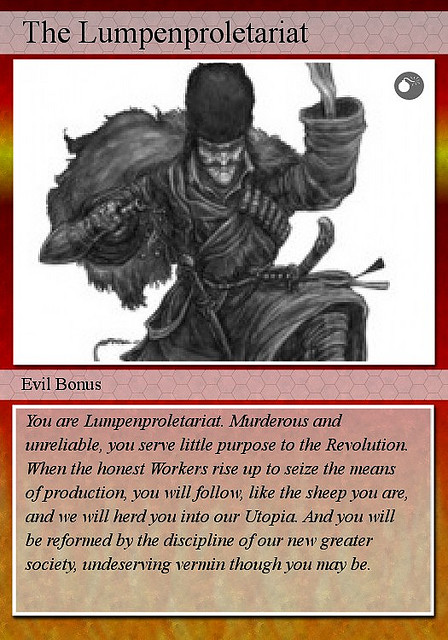
In fascism, practice precedes theory, and part of that practice is the cultivation of a working-class base - doctrinal purity comes later. And so does any other form of purity. We must acknowledge that many of the followers of the EDL, and the Neo-Nazi 'skin' movements, came from the ranks of the lumpenproletariat, not the proletariat (but a fine line exists between the two). How much more beneficial, for the Far Right, it would be if these uncouth types could be discouraged from entering the movement and more clean-cut and well-presented types (like those overall-wearing, cloth-cap wearing proletarians in Soviet iconography) could be persuaded to join. But alas, in politics, things don't work out that way. You can't pick and choose; nor can you isolate and segregate certain factions of the Far Right from the other. Nor can you say that you only want 'good' working class people to join. (For the past thirty or so years, the Far Left has been keeping out of its ranks what it regards as the 'bad' members of the working class; as a result, it has gutted whatever working class membership it had and turned itself into a bourgeois, non-working class and non-socialist (in the true sense of the word) movement).

The EDL seems to have waned, but several anti-Islamist offshoots - such as the North West Infidels and the South West Alliance linger, and so do the Australian equivalents: the UPF, Reclaim Australia, True Blue Crew... This so-called Australian 'patriot' movement does boast a sizeable working class following, and could be said to be quasi-fascistic in some respects. Like the EDL, it has been corrupted by Zionism and civic nationalism, but, on the other hand, it does show fascist potential - more so than the political parties with which it is aligned (Rise Up! and Australian Liberty Alliance). In other words, they stand close to the socialism of the NSDAP variety, about as close as the skinhead formations. Ideological proximity to the tenets of the NSDAP doesn't equal identity, of course, but the skins and the patriots are the closest we'll get - for the time being - to an Australian neo-fascism.

The interesting thing about the UK scene is that the civic nationalist and the overtly fascist groups are prepared to work together: see an account of a 2016 Liverpool demonstration here, which saw the civic-nationalist, 'hooligan' outfits NW Infidels, SW Alliance and the Pie and Mash Squad standing alongside the (now banned) National Action, which was a self-proclaimed 'national socialist' group. I take this as evidence that the gap dividing the two tendencies in Britain has been bridged. Likewise, that gap could be surmounted here in Australia.

Tuesday, January 31, 2017

The Left changes its tune on Trump

With such vehement opposition from Big Business - and I mean really Big Business - to Trump's travel ban, the fiction that Trump is a 'neoliberal' and a tool of the capitalist class becomes harder to sustain; so too does the notion that Trump's 'racist' immigration policies are caused by 'capitalism'.


One could oppose immigration on socialist, and not racialist, grounds. Marx writes that capital needs as big a population as possible, because the more 'variable capital' - i.e., labour - there is, the more surplus value the capitalist can extract. A lot of Marxism is true, but today's Left chooses to ignore it.

Trump will soon be cracking down on H-1B visas:


As the article tells us, H-1B enables 'tech' companies to dump American workers and exploit foreign ones:


There are signs that the Left is beginning to wake up to reality, and is seeing that what Trump wants and what the 'capitalist class' wants are two different things. A communist called Marvin Gandall wrote this and uploaded it to the Marxist PEN-L list, and reposted it at the Marxmail list:

(posted to PEN-L by Marvin Gandall)

Unlike Trump’s base in the petty bourgeoisie and declining sectors of the working class, the dominant multinational corporations require the free flow of labour, capital, goods and services.
The business breach with the anti-immigrant position of the Trump administration extends across the spectrum from the liberal capitalists of Silicon Valley to the right-wing libertarians aligned with the Koch brothers.

He includes a link to the Washington Post article, 'Backlash from big business grows over Trump travel ban'.


Wednesday, May 9, 2012

Golden Dawn, Dialectics and Making a Nationalist Revolution


There has been a great deal of jubilation, in nationalist circles, regarding Golden Dawn's electoral success (7% of the vote, translating into 21 seats), and horror from the liberal establishment (no horror, though, regarding the success of the main Greek Communist Party, which won 8%). At the same time, a few comrades have told me that such success for a radical nationalist party - which is unashamed of its fascist, neofascist and right-wing authoritarian roots - wouldn't be possible here in Australia or indeed in any other Western European country (or colony): it's only in the East of Europe that the radical parties - the Jobbiks, the Golden Dawns - can win seats. That is, the sad reality is that a nationalist party has to go down the populist route (i.e., the Breivikist/Wilder-ist route) to achieve electoral success in the Western half of Europe. The electoral schema is, for nationalists in Europe at present: Zio-populism for the West, neofascist radicalism for the East, and for Germany, in the center, nothing at all (no nationalist party of any stripe can make much headway in Germany, at least not at a federal level). So there are certain peculiarities, on the Continent, which prevent a radical Far Right party taking off in the Western half.

On top of that, it is pointed that the Greeks suffered from extremely high levels of non-white immigration prior to the election: according to the liberal German news agency, Deutsche-Welle, 128,000 illegals came to Greece in 2010 alone, and according to the UK tabloid The Daily Mail, a 100,000 illegals entered in the 12 months to February 2012. Greece's geographical position as the gateway to Eastern Europe has led to it being inundated with immigrants from Afghanistan, Pakistan, Ethiopia, etc., so much so that the liberal democratic government of Greece, even before the election, began work on erecting a six-mile, 13 feet high, double razor-wire wall along the border. Even so, that was shutting the stable door after the horse has bolted, and the presence of hundreds of thousands of non-white immigrants has led to the de facto ethnic cleansing of the majority white Greek population in certain urban areas. This awfulness, combined with Greece's economic straits, has led to a decisive nationalist vote.

In short, then, a 7% vote for a nationalist party 'won't happen here', in Australia, because (what the Marxists call) the 'objective conditions' aren't right: yes, white Australians are being gradually forced into minority status, in the urban and suburban areas, thanks to mass Chinese and Indian immigration; but they aren't in the sorry position of the Greeks, and certainly, economically, they are nowhere as badly off.

Is this fatalism and determinism warranted? Or is it unjustified? In order to arrive at an answer to that question, let's consider a few key theses: we have to get a clear exposition of the problem - the problem faced by nationalism - before we can get around to solving it.

Here are a few defining characteristics of the Golden Dawn:

1.  It has a mainly working-class, proletarian class composition;
2.  It is a radical party;
3.  It has authoritarian, anti-liberal, anti-parliamentarian leanings, and gravitates towards 'extraparliamentary opposition', i.e., activism on the street, demonstrations, and so forth;
4.  It is anti-capitalist, and opposed to the financial hegemony of the international bankers.

This last point is especially important: modern-day liberal democracy in Europe represents, to a certain extent, the 'dictatorship of finance capital'. Banks which have invested heavily in French, Greek, Spanish, Irish, Italian, etc., debt, stand to suffer if the value of this debt plummets (they will be breaking the international banking rules regarding a strict equity-to-asset ratio, which I won't detail here); certainly, they will see a loss on the value of that debt, if the governments miss out on one or two or three of their regular interest payments. Debts, such as mortgages, are assets for a bank, and just the way that the value of a mortgage (for a bank) will fall, if the borrower starts missing out on his payments, so will the value of a French government bond fall if the French government misses on its payments. Such is the power of the banks in Europe, they can compel the EU and Germany to enforce a strict 'austerity' regimen to ensure that all the interest payments from Greece, Italy, France, etc., are promptly paid and in full - even if that austerity regimen means tax hikes, cuts to welfare, etc., which end up destroying those countries economically. (This, of course, leads to a vicious circle: a country with 25% employment and zero economic growth is unlikely to reap in much of tax revenue, and so will be less likely to be able to pay its interest bill). The sensible thing would be, of course, for the Greek and other afflicted governments to default, and skip one or two payments until things improve - as they inevitably will. But it's axiomatic, for the EU and Germany, that the banks have to be insulated from losses, i.e., write-downs on the value of their bond holdings.

It goes without saying that such a policy hurts the Greek working-class: and the peculiar thing about the above defining characteristics of the Golden Dawn is that they are true of the communist parties, and, historically, the fascist parties of the 1920s and 1930s. What we have, in Golden Dawn, the Greek communist KKE and the splinter-communist Syriza, is a surge towards socialism - radical socialism - if we could define the above 1)-4) as being 'socialist'. The conventional wisdom is that socialists of one stripe or another will do well during a period of economic downturn, and the election results in Greece and France this year bear this out.

There are, of course, real differences between the Far Right socialists, and the socialists of the Far Left. The main difference is on the question of immigration. To explain this, we will have to backtrack a little, and look at some recent social history.

Since the 1960s, Europe - and the West - has been ruled by a dominating clique, which has manifested itself in politics, journalism, academia, entertainment. The intent of that clique has been to eradicate the majority white population of every white, European country and replace it with non-whites drawn from the Third World. Liberalisation of immigration from the Third World, mass indoctrination of the white populace with the virtues of 'multiculturalism', 'diversity', being nice to minorities, etc., have been put to use for that purpose. The end result of mass immigration is that whites, in cities from Oslo to London to Athens, are slowly being pushed out of the lands they have lived in for hundreds, if not thousands, of years: and this is the goal of the anti-white clique. They want, for instance, for a country like Sweden to be a wonderful smorgasbord of diversity: Afghans, Iraqis, Somalis, Kurds, Chinese, Pakistanis, will occupy Sweden from coast to coast, while the Swedes themselves will be reduced to a minority, living in the forests and mountains of the far-flung rural areas (until the cities, bulging to the brim with immigrants, expand and reach those areas too). It is a process of replacing one race by another. Non-white countries such as Kenya, Japan, Guatemala, of course, aren't expected to undergo the same process: 'diversity' is a unique gift - or punishment - reserved by the white man, to pay him back for centuries of colonialism and exploitation of the Third World. The colonies of Europe - Canada, South Africa, Argentina, Australia, New Zealand, the USA - are especially deserving of punishment, because, to the anti-white clique, their existence represents an obscenity: these countries were founded on the enslavement, rape, despoliation and dispossession of the natives, who were at a far higher level of moral and spiritual attainment than the white settlers.

Of course, the anti-white clique won't achieve the 'maximalist' (to borrow a Trotskyite term) program of wiping the white race out altogether. But they will manage to increase the non-white populations of the cities of Europe (and the European colonies) to bursting point, and thus, proportionally, reduce the white populations to a minority there. This is already happening in the traditionally white working-class towns of Bradford, Birmingham and Leicester. (Ideally, the whites should be ethnically cleansed at gunpoint: just as what happened to the Germans of Eastern Europe in the late 1940s, the Palestinians in Palestine in 1948, the various Balkans ethnic groups in the former Yugoslavian provinces of the early 1990s. But that can't happen, of course, so the anti-white clique resorts to other means).

It's a grim scenario, of course, especially given that none of the élites in the West (who are the custodians of the destiny of their countries) will or can do anything about it. The mainstream liberal media is beginning to acknowledge, of course, that this process is taking place, and is cautiously suggesting that the policy should be stopped for the time being; but acknowledgements and suggestions are no substitutes for doing, i.e., none of these conservative critics are willing to fight to have their views enforced, and none of them can even suggest voting for the parties (such as the BNP) who make opposition to immigration a priority. It's become clear that conservatism just doesn't have the strength, morally, intellectually, physically, to 'defend the West' at this crucial juncture. This is shown by their policies: the conservative government of the Tory David Cameron was elected, in part, on his pledge to cut British immigration to the 'tens of thousands', but immigration into Britain is even higher than when he took office.

Amazingly, conservatives turn into mush liberals when it comes to immigration. While American conservatives are prepared to invade Iraq and Afghanistan, drop bombs on Libya, water-board Arabs, cut welfare spending to 'balance the budget', they just won't countenance the deportation of illegal Mexican immigrants (it would 'break up families') or even cut off all the public housing, health care, education and other benefits which, in part, serve to induce illegals to stay in America.

As for the Left, well, they are completely out of the loop. The truth is that while the present-day ideology of the anti-white clique seems, on the surface of it, to be left-wing - with all its ranting and raving over the 'crimes of colonialism', its declarations that the 'white race is the cancer of history', and so forth - it is something totally new in the annals of the Left: we don't find a hint of it in Lenin, Bakunin, Marx, Engels, Trotsky, the Fabian socialists, Samuel Gompers and so forth. Conservatives like to blame modern-day multiculturalism and multiracialism on the 'Cultural Marxism' of the 'Frankfurt School', but one really can't find an endorsement of ethnic cleansing (of whites), any rationale, in the works of Adorno, Marcuse, Fromm, Walter Benjamin (one does find the standard-issue liberal bilge, regarding the rights of oppressed Negroes in the American South, of course, but that's another thing entirely). Likewise, where, in the offical Soviet communist manual, The Fundamentals of Marxism-Leninism (1963), is the suggestion of such a policy? There is the demand, by the communists, for 'revolutionary violence' in that manual (and in Soviet and Maoist propaganda from that time), but no demand for the disappearance of the French from France, or the British from Britain.

The Left, today, could be expected (given its ideology) to defend the interests of the white-working classes in the West and elsewhere: undoubtedly, the policies of the anti-white clique have caused great suffering to the traditional constituency of the Left (statistics show that 9/10ths of British jobs created in the Blair-Brown years went to immigrants, for example). But this isn't the case: the Left simply refuses to see any suffering. The Left believes that there is an infinite font of resources in the West - jobs, housing, education, health care, etc. - which should be shared, gratis, with the entire Third World; there's an infinite capacity which should be given to everybody. What's more, if we in the West take in immigrants and put them up in public housing, and on welfare benefits, we'll be giving them a better life - and protecting them from becoming child soldiers, or, if they are female children, from having their genitals mutilated. Those on the Right, who say that there aren't enough resources to go around, or that the immigrant groups will continue to practice female genital mutilation and honour killings (no matter what country they are living in), are just mean, nasty and horrid people.

In addition to all that, both the Left and Right are aesthetically blind. They don't see, they don't perceive, they don't understand, the concept of human degradation. There is something tremendously ugly, and sad, about immigrants sneaking into Britain, from across the Channel, by clinging to the undersides of lorries, by hiding themselves in garbage containers in trucks, or trucks carrying vats of chocolate; there is something tremendously ugly about immigrants (of a certain ethnic group I won't name, due to political correctness) of going about Melbourne, wearing ill-fitting, shabby clothes (which look as though they were stolen from the back of a barrow), sleeping, 20 people to a house, five people to a single bed, cheating utility and phone companies by not paying their bills, shopping, with their arranged marriage (and possibly co-sanguinary) wives, in the junk shops and haggling over the smallest dollars and cents... To a certain extent, life, when it gets to that level, is not worth living: these people degrade the quality of life in the West, and they are degrading to the human spirit. 'What, "spirit"?', say our establishment politicians: 'The only "spirit" I believe in is that of the Anglican Church, or the Catholic Church, which accepts all races equally, especially brown ones: your "spirit" sounds to me quite fascist'.

And so we are, in the West in 2012, at an impasse.

All of the above explains why, despite their turn towards socialism in the recent elections, the French and the Greeks didn't give complete victory to the socialist Left. As Gilad Atzmon shrewdly points out, it's strange how the Left embraces Palestinians expressing Palestinian nationalism, but can't abide by a Frenchwoman who expresses French nationalism - Marine Le Pen. But this is because, I argue, that the Left now accepts, along with the Right, all the presuppositions of the anti-white clique.

Given all this, it has become clear, to me, at least, that the West needs to adopt the most uncompromising and radical measures to save itself in its current predicament. I mean this well and truly: 'radical' comes from the Latin word radix, meaning 'from the root', and we need pull up the existing political, economic and social structures from the roots. In practical terms, this means - for Britain - the suspension (perhaps permanent) of parliament and democratic elections, the ascent to power of a new, nationalist-minded élite, and the conversion of the existing British constitutional system away from constitutional monarchy and towards a republic. In turn, the power of the City of London - Britain's financial hub - will have to be curtailed, for the future nationalist politicians simply can't be subject to the whims of the global bond and stock markets.

In any real 'dialectical' change, or evolution, the Marxists argue, the new order has to contain traces of the old: it is, in short, a 'sublation' - the present order contains the seeds of the future, within itself, and so revolution is a matter of bringing out the possibilities and making the new order sprout and grow. There is a clean break, but, at the same time, it is not the case of an old order (e.g., constitutional monarchy, liberal democracy, capitalism) being swapped for something unrelated and arbitrary. The white British simply won't convert, en masse, to fundamentalist Islam and ditch liberal democracy for Islamic theocracy: the tendencies, cultural and historical, towards radical Islam simply aren't there in the British people (whereas, in the case of the Egyptian people, they are). Whereas what I am advocating for the British is there. Britain was a republic, for ten years, under Cromwell, and parliament was suspended during his reign. But, aside from the historical precedent, the British soul, British history, British culture, contains within it radical socialism - a socialism which could form the basis of the new constitutional order. And it must, because radical ideologies such as Islam aren't an option.

The same goes for Australia: 'white man's socialism', the socialism of the old Labor Party, and the old Australian 'bush' nationalists, is still there within us, deep below the surface. But, in order to implement it, it needs to be Europeanised: not only does it need to be Marxianised, it needs to be fascist-ised. In other words, it needs to take into account recent (and by recent, in this case, I mean within the last hundred years) political and intellectual developments on the Continent.

Marx's Kapital doesn't contain the blueprint of a future communist order, as readers of it know: it attempts to describe the existing state of affairs and portends a clean break from them - the ruptures which will lead to the birth of a new order. But it doesn't describe how things ought to be, and this is one of the problems faced by the new rulers of communist regimés: where were the prescriptions, in Marx, for the new order, how would we know what socialism looks like? Engels, it is true, predicted the disappearance of money, etc., under socialism and communism, but, in general, communist theory always hedged its bets when it came to the future. It was 'dialectical', which is to say, the changes would come about organically and develop out of the old. In contrast, the so-called Utopian socialists devised detailed schemes, and drew up blueprints, for the future socialist order and how the communities in that order would live. Henceforth, the schemes would be imposed without taking circumstances and limitations into account. It was the flexibility of Marx's 'scientific' socialism, in contrast to the apriorism and inflexibility of his scheme-making 'utopian' socialist forebears, which gave it a main advantage. And this is something we nationalists, in 2012, ought to imitate.

In short: in politics, we are like painters and sculptors, who have to work with the materials we are given. We can't go beyond the given. At the same time, as revolutionaries, we recognise the need for a clean and decisive break. Revolutions make use of the existing material - the cultural, historical, economic and political tendencies - to hand. At the same time, they are brought about by élites, minorities, standing on the outside of the prevailing order. No politician, no matter what ideology, accepts the existing facts 'as they are', otherwise, he wouldn't be in politics. So, revolutions are made, they are brought about. It is our task, as revolutionary nationalists, to manufacture the conditions for revolution.

That doesn't mean that we can ignore the 'objective conditions'. One only has to recall the case of Che Guevera, who went about 'making revolution', half-cocked, in Congo and Bolivia, and failing miserably because he out-and-out ignored the 'objective conditions', didn't bother to investigate what the working-classes and peasantry in those countries were about, and so forth. A more recent example of (what the Marxists call) 'left-adventurism' is the anti-globalisation riots - the black bloc anarchists who go around assaulting police and smashing the windows of Starbucks and McDonalds - and the Occupy movement. (One really can't blame the anarchists or the Occupiers for their spontaneous disorders, given that conventional Marxism has failed the Left so dramatically). In other words, we mustn't think that inducing riot, rebellion and insurrection, leading to armed conflict - just as see in the Arab world right now - automatically adds up to revolution, although such things can, of course, occur naturally in the midst of a revolution.

The good news is that the white peoples of the West are gradually waking up to the fact that they are being shafted by the anti-white clique. They are being told, around the clock, by the establishment media, intellectuals and politicians, to pay no heed to their ethnic dispossession, but, as recent electoral events in Europe show, they are no longer listening. But they are a long way from revolting. Mainly this is because the nationalists and the Far Right have to get their house in order.

Part of the problem is that we, in our economic thinking, gravitate, by force of habit, to ideas which show a petit-bourgeois propensity. How many times do we hear a nationalist say, 'Oh, I agree with you, companies like Goldman-Sachs are bad, globalisation is bad, all the companies listed on the DJIA or the All Ordinaries Index are bad - big business, corporations, global conglomerates, are all bad. But the small proprietor, the white middle-class, the subsidised EU-farmer - we mustn't hurt them! We must go back to small business: artisans is what we need. We must have more handicrafts...'. Such thinking is reflective of traditional anarchism and socialism (the pre-Marxist 'utopian' socialism), and the petit-bourgeois class origins of such thinking, and it still holds an enormous allure for the Far Right today. It's something to be avoided, an alternative is needed. Really, such splendid experiments in socialism such as Herman Goering's Four-Year-Plan, and his Hermann Goering Steelworks, would never have gotten off the ground with such thinking.

I myself don't have an economic plan, and don't think nationalists need one. At the same time, we must have a complete break from the existing political, social and economic order, and that entails a rejection, or revision, of the existing capitalist system. The success of Golden Dawn is a step in that direction: despite their stated economic platform, they are a symptom of the ruptures and upsets predicted by Marx in Kapital. Perhaps they are a sign of the new socialist order as well.


Tuesday, October 11, 2011

Deadbeats in the Movement: the Extreme Left, the Extreme Right and the Scum


Again and again one has to ask: why is that extremist political movements, of both the extreme Left and Right, attract so deadbeats, losers, mentally-subnormal people, wasters, lumpenproles, scum?

I have to qualify my statement here, and specify which type of person I'm talking about. The type is: someone who is intensely alienated from their community and the society around them; who doesn't have the strength to hold down a job; is constantly in debt or in financial trouble, is pursued by creditors, or chased by debt-collectors, who can't, or won't pay utilities bills, phone bills, Internet bills, etc.; who has a history of brushes with the law; who can't be trusted with money or any sort of responsibility; who generally isn't someone you'd want, over in your house, for dinner, or to live with, or work with; who often suffers from what modern-day psychologists call a 'personality disorder'; who won't keep their house, their front yard, or anything, clean and tidy; who, in general, is a species apart, from all the apparently nice, normal decent people who appear to make up around 90% or so of the white population out there, who we live with, socialise with and work with.

I have run into, quite often, people of this type, on both sides of politics. On the Far Right, frequently, this type isn't interested, a jot, in the (white) community and society around them, or the fate and well-being of the Western culture and civilisation as a whole; in fact, they are so alienated from it - so far outside its traditional laws, customs and morals - they would be freaks and outcasts even in an ethnically-homogenous white society (like that of the 1950s and 1960s). They are racialist, but not out of love, or a sense of involvement with, or a feeling of concern with, the white race and the white peoples of the West. No, they are racialist, merely out of a desire to place themselves above, to hierarchisise themselves, the Chinese, Indian and Arab immigrant populations. They may be low in the totem pole, so to speak, among white people, but, they assure themselves, they are superior - in some way - to the Chinese, the Indians, the Muslims. We nationalists know what type of groups, within the nationalist spectrum, individuals of this type gravitate to (I won't name any of them here, lest I offend the sensibilities of "comrades" in the movement).

On the Left, the situation is, more often than not, just as bad. We have anarchists who live in squats, on a level little better than the animals whose rights they claim to champion; sexual deviates, who use their deviancy as the basis of a (wholly new, and really un-Marxist) form of anti-capitalist and neo-Marxist politics; ferals and dirty, grubby hippie types, often young, who waste time and money (not their own, but money from the welfare state) on pointless "anti-fascist" "activism", instead of marrying, starting a family, working, providing for one's children, paying off a mortgage and mowing the front lawn, like most decent white people do.

The good-for-nothings on the Left claim to represent the working classes, and some of the good-for-nothings on the Right claim to be "National Socialists" in the German tradition. But (bear in mind that the NSDAP was the National Socialist German Workers Party) neither of them work. It takes discipline to hold down a job, which can sometimes be a drudgery; which can require getting up, very early in the morning, and commuting long distances; and working with unpleasant (and, nowadays, often Chinese, Muslim, African and Indian) colleagues and a customer base. And that is a discipline that our good-for-nothings just don't have.

It is these people who are the true race traitors. While the immigrant Indian or Chinese comes to our country, marries, breeds (and non-white immigrants to Australia are prolific breeders), gets a job, takes a mortgage, and brings more and more of his relatives, from his country, and takes full advantage of the existing opportunities here, the deadbeat Leftist or nationalist does nothing: he lives as a fringe person in his own society. By living what is (by the standards of any society) a worthless and immoral existence, he is leaving the country wide open for exploitation, by non-whites, who will take up all the obligations of a normal working, family person and thereby end up supplanting him in his own country. The Leftist or nationalist who is a deadbeat is, in effect, practising individualism - and by individualism, I mean a lack of any responsibility to one's white community as a whole.

Why? Both the extreme Left and Right are fringe movements (for the time being) and, as a result, tend to attract fringe people: that's the conventional answer. I wonder, now, though, whether this explanation really goes to the root of the problem: I'm becoming more and more convinced that the answer lies in ideology.

In Marxism and anarchism, for example, we have an anti-work ideology. Marx famously refused to work, and support his wife and children, because he was determined not be a labouring machine, exploited by capitalism for profit. (We can see, of course, how Das Kapital justifies precisely this sort of attitude). As a result, his wife and children starved, and lived in squalor - simply because the father, the traditional breadwinner and patriarch, refused to perform his duties. Anarchism is the same, of course, but at least they are a little more honest about 'not liking work' than the Marxists.

In nationalism, however: where does the justification come from? Well, one has to look at the work of our most revered intellectuals. Take this excerpt from Savitri Devi's The Lightning and the Sun, 'Kalki, the Avenger':

The streets are full of dregs of humanity, at least full of bastards and of sub-men. One only has to look at the faces one sees in the over-crowded buses, or in the cinemas and dancinghalls and cafes in large towns, nay even in small ones, even in the countryside, everywhere, save in those lands in which the dominant race is relatively pure. It is a pitiful sight; a pitiful world; a world up-side-down; a world in which the average cat or dog is, as such, immeasurably healthier, more beautiful — more perfect — than the average man or woman and a fortiori than the average post-1945 State ruler; nearer to the ideal archetype of his species than most present-day human beings and specially than the official (and the hidden) leaders of the present-day “free world” — President Eisenhower (or rather, Mr. Baruch) Churchill, Mendes-France, etc., (let alone their most obedient servants Konrad Adenauer, Theodor Heuss and Co) — ever were to the ideal archetype of man, God’s masterpiece.

If only the, ugly sub-men were capable of lofty thoughts — or simply
of thought — that would be something! But they are not. And their leaders are worse than they, not better. True, they all speak of “free thinking”; speak of it, and write about it. They criticise their former friends (the Communists) for “killing individual thought.” Yet they are themselves the first ones to lack both freedom of judgement and individuality. They all have the same views; and the same ideal. Their views are those of the ruling press. Their ideal is to “get on in life,” i.e., to make money and to “be happy,” which means: to enjoy tasty food, fine clothing, lodgings provided with the latest commodities; and, in addition to that, as often as possible, a little drink, a little light music, a little sport, a little love-making. Maybe, they call themselves Christians — or Hindus, or anything else. But whatever religion they might profess, their faith is skin-deep. Nothing, absolutely nothing more-than-personal — and, a fortiori, more-than-human, — interests them. The one thing they all pray for, when they pray at all, is “peace”; not the unassailable, inner peace of the Best (of which they have not the foggiest experience), but peace in the sense of absence of war; the indefinite prolongation of a “status quo” which allows them to think of to-morrow’s little pleasure without the fear of to-day’s deadly danger; peace, thanks to which they will, undisturbed, — so they hope — be able to go on rotting in the midst of that increasing comfort, which technical progress secures them; peace, thanks to which they expect to remain (or gradually to become) happy — in the manner pigs are happy, when they have plenty to eat and clean straw to lie upon.
Hardly the thoughts of someone who is 'well-adjusted'! Now, of course, the brilliant Devi has an axe to grind, true. But the sort of alienation, evinced in the above quotation, is hardly conducive to discipline - the discipline of paying one's bills; paying one's debts; of getting up on time; of going to work; of caring for people who are dependent on you and more vulnerable than you (e.g., children); of not lying... In short, if you start to think things really are as bad as Devi says, you are not going to put the effort in - into working, keeping alive, being a responsible person in this society of ours.

Without the acknowledgement of customs and rules - and a society is made up of customs and rules - a society, no matter what colour it is, just can't survive. The reason why Anglo-Saxon societies (such as in North America, or (white) South Africa, or Australia and New Zealand) do so well is that, traditionally, they have stuck, more than most, to these rules. Whereas certain other ethnic groups - even within the white race - don't stick to these rules, and in fact, seem to be convinced that lying (for instance) in business, or everyday life, is a way of 'getting ahead'.

In the same way, someone who reads Das Kapital, and believes in it, is going to be less inclined to work in the capitalist system. After all, the central thesis of that book is that anyone who does work is getting 'done over', exploited, and horribly, by the capitalist, for the sake of capitalist profits. Labour, in the capitalist economy, is, in essence, exploitation, pure and simple. This intellectual thesis filters down to the deadbeat, work-shy Leftist.

The deadbeats in the nationalist scene, of course, often (in my experience, at any rate) don't read Savitri Devi (they tend not to read at all). But ideas, at the top end of the spectrum, have a tendency to filter down to the lower end. The ideas of a Devi, a Yockey, an Evola, do tend to descend to the (less intellectual) on the Far Right, and so a lumpenprole will find his justification - morally, ideologically - for his deeds in some of the ideas of these great thinkers.

This raises an interesting question. Many nationalists ask me how we can go about attracting more 'normal people' to nationalism, and how, at the same time, can induce the freaks, weirdos, lumpenproles to go away. One possible answer is that we can change our movement by changing our ideas. We have to look - take a long, deep, hard look - at the intellectuals whose work provides the basis of our movement. What idea, or set of ideas, is it that attracts these freaks and weirdos? Which thinker, which book?