Showing posts with label Steve Sailer. Show all posts

Saturday, November 30, 2019

The Metalstorm: Why some nationalists dislike the Nazis


I.

After the eruption of hostilities in Europe in 1914, the English - and the Americans - produced a torrent of literature denouncing German and 'Prussian' cruelty, aggression, rapacity, militarism, authoritarianism, racial self-aggrandizement, Machtpolitik, Kultur, and war crimes (real or imagined); a hundred years later, this torrent shows no signs of abating. But if the English polemicists and the German nationalists - who wrote rebuttals - agreed on one thing, it was that 'Prussianism', 'Prussian militarism', 'Prussian ethical-socialism' (as Spengler called it), defined the essence of the German national character.

To Spengler, each of the five leading nations of the West - England, Germany, France, Spain and Italy - could be summed up a certain Idea, a style, a culture, and it is this that distinguishes one nation from the other. In much the same way, a certain style of each race - in that most racialist and ethnocentric of sci-fi TV shows, Star Trek - helps us to tell one race apart from another, so much so that one would never mistake a Klingon for a Vulcan, a Romulan for a Ferengi. Of course to a Ferengi or Klingon, all kinds of difference - mainly political - exist within the race, but the casual outside observer hardly sees these: he only sees unity and homogeneity. And this uniformity is determined by the style of the race as much as the genetics.

After Germany's defeat in 1918, venerable German institutions - the German Army, the German General Staff, Junkerdom, and the East Prussian state itself - survived; after Germany's defeat in 1945, they were destroyed. Nothing of them remained, not even the 'Prussian Idea' itself. We see here the complete disappearance of a culture, a style. Only ghosts of it linger: we find fleeting images of it in the first three Star Wars movies, in episodes of Star Trek and Battlestar Galactica, in the multitude of computer and board wargames devoted to WWI and WWII. Pertinent to this subject - the prevalence of Nazi and 'Prussian' types in popular culture - is this comment at Steve Sailer's site:

Having Nazi bad guys in situations where Nazism isn’t at all relevant is just the mark of a lazy writer who can’t be bothered to develop good antagonists on their own. Even in situations where they aren’t actual Nazis, the aesthetic provides a convenient visual shorthand.

In Star Wars we would know the empire was evil just by looking at the officers’ uniforms, which were heavily reminiscent of the uniforms worn by Wehrmacht and SS officers during WW2. Additionally, the peaked caps were shaped like those worn by Imperial Japanese military during the war. Add in the patrician affect of Imperial officers(a lot like the aristocratic manner stereotypical of German officers in movies of that period) and you have instant baddies without having them say or do anything evil. Vader’s helmet was specifically designed to be recall the German stahlhelm.

But times of changed. It seems that American filmmakers no longer want to depict dapper fascists. To judge by the listings of upcoming movies at IMDB.Com, Hollywood seems to have slowed down on the production of one of its staples - the anti-German war propaganda movie: I count only one WWII drama slated for release in 2020.

In the world of politics, outside of entertainment and popular culture, the 'Prussian' - with his monocle, riding crop, long boots, dueling scars, smart uniform, and cap set at a jaunty angle - has ceased to exist. His resurrection was predicted by Yockey on the reasoning that while one can kill a man, one cannot kill an idea: one can lop off the top of a tree, but so long as the tree has roots deep in the soil, it will regrow. But 75 years after the end of WWII, this analogy has been shown to incorrect.

The disappearance of 'Prussianism' violates one of the tenets of geopolitics - that nations almost always revert to type. For the past 75 years, Japan has kept its head down and sought to avoid being noticed, and it shies away from all war and all power-politics. But because of the recent Chinese bellicosity in the South China Sea, smaller nations such as the Philippines and Vietnam are looking to Japan as a protector, and as a result, Japan is being forced to accept the mantle of a leading Asian power. One cannot escape one's geopolitical destiny. But for Germany, this law has been suspended. In all the negotiations between the UK and the EU over Brexit, France has taken the lead: the understanding is that France, and not the faceless EU bureaucracy, which gives voice to the sentiments of the EU, and if Boris Johnson or Theresa May want to parley, they must parley with Emmanuel Macron. Germany has been conspicuous by its absence. One would think that Germany was not the wealthiest and most powerful nation on the Continent, and that it had no opinions on what is the most important question for the EU for the 21st century. The British press, performing its traditional role of stoking British resentment against the Germans, continually tries to goad Germany into making provocative statements on Brexit, but Merkel refuses to take the bait.

II.

The Germans will not be taking up Spengler's 'Prussian Socialism' any time soon. But suppose that certain prerequisites were fulfilled for its return, one of the prerequisites being the election to office of a German nationalist party (such as the AfD): what would happen then? I think we all know the answer. England and America, Israel and Russia, would demand that the results be overturned and 'democracy' restored - otherwise, war.

The world will ignore the calls of the 'international community' for sanctions and war only under one condition: that it ceases to believe or starts to doubt that the Holocaust happened. As part of a public relations campaign for German nationalism, the new German nationalist government could deban all Holocaust Revisionism within Germany's borders and promulgate Revisionism across Europe and the world. It could muster up an international task force of forensic investigators to take examine the 'death camps' of Auschwitz, Treblinka and Sobibor for traces of the poison gas which killed millions of people. If no traces were found, or even if the final report of the investigators was divided on the matter, doubt and confusion would be sowed in the minds of British and American public - the same public which normally would join wholeheartedly the chorus of condemnation of the nationalist Germany.

One can dream: the above scenario at the present seems highly unlikely. The reason for that is that German nationalists, even nationalists of the most populist and civic stripe, are faced with a paradox, and this is: they cannot win power without the help of Holocaust Revisionism, but they cannot disseminate Revisionism unless they win power.

The stalemate can only be broken by a miracle. In the South Park episode 'Are You There God? It's Me, Jesus', God visits Earth and before an assembly of South Park residents, offers to answer one question - any question. One of the South Park children, Stan Marsh, asks a question which is quite trivial. God answers it easily (with His perfect and omniscient knowledge) and then departs the Earth, promising to return in the year 4000, much to everyone's dissatisfaction. Now, suppose that this celestial visitation were to occur today and the question was asked of God, 'Did the Holocaust happen?'. Suppose that God's answer was no, and that Hitler and the NSDAP did not order the extermination of Europe's Jews, did not gas the Jews (or shoot them en masse) and did not kill 60,000, let alone six million, Jews. And then suppose that God's answer was beamed into the minds of every sentient being on Earth: that and only that would bring about the change in the attitude of humanity towards Germany that the German nationalists so sorely need.

This story line - and indeed, it will remain nothing but a story - implies that Holocaust Revisionism constitutes a revelation to the world (and in my daydream above, a divine revelation), but in truth, the world has known, and known for some time, that the Holocaust did not happen. But this understanding has not been acted upon because those in authority will not acknowledge the truth of Revisionism.

When I am speaking of those in authority, I am speaking of three leading groups in particular. These are:

International Jewish groups. If six million did not die, then Jewry would lose its right to Palestine. Jews see the Holocaust as a religious justification, in accordance with ancient Talmudic prophecies, for the recovery of the lost State of Israel.

The Anglo-Conservatives. By 'Anglo-Conservative', I mean American and British conservatives of the Victor Davis Hanson and Rush Limbaugh sort. Usually boomers, they hew to the official party line on WWI and WWII and America's involvement, and they hate German nationalism (of any era) with a vengeance.

Left-wing journalists. If God were to come to Earth (as per my South Park fantasy above) and reveal the truth to the world regarding the Holocaust, the media would simply refuse to report it.

All politics is an activity related to power, Yockey writes, and we would assure the triumph of Revisionism were we were to knock the three groups out of their leading position in the power structure. The question is, how?

III.

It goes without saying that the 'Prussian' is a soldier. This is important for the reason that in German nationalist ideology, politics is tied to war.

The Left takes the same view of politics. One of the dirty secrets of 20th century communism is that no communist won power without waging war beforehand: the successful communists did not win elections in Russia, China, Vietnam, Cuba, they won battles. Stalin, Trotsky, Mao, Tito, Kim Il Sung, Ho Chi Minh, Castro: all commanded soldiers, their example presenting a stark contrast to the anemic leftism of today.

The former left-wing terrorist T. Derbent wrote a classic monograph, 'Categories of Revolutionary Military Policy' (2006), which is a treatise on military science and left-wing politico-military strategy. Much of it can be applied by both the Left and Right: the white nationalists in William Pierce's Turner Diaries (1978), for instance, followed the same strategy as the left-wing urban guerrilla groups operating in the 1960s and 1970s. (Pierce, much to his chagrin, was compared by hostile reviewers to the left-wing Brazilian guerrilla Carlos Marighella).

And this brings us to the heart of the problem. Warfare has changed since the time of Hitler and the Kaiser, Guderian and von Moltke. In the first half of the 20th century, the Germans led the way when it came to warfare, but since then, 'Prussian militarism' and the institution of the General Staff have become archaic, outmoded. This partially explains, to my mind, the success of computer games such as Hearts of Iron IV. Gamers can exercise their 'Prussian' world-conquering urges and live vicariously through it, but they can also return to a distant past which is unlike our present and in some respects qualitatively better.

But in other respects, nationalists see the past as worse than the present. No nationalist in the West wants to see a return to WWI or WWII. Today nationalists see white life as something precious and whites as an endangered species. Our sons are not be sent off to die in wars, and no blood of a white Western man is to be spilled.

And this contravenes National Socialist (and 'Prussian militarist') doctrine. In the wartime book 'The Spoil of Europe' (1941), written by an anti-Nazi, Thomas Reveille, we find an (mostly accurate, to my view) enunciation of the fundamental principles of National Socialism:

The State, according to Hitler, has a twofold domestic task. The first is to ''forge the sword” which shall "secure for the German Volk the land and soil that is due to them on this earth” and "their position as lords of the world.” The second domestic task of the Nazi State is to ensure "the preservation and advancement of a community of physically and spiritually similar living creatures.” This twofold task is to be pursued simultaneously. In case of need, however, the latter should be temporarily sacrificed for the former...

[In order to conquer Europe, Germany needs] The forging of the sword and the creation of an indissolubly unified Germanic community in the existing frontiers of the Reich. The Nazi doctrine always assumes that the sword must be ultimately wielded in order to achieve each major objective...

Germany's mission is to rule the world and to fulfill this by any and all means. Europe is the center of the world. The Reich has obligations to its kith and kin overseas. It has also the imperious duty of making Germany's acquisitions perpetually secure not only by forging a sword for their defense but also by a simultaneous attack, through political disintegration or war, against possible enemies and coalitions. Full account is also taken of obstacles to the process of the continuous outward push of Germandom. 

The white nationalist may like the Volk talk, the talk of blood and soil, and the goal of 'the preservation and advancement of a community of physically and spiritually similar living creatures', which sounds rather like David Lane's slogan of the 14 words. But the 'forging of the sword' frightens the white nationalist, because a war waged by any European or Western nation automatically entails casualties - white casualties. And indeed, not only white nationalists but most European white men object to going to war, possibly because they  understand (more than they did a hundred years ago) what it means. As Steve Sailer writes in 'The Dregs of War', 


I want to mention how this latest phenomenon supports John Mueller’s hypothesis in The Remnants of War (which he should have titled The Dregs of War).

Mueller is the Woody Hayes Professor of National Security Studies at Ohio State. He argues that Kursk-Orel battles between mass armies in open fields are over. If they gave that kind of war, nobody would show up.

His specific examples had to do with the 1990s Balkan Wars, which were portrayed in the press as driven by ancient mass enmities. But Mueller argues that the amount of bloodlust in the overall populations was quite low. The various states had massive problems with draft evasion. Basically, nobody wants to go to a modern battlefield with state of the art weapons because everybody figures they wouldn’t last long in the metalstorm.

Sailer points to the conflict in Ukraine as an example of the new kind of war, a war which differs from WWII: 'The Battle of Stalingrad, it isn’t. So far'.

Because the realities of war have changed, then, the Far Right needs to grope around like the Far Left (as Derbent does in his monograph) for a new politico-military strategy.

IV.

We should keep in mind that the socialist and conservative regimes in Western Europe today were (in the case of France, Holland, Belgium, Germany, Austria, Italy, Norway, and Denmark) installed at the point of a bayonet: the British and Americans waged a ferocious war to 'liberate' them from fascism and Far Right conservatism. It could be that the Far Right, the nationalist Right, in those countries may need to wage another war to win them back: quite possibly, the Merkels and Macrons cannot be pushed out any other way. If that is the case - and keep in mind we are in the new age of the 'dregs of war' - what would that war look like?

Years ago, a poster on 4Chan/Pol detailed a long-running fantasy of his - a fantasy informed by the Terminator movies and other cyberpunk pop culture works. A race of cyborg warriors would time-travel from the future, wage war against the Merkels and Macrons, and free Europe. This post stood out for me, as I  - in a similar science-fiction-ish mood - had indulged in a similar daydream. And at the time it seemed quite logical to me, given the circumstances, that the only army which could take on the liberal establishment and win would be one composed of super-soldiers using a technology far advanced from that of present.

In my scenario, the soldiers would win eschew a direction confrontation with the armies of Europe and avail themselves of Fidel Castro and Che Guevara guerrilla tactics, which, to my mind, would prove to be extremely effective.

Of course I understand that such a war (cyber-war?) can only take place only in the realm of fantasy. But does another way forward exist? Bismarck famously said that politics is the art of the possible, and by this he meant there is more than one path to the fulfillment of a political task. He may have been right in this, but at present, I can only see one possibility - one which is (I admit) quite impossible. 


Tuesday, April 11, 2017

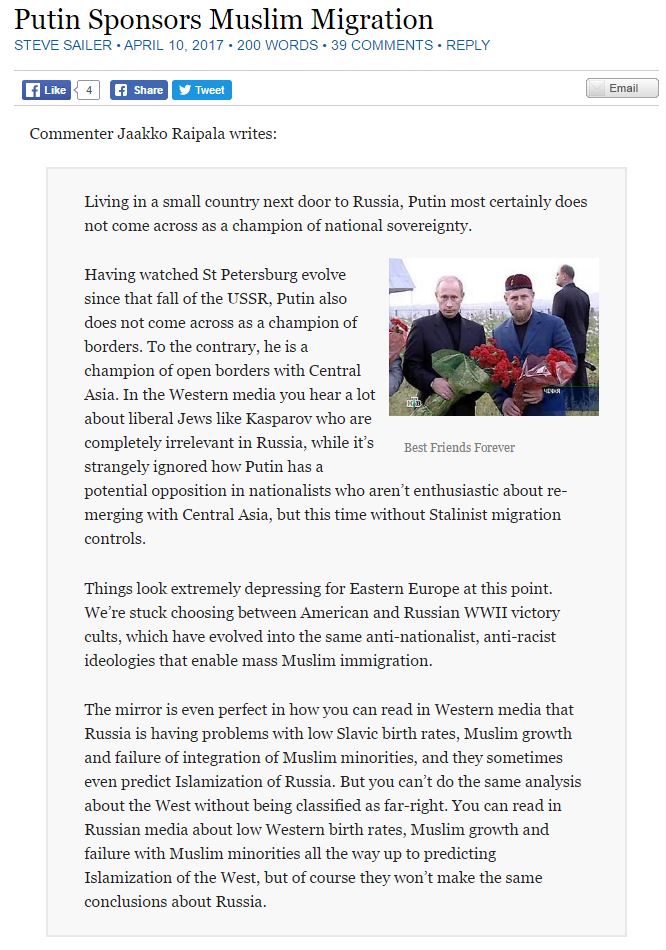
Steve Sailer: Putin Sponsors Muslim Migration


Will you see any Putinista acknowledge the above? No, never. They simply don't listen.

We can find a few thoughtful comments for the Sailer piece, but inevitably, the Putinistas come out of the woodwork to defend their great pro-Muslim immigration leader. I've noticed a pattern: the Putinista defender will ignore the Muslim immigration question and attempt to change the subject by yammering on about Soros and how anyone inside Russia who opposes Putin - nationalist or not - is a Jew or in the pay of the Jews. Or he will gratuitously insert one of his favourite topics, the perfidy of the Ukrainians, who are run now by both Neo-Nazis and Jews.

It's as if the Putinistas don't want you to notice that the same demographic displacement that is happening to the West is happening to Russia.


I see now that Putinism, and Alt Rightism, is multiculturalism - a new 'civic nationalism' or 'civicism', you could say, a creed in which race and religion doesn't matter: the main thing is that you oppose 'interventionism' and 'neoconservatism' and 'wars in the Middle East' and 'Trump plunging us into WWIII'.

Take a look at the below Man with the Golden Gun - he's the face of the Alt Right now.


Sunday, January 3, 2016

2016: This Year, Zios, the Gloves Are Off


I.

2015 turned out to be a tumultuous year in Australian Far Right politics. The Reclaim movement took off, drawing working-class crowds in the hundreds and shocking the mainstream political establishment - and the Far Left.

 Quite a few people on the 'old' Australian Far Right - Australian nativists, white nationalists, neo-Nazis, neo-fascists, race realists, you name it - jumped on board, and a handful even managed to end up in prominent leadership positions within Reclaim. But, inevitably, reaction set in. Whenever a Far Right and populist movement emerges in Australia, the mainstream Australian conservative party will a) either try and infiltrate it with a view to using it as a vehicle to garner more conservative votes or b) neutralise it through dirty tricks. We've seen shady political operatives working for the conservatives - particularly in New South Wales - try both approaches. That's business as usual for Australian politics, and not only for politics in Australia: look at Russia, where Putin has jailed one half of the Russian extreme-right movement and co-opted (through bribery, or force, or both) the other half. 

 One unexpected consequence (although it should have been foreseen by the nationalists participating in Reclaim) was that the Zios and the civics in Reclaim decided that they didn't like the presence of the nationalists, and so worked to purge them. To some members of the 'Old Guard' of Australian nationalism, this seemed eerily reminiscent of Nick Griffin's attempt at a purge of racialists and 'Nutzis' from the British nationalist movement over ten years ago. Then Griffin claimed to be a 'moderniser' who would remove the 'dead wood' - all the anti-Semites, racialists, neo-Nazis, Mosleyites, League of Empire loyalists, conspiracy theorists and the like - hanging around British nationalism's neck like an albatross for decades. A purge by Griffin, or so the narrative ran, would show the British middle-classes, and the British political establishment itself, that British nationalism had cleaned up its act and was now ready to assume office. At the time, Griffin's thesis - that the 'Young Turks' of nationalism needed to sweep the 'Old Guard' into the dustbin of history - seemed a beguiling one; at the time, I was willing, for the sake of argument, to give Griffin the benefit of doubt. But he crashed and burned, as we all know, and went back on his words. I've become leery of 'modernisers' ever since that experience, and after 2015 - when I've been lumped in the same camp as the 'Nutzis' scorned and excoriated by Griffin - I've become even more averse.

 This year shall require a Herculean effort: to boot the Zios and civics out of the Australian Far Right, to lock them out of the movement they helped create - Reclaim. This shall require a recourse to communist tactics (more later) and a twin effort: one from below, one from above. The effort from 'below' shall come from the grassroots of Australian nationalism, the effort from 'above', from those nationalists and patriots - real patriots, as opposed to 'civic' ones - who are located at the top of the Reclaim leadership.

 This, in turn, necessitates a different approach from the one usually taken in nationalist and racialist politics. Which is why I have little time for snide polemics like that found in a RamZPaul video, championed by Alt Right, here.

 Readers can watch the video, and read the responses at Alt Right, themselves. I have nothing to contribute to the debate, except to say that two lines seem to be emerging in the Far Right racialist movement: between those who don't have a problem with the historical German National Socialism and those who want to 'play it safe' by disavowing it. Within the context of its own (hyper racialist) philosophy, the latter camp (mostly based in America) doesn't seem to make much sense to me. Surely any white nationalist, racialist, race realist, Whitakerite, what have you, would champion Hitler?

 I am, at the moment, re-reading that great political text, Mein Kampf. In an old philosophy textbook, I once saw a reference to Nietzsche as the 'King of the One-Liners'. I don't know if that is true of Nietzsche (it probably is), but certainly, in the field of politics, it is of Hitler. Consider the following, taken from volume II, chapter II, 'The State':

But it is almost inconceivable how such a mistake could be made as to think that a Ni**r or a Chinaman will become a German because he has learned the German language and is willing to speak German for the future and even to cast his vote for a German political party.

Only with the extermination of the last race that possesses the gift of cultural creativeness, and indeed only if all the individuals of that race had also disappeared, would the earth definitely be turned into a desert.

On the other hand, a State may be called bad if, in spite of the existence of a high cultural level, it dooms to destruction the bearers of that culture by breaking up their racial uniformity.

Therefore, the worth of a State can be determined only by asking how far it actually succeeds in promoting the well-being of a definite race and not by the role which it plays in the world at large.

The protest which is put forward in the name of humanity does not fit the mouth of a generation that makes it possible for the most depraved degenerates to propagate themselves, thereby imposing unspeakable suffering on their own products and their contemporaries, while, on the other hand, contraceptives are permitted and sold in every drug store and even by street hawkers, so that babies should not be born even among the healthiest of our people.

They [the Christians] talk about the Spirit, but they allow man, as the embodiment of the Spirit, to degenerate to the proletarian level.

It will be the task of the People's State to make the race the centre of the life of the community.
[The People's State] must proclaim the truth that the child is the most valuable possession a people can have.

Provision must be made for the normally fertile woman so that she will not be restricted in child-bearing through the financial and economic system operating in a political regime that looks upon the blessing of having children as a curse to their parents.

Loyalty, self-sacrifice, and discretion are virtues which a great nation must possess.

Either the German youth will one day create a new State founded on the racial idea or they will be the last witnesses of the complete breakdown and death of the bourgeois world.

The man who demands from Fate a guarantee of his success deliberately denies the significance of an heroic act.

[On modern education] And, though it may seem incredible, many a boy is told that the gallows tree is waiting for him, because he has shown certain traits which might be of inestimable value in the nation as a whole.

[On social justice ] One can be proud of one's people only if there is no class left of which one need to be ashamed.

[The individual's] real purpose in life is to better himself and raise himself to a higher level as a human being, but this he can only do in and through the community, whose cultural life he shares.
Man should take care not to have too low an estimate of the power of an ideal.

I don't see how anyone who posts on Alt Right, American Renaissance, Counter-Currents, Steve Sailer and the rest can really object to the above - especially the quotations on race. They should embrace Mein Kampf as a great racialist text, on a par with the writings of Stoddard and Grant. But they don't - because they are afraid. Fair enough. But they seem, in the words of Keats, 'Half in love with easeful death'. If you look at the RamZPaul article, you find, on the left-hand column, a picture of 'radio priest' Father Coughlin, noted Depression-era American fascist (under the heading 'Alt Right Podcasts'), a mocked-up photo of Hitler with his arm on Afro-American athlete Jesse Owens' shoulder... One angry respondent to RamZPaul made the point that RamZPaul (and, by extension, Alt Right) depends on the white nationalist / neo-Nazi / racialist / '1488' brigade for their bread and butter, and yet he spits in their faces. Which raises a valid point: how often do you see communists festoon their sites with pictures of Mao, Lenin, Stalin, Trotsky, Marx and Engels - in an 'edgy' and 'ironic' way - and at the same time write articles lampooning and denouncing them?

 The truth of the matter is that the Nowickis and RamZPauls and the rest of the Americans belong in the nationalist, racialist, 'neo-Nazi', 'neofascist' camp (or whatever you want to call it) but don't want to get their hands dirty and engage in actual politics - not like we Australians are presently doing.

II.

The chapter, 'The State', probably stands as the most idealistic in Mein Kampf, and Hitler seems to be an ultra-idealist - I once complained to a nationalist friend that Mein Kampf was all theory, no politics. Unlike Hitler, I lack the capacity to make stirring speeches which appeal to the deepest longings of the human heart; in response to any speech of the Hitler type, I'll ask - as a practical man - 'OK, chief, I agree with you, so - how do we put your speech into action?'. I see a Hitler piece of writing as a problem needing to be fixed, and an especially difficult problem given that Mein Kampf seems to fill the Zios - not just the Jews, but the Zios - with an irrational, psychotic fury; they don't see the idealism, or the good, in Mein Kampf - quite the opposite. They lack all objectivity, they can't see the good, and bad, sides of the doctrine, and what's more, they loathe you if they discover that you have good things to say about it and become absolutely determined to destroy you.

 Most people view politics through the prism of elections, votes, parties, polls. I view it differently. Imagine politics as an endless archipelago, with the followers of each political tendency or movement clustered on a different island. Each clump of people represents only a small percentage of the population; you can't say that large percentages are neoliberal, or Trotskyite communist, or Catholic conservative, or whatever. In politics, you will be, as an activist, working with small groups most of the time: instead of hundreds of thousands, or millions of voters, you'll be dealing with groups the size of squads, platoons, sections, companies - each occupying their own little island. The communist groups - particularly the Trotskyite ones, which multiply like vermin - in Britain consist of only small numbers of people relative to the population and have never won a general election. But look at the damage they have wrought to Britain over the past four or so decades - it's incalculable.

 For me, politics - especially after 2015 - has become a war, a war for total control, and one waged between small units. By 'total control', I mean total and absolute control over the actions of a group on another island and the flow of information from one island to another. Some may call that impulse of mine totalitarian, and so be it: I've become a totalitarian.

 To give a concrete example of the above, let's take the Reclaim rallies. Many of the speakers there extol the virtues of courage, honour, loyalty, patriotism, fellow-feeling and they sound off against Islam - all of that is OK by me. But some, subtly, will work in Zio and civic themes into their speeches: they will praise multiculturalism, multiracialism, diversity, non-immigration (so long as the immigrants aren't Muslim); they will praise Churchill and denounce Hitler, German National Socialism, and the 'racists' and 'Nazis' in the audience (whoever they may be). I was told that, at a Reclaim rally in Perth, eight flags were festooned on the stage - six of them Israeli, two Australian. (I think we see the agenda of what Yockey calls the 'Culture Distorter' here). But if I ran the rallies, I'd make sure that there would be no Israeli flags. And I'd turn off the microphone the minute any of the Reclaim speakers started inserting, at random, references to Hitler, WWII, the National Socialists; if they started engaging in 'virtue signalling' by praising multi-culti and diversity. But then, I'd warn the speakers beforehand not to spout any of the Culture Distorter's drivel, and probably wouldn't have invited them to speak in the first place if I had identified them as civics and Zios. Politics becomes a battle of opinions, and we see, from Reclaim, that the Culture Distorters are, very cleverly and subtly, doing their best to divert the rage felt by the masses against Islam in Australia to safe channels: support for Israel, votes for the Liberal Party, support for a Dresden-style bombing of 'ISIS-held' areas of Syria and Iraq... The Culture Distorters mustn't be allowed to do this. I don't expect to hear extracts from Mein Kampf and Yockey's Imperium read at these rallies, but at the same time, I expect displays of Zionist fervour, gratuitous comparisons of the Koran to Mein Kampf, coddling of negroes and other non-whites in the audience to be omitted. I think that these demands are reasonable and simple enough for the rally organisers to meet, but I know that they won't be met - not until I and my tendency (the racial nationalist or nativist tendency or whatever you want to call it) have become, in effect, the sole rally organisers. We have to run everything, and when we give an order, we will see that it's obeyed. If that makes us 'fascist', 'totalitarian', then so be it.

 An outside observer may ask: 'Why the devil do you care about what is said and not said at a rally?'. I'll answer the question this way. The old cliché in politics goes, 'If you can't run your party, you can't run the country'. Like it or not, the vast number of nationalist and 'patriot' groups constitute my party. And if I, as a nativist or racialist or whatever, can't get the most basic strictures enforced, then how can I ever expect to run the country?

 Selznick wrote, in his Organizational Weapon (1953) that the NSDAP and the communist parties of Europe resembled a 'state within a state'. Now, one must ask: did those organisations permit anarchy in their ranks? Did they tolerate anarchy within their 'states within a state'? Or did every publication, every rally, every march, every demonstration, every radio broadcast not reflect one view, one line - the line held by those at the top...

III.

So how are the political battles of this year to be fought? By using certain communist tactics which seem to have been borrowed from the NSDAP (but it's hard to tell what came first - the chicken or the egg). To explain this, let's take a look at the British Labour Party.

 I wrote in a recent article that communists had succeeded in taking over that venerable British institution, the Labour Party. The Party had been falling into the communist orbit for some time - and it's hard to tell, from looking at its present array of MPs, who's a communist and who's not - and the mass infiltration of communist members, and subsequent election of Jeremy Corbyn, an unreconstructed eighties-era Trotskyite, represented the death blow to Labour's social democratic wing. But it looks like the takeover wasn't quite complete: pockets of resistance remain. Now the Corbynista Marxists in the party have set themselves the task of eradicating them...

 As to how they intend to do this, the Corbynistas appear to be taking a leaf out of the old communist playbook - one in particular by Jan Kozak, And Not a Shot is Fired (1999). In the late 1940s, communists in Eastern Europe managed to take over states which were ostensibly liberal democratic in what was a series of more or less bloodless coups. Kozak, a Czech communist, wrote two lengthy papers outlining the methods used and giving an ideological justification for them. These papers were collected and published in 1999 by a conservative American publisher who sought to warn the post-cold war world of the dangers of a resurgent communism. Roman Saskiw has done a short review on YouTube of the book here.

 To explain Kozak in a nutshell. In Eastern Europe after the war, the communist parties manage to a) get elected as part of a coalition government (which included many non-communist parties) and b) get control of two vital government departments - the Ministry of the Interior and the Ministry of Information. Flows of information through the media were cut off, or regulated, by the communist-controlled Ministry of Information, while anyone belonging to one of the non-communist parties who take a stand against the communists was hounded, harassed, and even arrested, by the Ministry of Interior's secret police. Because of this pressure, politicians opposed to communism were often expelled from their parties and replaced with quiescent, pro-communist fellow travellers. Eventually the parliamentary majority held by the non-communist parties was whittled down. Meanwhile, the communists in the cabinet managed to get a few communist laws passed, nationalising key sectors of industry as well as churches and schools, introducing land reform, raising taxes on the wealthy... These procedures - or perhaps we should call them tactics, as we see that the entire thing resembles a war - made up what Kozak calls 'pressure from above'. 'From below', the communists organised a massive extra-parliamentary opposition, composed of trade unions, armed worker's militias, 'action committees', student groups and the like. These agitated in the usual communist manner and availed themselves of the usual protest methods - grievance meetings, resolutions, delegations to politicians' offices, demonstrations, strikes. During the assumption of power by the Czechoslovak communists in 1948, the 'action committees' even occupied factories and government offices. All of this was stage-managed by the communists; you could say the extra-parliamentary opposition was mobilised and deployed like a military unit on the battlefield.

 Kozak speaks of this as a 'two pincer' strategy: one from below, the other from above, bear down and crush liberal democracy like an eggshell. The Corbynistas are applying this method in miniature, but to the Labour Party, not to the British State itself. Corbyn can, as leader of the party, apply pressure from above to the 'old' Labour holdouts and to insubordinate MPs. 'Grass-roots' organisations such as Momentum - a communist front group - apply the pressure from below.

 Unfortunately for the Corbynistas, a secret paper (called 'Taking Control of the Party') by the director of Momentum, Jon Lansman, (ex-member of the notorious Trotskyite outfit the Militant Tendency) was leaked to the media. We find this account of 'Taking Control of the Party' in the lurid Daily Mail:

The document calls for control of:

Selections of all candidates for parliamentary seats and even appointments of all senior staff in the party. The NEC [National Executive Committee] currently has nothing to do with recruitment.

Making policy - all Labour policies would have to be put to members for debate before they can be adopted, which would give Mr Corbyn a chance to change party policy on Trident. But it would provoke a major row with his shadow cabinet and unions, who largely support renewal of the nuclear deterrent.

Media strategy: a 'communications committee' would be set up to 'oversee the party's media and campaign messages' – implying it would vet all the press releases of shadow ministers. It would also develop a programme of unspecified 'political education activity'.

Boundaries: most chilling for moderate MPs, it lays out how Mr Corbyn's supporters could get involved of the review of constituency boundaries in 2018, in which some MPs will lose their seats. If the hard Left seized control of this independent process they could ensure moderate MPs are ousted in favour of Mr Corbyn's supporters.

The Mail goes on to say:

Mr Corbyn has the support of only a small number of Labour MPs but was elected with an enormous mandate from party members and assorted left-wingers who signed up to vote for £3.

His supporters have been trying to tighten their grip on the party's machinery. They already have a majority on the NEC - the main administrative body which has representatives from local parties, unions, MPs and affiliated groups - after installing members from hard Left unions and Corbyn-supporting MPs.

Now this is real politics. One can't imagine a RamZPaul or a Greg Johnson or Andy Nowicki or Jared Taylor engaging in it.

IV.

One has to ask - when looking at the history of Eastern Europe in the late 1940s - why the non-communists allowed the communists to get away with what they did - why they didn't put up more resistance. The answer lies in the prestige and power of the socialist idea. This idea had few detractors in intellectual circles: you didn't find many propagandists and agitators for neoliberalism and free-market capitalism in those days. Besides which, the masses really didn't understand that communist program - nationalisation, collectivisation, five-year plans, forced requisitioning of produce from peasants - entails misery. Communism resembles a confidence trick which can only be pulled off once. Having fallen for it once, the peoples of Russia and China - after 1990 - aren't going to fall for it again. Today's Far Left knows this fact and feels depressed by it.

 But, at the time of the East European coups - the late 1940s - the Marxist ideal stood high. The communists spent a lot of time attacking their social democrat rivals for falling short of that ideal. They intended to 'expose' and 'unmask' the social democrats before the 'masses': they informed the 'masses' that the social democrats weren't the real deal, that the social democrats had sold out to capitalism and the bourgeoisie and were diverting the working peoples from true socialism. This strategy proved to be quite effective. The communists would ask, 'If you want socialism, why settle for half-measures? Why not go the whole hog? Doesn't social democracy represent a step down?'; the social democrats were unable to answer these questions adequately. On a subconscious level, they felt guilt, and it could be said that the communists were able to guilt-trip the majority of them into submission. 

 This 'unmasking' strategy paid dividends for the communists at a time when the prestige of socialism - and Marxism - was soaring; it can pay dividends for we nationalists today. We know from the history of the Weimar Republic that the NSDAP's rivals on the Far Right - Hugenberg's German National People's Party (DNVP) - promulgated a German nationalism that agreed with German National Socialism on many points, and from a superficial perspective, the ideology of the two parties look identical. But Hugenberg was selling soft soap, just like the social democrats, and in the end the 'moderate' Hugenberg was defeated by the 'extremist' Hitler. A lesson there can be found for us. No doubt, in those election campaigns in the early 1930s, National Socialist agitators asked the question, 'Why vote for a watered-down German nationalism when you can have the real thing?'. The question doesn't have a real answer. If the Hugenbergites made the rejoinder, 'Hitler is too extreme, Hugenberg is a moderate, a sensible man, a man who'll get things done', they'd have put themselves on the back foot and appeared defensive. 

 The applications of this strategy to the present dispute between Reclaim and the nationalists seem obvious. The nationalists can make the argument: 'Why cut only Muslim immigration? Why not all immigration? After all, White Australia was a national institution which came to an end only fifty years ago. What real "patriot" would be against White Australia? Or does the so-called "patriot" movement support the state-sanctioned multi-cultism of Whitlam and Fraser... Are we rolling that multi-cultism back? At all? You don't sound like a "patriot" to me'. Many nationalists dwell in the Reclaim ranks, some of them in leadership positions. They can be made to feel ashamed - guilt-tripped - for supporting a movement which a) equates the Koran with Mein Kampf, b) supports non-white immigration and c) supports Israel.

 These nationalists can serve as the men on the inside; like Corbyn's communists within the Labour Party, they can apply pressure 'from above' and carry out the Eastern European communist program of, in Selznick's words, 'purges, indoctrination and intimidation'. In turn, 'spontaneous', 'grass-roots' mass organisations can pressure Reclaim 'from below'.

 Really, though, everything turns on the nationalists within Reclaim. Do they have the requisite strength to carry out the task of de-Zionifying and de-civicising the Reclaim movement from within? Can they demonstrate the toughness and political acumen of the Corbynistas or the East European communists? Or the NSDAP, for that matter? We need political operators who are tough men, men who'll eat glass for breakfast. Can we find them?

 On the answer to that, the future of nationalism in Australia depends.


Sunday, October 7, 2012

The Undeserved: a Post-Mortem of the Obama Presidency


Nationalists and racialists, in general, don't pay much attention to elections. But I have been fascinated by the current presidential race, especially by the Obama-Romney debate. I read the transcript, watched the whole thing (one and a half hours long) and read every news article and piece of analysis on it... Why? Because the turning of the tide, in politics, is always interesting: how one can become a political winner - within the context of a US presidential race, or a Politburo leadership struggle - or a political loser, within the space of a few hours, reveals a lot about politics and the leadership process - and the masses who help put these leaders in power. In elections in which an incumbent is defeated, the masses - and the media - are infected by a sort of euphoria, especially when it becomes apparent that the victory of the challenger is assured. (I remember reading a biography of Carl Schmitt, describing the incredible scenes of jubilation, in the streets of Berlin, after Hitler's ascendancy to the chancellorship. In his diary, Schmitt wrote, wonderingly, how he saw a carnival atmosphere, and how everyone, from all works of life - including streetwalkers - were ecstatic...). It's hard for even a misanthrope like myself not to get caught up in the hype. I was very glad to see the back of John Howard, in November 2007, even though I didn't think much of Rudd; I was glad, too, to see McCain and the loathsome Republicans thrown out in November 2008, although I had doubts about Obama's economic program (I remember thinking to myself, 'But what's he going to do, once he gets into office?'). Even in 2000, I hoped that Bush Jr. would win over Al Gore, because I didn't think I could endure life on this planet with the prissy, sanctimonious and pompous Gore as President of the United States.

I'm sure that these are the same feelings as many in the American electorate, and one, after a while, develops a 'nose' to see how the Americans will vote. It was fairly obvious to me, at the time, that the 'young' and 'progressive' Bill Clinton would win over the elderly, stentorian George Bush Sr. in 1992; likewise, that Obama would win over the semi-senile John McCain in 2008. As for incumbents, it was fairly clear, at the time, that Bush Jr. would win over John Kerry (an ageing Jewish-American with a grey Beatle wig and a tedious manner of speaking); and that the (at the time) switched-on, pro-growth Bush Sr. would win over Michael Dukakis (a dull, grey little man). (Sometimes one has to wonder how the party machines, for both the Republicans and Democrats, throws up such mediocre candidates who are clearly unelectable: McCain in 2008, Bob Dole in 1996, Dukakis in 1988. The answer to that is: often it's the case that there's no-one else).

Since my last post, I've re-read the opening chapters of Wanniski's The Way the World Works (1978) to gain a better understanding of his political model, as well as some old articles of his (on the 1980 and 1984 presidential campaigns). I'm awestruck: I don't think anyone understood, as much as Wanniski, the mechanics of elections, leadership selection and the liberal democratic political process (and, by extension, the political process in non-liberal states - e.g., communist one). Although I'm repelled, of course, by Wanniski's liberalism, Afro-Americo-philia, anti-Germanism and anti-Nazism and the rest, I try not to let that get in the way. His models and theories don't explain everything about politics, race and culture, any more than Marx's do; but we must use them as a kind of overlay - that is, we have to ask ourselves, 'How can such-and-such a political phenomenon be revealed, in the light of Wanniski's model', and see what the answer is.

In the Wanniski model, the electorate has a wisdom greater than the sum of its parts: given the choice between two (often unpalatable) alternatives, it chooses the best one. It should be thought of as a deaf-mute, who can only communicate by sign-language and gesticulating (in the same way that one does in the party game of charades). It instinctively prefers a candidate of the A-type, but, when A isn't to be found, has to choose between two other candidates, B and C. Because B is a little more like A than C is, it goes with B. What if the two candidates in question are not B and C, but are the equally unpalatable D and E? Again, the electorate will make the right choice, all things considered: perhaps E shows signs of not being as unpalatable as D.

The job of the politician is to be the interpreter of the deaf-mute electorate's desires - which are signalled, to him, by, not only the results in elections, but by opinion polls, the reactions of audiences at rallies and speeches, letters to the editor, personal attacks on his character (leading all the way up to assassination attempts, which, according to Wanniski, can convey the desires of a certain segment of the electorate).

Wanniski explains the process by using the economic concept of marginality as an example. 'The last straw that broke the candidate's back' - that's the marginal straw. We could say that the addition of that straw was at the margin - the point where change takes place. Were that last, marginal straw endowed with consciousness, it wouldn't be able to understand why, precisely, its addition broke the camel's back. But were the previous thousand or so pieces of straw, plus the marginal one, all endowed with consciousness - then it would understand. As it is for the straws, so it is for the voters, who, together, form a 'group mind' (and which, like that marginal straw, doesn't recognise itself as part of a totality).

Wanniski's theories explain why it is that the House of Representatives, in the US, goes to the Democrats when the President is a Republican, and vice versa: the electorate is, through its voting, trying to balance things out. In the last (2010) Australian federal election, the Labor government was returned to power as a minority, with an electoral majority of just one seat. Wanniski would say that, obviously, the electorate was sending Prime Minister Gillard and Labor a message: we want you in, but don't make any radical changes, like Rudd (the former Labor Prime Minister) did with his mining tax proposal. With the Labor government hanging by a thread after the election, it was presumed (by the electorate) that Labor wouldn't feel as though it had the mandate to undertake any unpopular experiments.

We in Australia know what happened, of course: Labor went ahead and forced through the unpopular, environmentalist carbon tax through parliament and the senate (where the Greens had the deciding vote), despite promising, before the election, not to do so. As a result, Gillard's popularity plummeted and Labor is facing wipeout at the next election. Wanniski would say that the electorate wants to punish Gillard for her broken promises and for ignoring the message of the 2010 electoral results. (Had she shelved the mining tax, and ignored calls for a carbon tax, she'd be a lot more popular than she is now). Labor's only consolation is that the opposition leader, Abbott, who is the leader of the conservative Liberal-National coalition, is even more dislikable, on a personal level, than Gillard is. (Abbott has recently embarked on a media campaign to make himself more 'likable', to humanise himself in the eyes of the electorate: whether he succeeds or not (and nothing can make this odious little man likable or popular) is another story altogether. It's possible he may be deposed in a party coup).

I think most mainstream analysts get all this - how the electorate operates like a hive-mind (Wanniski, famously, said that Washington, and Congress and the Senate, represent the brain of America). What's more controversial is Wanniski's thesis that the electorate understands economics, perfectly, and what's more, is supply-side in its orientation. It wants a supply-side leader, but, if it can't have one, will choose a socialist who will focus on wealth distribution and shielding his constituents from the effect of economic calamity.

Wanniski's doctrine on this point helps explain the rise of Obama in 2008.

From the supply-side point of view, the financial crisis of 2008 can be explained by the phenomena of monetary deflation. In the lead-up to the summer of 2008, Bernanke flooded the markets with liquidity - US dollars - which led to a depreciation of the US dollar and a dramatic rise in the price of land and other commodities (including gold, which went up from $USD275 an ounce in 2001 to $1000 an ounce). All of this was redolent of the 1970s, when the US - and the world - went off gold and experienced a massive inflation. In that decade, the prices of gold, oil, land and other commodities rose into the stratosphere. Accompanying this was a big expansion in investment and lending (as banks tried to offload a rapidly-declining US dollar and pass it on to someone else, as though it were a hot potato). But the day of reckoning came. In both inflations - the 1970s inflation and the 2000s - there was a sudden reversal of course. In the early 1980s, the Fed suddenly withdrew liquidity - or didn't provide it at the rate it was being demanded - and, as a result, the price of gold, oil and other commodities collapsed. (Gold went from $USD850 an ounce to $US600 and then $USD300). The big oil-producing nations like Iran and Iraq, and the big commodity producers like Chile and Australia, went temporarily bust. Similarly, in the deflationary summer of 2008, commodity prices collapsed (gold went from $USD1000 an ounce to $USD700 an ounce) and so did the real estate speculators, mortgage holders and banks which had plowed enormous amounts of money mortgage-backed securities. All of this happened under the watch of a Republican, George Bush Jr. - who was a supply-sider when it came to tax cuts, but, when it came to monetary policy, was a Keynesian or a monetarist (in all fairness, he wasn't the one deciding monetary policy - Bernanke was).

The defeat of the Republican Party in 2008, then, was inevitable. Seeing that none of the candidates for the Democratic and Republican nominations, in 2008, understood - or appeared to understand - supply-side monetary policy, it was natural that the presidency should go to a socialist who would devote his attentions to welfarism and wealth redistribution.

The supply-side tax cuts, which the Republican Party traditionally specialised in, wouldn't help solve the problem: only supply-side monetary policy would. Seeing as the latter wasn't on offer, the US electorate, understandably, chose the lesser of two evils. Obama's economic platform demanded tax increases - a roll-back of the Bush Jr. tax cuts, and an increase of the capital gains tax rate from 15% to 28% - but the electorate discounted this, perhaps feeling that Obama would be unable to implement his tax hikes (in any case, it was right).

But, in the words of John Tamny, after the 2008 financial crisis, Bernanke 'doubled-down' on his inflationary monetary policy. Perhaps recognising that the problem was deflation, he set about to injecting huge amounts of liquidity into circulation. But he ended up over-compensating, stepping on the gas pedal too much. With QE1, QE2 and now QE3, gold has risen to hitherto unknown heights: last year it reached a record high of $US1889 an ounce.

Perhaps Bernanke wanted to trigger off another banking or real estate bubble. Wanniski observed that the economic model of the monetarists relies on something he calls 'money illusion'. The central bank engineers a devaluation, thus bringing about a rise in prices. The general public sees prices rise, and thinks that these are due to a real increase in the national wealth, a real boom; it thereby goes out and spends and produces more, and increases its economic activity. If the central bank tries the same thing twice, however, the general public will see through the deception and recognise the second round of price rises as being mere inflation. In other words, it will see that these rises are due to nominal, not real, factors: that is, that the rises come about from printing money, not economic growth.

At any rate, things have stayed rather flat since Bernanke began his 'quantitive easing', and none of it has had the desired economic effect. The same goes for Obama's enormous deficit-spending on public works, etc., deficit-spending for the sake of it, all designed to 'pump-prime' the economy in the Keynesian manner.

Obama is possibly the most anti-supply-side Democrat President of all time. Wanniski praised Carter for reducing the capital gains tax rate from 35% to 28% in 1978, and Clinton for cutting it from 28% to 20% in 1997 (and cutting taxes on Roth-IRAs). Kennedy, of course, was a supply-side icon for his huge Reaganesque tax cut plan of 1963, which saw a reduction in the top rate of income tax from 91% to 70% and in the rate of corporate tax from 52% to 48%. (Ironically, Kennedy's tax cuts were blocked by 'fiscal conservatives' in Congress, and didn't pass until 1964, after his death, at the urging of Lyndon Johnson). In other words, Kennedy, Johnson, Carter and Clinton were, in the words of Wanniski, 'pro-growth' and nascent supply-siders. Obama, on the other hand, has vociferously fought for huge tax increases - and may get his way soon (hence the upcoming 'fiscal cliff). Kennedy began his presidency with a mild leaning towards socialism, but, after encountering a stubborn recession, began contemplating supply-side remedies. Perhaps the electorate believed that Obama would undergo a similar conversion. But he didn't.

What does all this add up to? It adds up to a Democrat who, economically, is a clone of George Bush Jr. when it comes to monetary policy, but unlike Bush Jr. and Clinton, is anti-supply-side on fiscal policy.

What of the foreign policy? Again, it's a continuation of Bush's failed policies. Prior to the 1970s, the Anglo-Saxons ruled the Western world: America was the dominant power, with Britain acting as a 'junior partner'. The story of America, after the 1970s, is the displacement of Britain from the position of 'junior partner' by Israel, and then, finally, a reversal of 'senior' and 'junior' positions by the late 1990s: Israel became the senior partner, America the junior partner. Obama has continued in that vein, as will Romney, of course, if elected.

If we were to assess Obama from the Jewish-Israeli viewpoint - as a good little goyische tool of Jewish-Israeli and Jewish-American interests - we find that Obama hasn't done much good, foreign policy-wise. As a statesman of the Judeo-Anglo Empire, he was meant to have expanded American and Israeli hegemony, but didn't. (I don't consider the assassination of Bin Laden as a foreign policy 'success', because I don't think that that assassination was real - I think it was a hoax. Unlike Ghaddafi, we never got to see Bin Laden's body). Libya was a success story of sorts, but Libya, post-Ghaddafi, is highly volatile - as we have seen after the recent murder of the US Ambassador (who, ironically enough, posed for photographs next to Ghaddafi's corpse (no-one posed next to Bin Laden's corpse)). Obama has been criticised by "conservative" (that is, maniacally pro-Israeli) Jewish-Americans for not being sufficiently enthusiastic about bombing Iran. (The same "conservatives" have been mostly quiet on the withdrawal of troops from Iraq - even they see that the Iraq mission was a failure). This doesn't mean, however, that Jewish-Americans, on the whole, don't vote Democrat and won't vote for Obama this November.

In politics, one can't please everybody. Obama's foreign policy platform was more or less Bush-ite, but he managed to portray himself - to the liberals, pacifists and college students who voted for him - as a dovish anti-neo-con. Weren't they fooled! But, if you vote for a Democrat or a Republican in the 21st century, you're putting yourself in league with the devil. The Democrats and the Republicans are now the war party, just as Roosevelt and Churchill were in the 1930s, and, like Roosevelt and Churchill, they are willing to go to war for Jewish causes... (I couldn't give two hoots, of course, as to whether or not a grubby Afghan or Pakistani militant gets killed by a drone plane, or if Iran's reactors get bombed; but I do feel that the American voter, in 2012, should know what he's getting into).

But to return to the topic of the economy. The Bush Jr. years have reinforced the lesson that supply-side fiscal policy is no good without supply-side monetary policy. Carter signed off on a sizeable capital gains tax cut in 1978, but was undone by the Federal Reserve, which proceeded to devalue the US dollar all the way up to $USD850 an ounce of gold in 1980. Clinton was fortunate that, in 1997, when he signed off on his capital gains tax cut, the Reserve had been keeping the US gold dollar price more or less stable since 1982, and continued to do so (more or less) through his second term, which saw a huge economic boom. Bush Jr's tax cuts in 2003, however, weren't as effective as they could have been because, like Carter, he was undermined by bad monetary policy by the Federal Reserve. A state can have the best fiscal policy in the world - with low taxes which give incentives to produce, and, what's more, are easy to pay - but if that state has a central bank which wants to emulate Zimbabwe, or the early Weimar Republic, and embark on a destructive course - then that state will suffer.

Belatedly, the leadership élite of the US has begun to recognise this. Certain of the élite is beginning to express its disquiet with  Bernanke's 'quantitative easings'; some are even beginning to suggest that the answer to America's monetary problems may be a return to gold.

The trouble is, however, Obama, who may help deliver a fiscal whammy. The fact that Obama wants this so badly really makes him uncharacteristic. As can be seen from the US political history recounted here, for the most part, presidents - even Democrats - are biased towards supply-side tax-cutting, and the Democrat presidents tend to be centrist and pro-business. Obama isn't, though: he's well to the left of Bill Clinton.

The question is, why? Not why is he left-wing (as opposed to centrist), but why was he selected, by the Democrats, as a presidential candidate? Normally, the Democrat president would be a centrist type who, while probably not being able to do much, wouldn't have run up such a deficit and wouldn't have gone after the Bush Jr. and Clinton tax cuts with such zeal. Left-types like Obama exist in every liberal democratic party, and indeed, are necessary - they are a complement to that party. But they are usually kept in the background. Obama, of course, was pushed to the fore - by the Democrat party machine, and by the voters in the 2008 primaries.

Another remarkable thing is that Obama is such a non-entity, politically and intellectually speaking - as evinced by his performance in the debate, he doesn't seem to have much energy or enthusiasm for the top job - and really can't work with other people (during the debt deal in late 2011, Nancy Pelosi reportedly put him on mute during a conference call, so she and the other Democrat negotiators wouldn't have to put up with his droning voice). In other words, he doesn't have the necessary skills to be the leader of the United States (and, for his entire adult life, hasn't showed any evidence of much leadership in any capacity). On top of that, he doesn't respond well to criticism, mainly because - unlike Bush Jr., or Clinton - he's never received any, at least from the mainstream media.

The conservative blogger (who writes for the US anti-immigrant site VDare) Steve Sailer penned a biography of Obama, America's Half-Blood Prince: Barack Obama's "Story of Race and Inheritance" (2008), before Obama was elected (he wanted America to know what it was getting into). In it, he outlines these character traits of Obama's, which, finally, the mainstream commentators are beginning to pick up on. (We now see analyses with titles like, 'Does Obama really want this job?'). One of Sailer's theses is that Obama marketed himself, consciously, as a black politician white liberal voters would feel comfortable with. In the (perhaps apocryphal) words of Senator (later Vice-President) Joe Biden, 'He's the well-spoken one we've been waiting for'. Obama (along with his wife) got where they were mainly through affirmative action. What's more, he hasn't been criticised as roundly as prior presidents (or scrutinised) because journalists and commentators are terrified of being called 'racist'.

Wanniski had some good things to say on affirmative action. He believed that having ethnic minorities on the board of one's organisation could be useful, in that it exposed that organisation to the minority point of view. Which is reasonable enough. There are 34 million Afro-Americans in the US, and no president, or party, can afford not to take them and their interests into account. (In an ideal white nationalist world, there would only be white people in the US: but, as it is, any liberal democratic politician has to deal with this sizeable minority).

But, having said that, were it the case that Obama occupied his job only because of affirmative action - that would be an injustice. It's not that his being there prevents a good, more well-qualified, white person from doing the job: I don't really have any pity for any white, or Jewish, Democrat candidates who were passed over in favour of the black guy. No, it's that Obama received what he has without deserving it, he doesn't merit it. Sailer raises that point, again and again: had Obama not been black, and the 'right kind' of black (that is, a black politician acceptable to white voters), he wouldn't have gotten the job. (Obama is meant to be an 'intellectual', but the evidence shows that all he's ever written or thought about was race (as Sailer chronicles at length). He, like a good many other black 'intellectuals' (e.g., Touré), can't write on anything except race. The Jewish-American leftist, Leni Bremmer, observed that the great Jewish Zionist-nationalist Vladimir Jacobtinsky couldn't write on anything except Jewish matters. Given that only a small proportion of humanity is interested in such things, Jacobtinsky's thought was bound to have a small appeal. In other words, it was boring to most people. The same goes for the writing of the Obamas and Tourés).

After the debate, liberal commentators are beginning to realise that their idol has feet of clay. And it's possible that the 'first Black president' may be the last - at least for the time being. Sailer argues that Obama represents the zenith of Afro-American political power in the US: Obama will be the equivalent of David Dinkins (the mayor of New York from 1990 to 1993), who was the first and only Afro-American to hold that office (New York has only elected whites and Jewish-Americans since then). Sailer mischievously observes that liberal whites have become a little tired of having Afro-Americans as their favoured, pet minority, and may soon take up the cause of an even more suffering, put-down-upon people - gays (which helps explain the recent push, by liberals, for gay marriage). (Given that reasoning: Obama, according to rumour, is a homosexual - perhaps he could boost his political career by divorcing Michelle and coming out of the closet?).

But this brings us to the question why Obama isn't good enough. The subject of Afro-American incompetence is a touchy one, to say the least. In the liberal narrative, Afro-Americans have always been as good as whites, in any capacity, but have always been held back by racist whites, who don't regard Afro-Americans as equals, have built up myths of white racial superiority, and don't recognise the sterling virtues of Afro-Americans. But the recent debate performance has given this liberal narrative a drubbing. Not that, for liberal white commentators, it's beginning to unravel: no. But they are beginning to confront Obama's deficiencies, and perhaps are thinking, to themselves, the naughty thought: 'A white guy wouldn't have done as badly as that'. (One conservative blogger for The Washington Times remarked, sneeringly, that to say Obama was as bad as Carter in the debate of 1980 is an insult to Carter). Hence the amusing on-air breakdown of liberal journalist Chris Matthews over Obama.

I was struck, in watching the debate, by how Romney appeared to be a headmaster scolding a disobedient pupil (Obama) in his office (with Obama staring at his feet, glowering and nodding); or how Romney appeared to be a judge in court sentencing some malefactor. Other people have picked up on this - and the racial overtones. As the liberal commentator Henry Porter writes, in The Guardian (where else):

That the president is black, that he seemed dog tired and often glanced at his notes when Romney was speaking had an uncomfortable but rarely acknowledged resonance in the US. I am sorry to have mention this, but the contrast between the black guy, momentarily off his game and looking downwards, and the white guy, all crisp, clear-eyed and on top of things, will register in the subconscious of an electorate that is far from being free of racism. ['Has a disillusioned Barack Obama lost the will to win?', The Guardian, 07/10/2012].

The fact that millions of Afro-American politicians are prepared to vote for a candidate because of his race, is not "racist", of course: race-based voting is only racist when white people do it. But let's not go into that... We know how unfair and unjust the anti-white brigade (of which Porter, and the entire staff of The Guardian, are members) is.

John Tamny wrote an attack on Romney after the debate, chiding him for not being sufficiently neoliberal and supply-side (see 'Presidential Debate: Romney Started Slow, Then Thoroughly Beat Obama'), which missed the point. Romney sounded Wanniskian enough (especially when he declared that the only way to boost tax revenue was to boost growth, and employment, and he showed himself to be concerned about inflation, which he recognises - unlike Obama or Bernanke - as a problem). But the debate wasn't a lesson in supply-side economics, or a sermon on neoliberalism, markets and so forth: it was about (rather dry topics such as) Obamacare, Medicare, Bowles-Simpson, Dodd-Frank and waiving tax deductions (I found Romney's position on tax to be mostly incomprehensible, as did, I'm sure, most viewers). The main thing is that Romney repositioned himself, and had taken Wanniski's advice and started listening to the electorate - all of it. Porter sees this:

But whatever the subliminal traffic of the debate, there is no doubt that Obama conceded important territory by allowing Romney to stake a claim for the presidency as a unifying figure, the candidate who, despite his privileged background, tax records, offshore bank accounts and the export of American jobs to China, could heal the rift in American politics.
Romney sold his record as governor in Massachusetts, where he worked with a large Democrat majority, as the qualification for ending the logjam in Washington: he was the man to walk across the aisle and do business with the other side.
While incanting the creed that espouses individual choice and enterprise over big government and centralised authority, Romney shifted to the centre ground and simultaneously implied that Obama was, in fact, the divisive figure of US politics. A successful completion of this move may be as dangerous to Obama as the spooky invocation of Ronald Wilson Reagan. [Ibid.]

The point is that, to be a leader (in the US, or China, or wherever), you don't need to be a supply-side economist (like Tamny is), but a listener - and someone who can 'work with the other side' (that is, the representatives of the side of the electorate which didn't vote for you). One of the common complaints of average Americans (when interviewed on TV) is that Washington is full of obstructionism, logjam-ism, 'partisan gridlock', and so forth. A leader who can untangle that Gordian knot is far more desirable, and acceptable, to voters than one with an excellent fiscal and monetary policy. This is why the men with impeccable supply-side platforms - men like Herman Cain, Rick Perry, Tim Pawlenty - are passed over in favour of the Romneys. Americans, in 2012, will only vote for a Republican who is a bland centrist like Gerard Ford. Romney, with his recent repositioning, fits the bill nicely. Someone like Newt Gingrich, who antagonises people even within his own party, and who doesn't change (the way Romney does) in response to negative feedback, doesn't fit the bill.

What does all this mean for nationalism? Edward S. Rubenstein has been writing an interesting series at VDare.Com, suggesting that the majority of jobs created, since the start of the Obama administration, are being snatched up by immigrants and taken away from white and Afro-American people. He uses the official US Household Survey (which breaks down the data by ethnicity). His latest instalment, reflecting Friday's US unemployment numbers, is here. Romney will be under pressure, from both the Left and Right, to give a blanket amnesty to the 11.5 million illegals in the US, and to invite more legal immigrants ('skilled' immigrants, that is, Indians) to live there after they finish a degree (exactly the same system which led to a tripling of the Indian population in Australia after 2004). Not that Romney needs pressuring: he's a multi-culti maniac like the rest.

At present, the polls (which have been confused and confusing for this election) suggest a tight contest, like Gore and Bush Jr. in 2000, or Kennedy and Nixon in 1960, which could go either way. I would very much like to see Obama lose, because I want to see the back of him - and I would enjoy the outrage and disappointment of the white liberals who support him. (Indeed, the title of Porter's article implies that it's not that Obama wasn't good enough, it's that we weren't good enough for him. Obama, if he does depart the vale of tears which is the US presidency, will be yet another victim of white racism).

The well-being of a kingdom depends on its king. The demeanour, the persona, of a ruler has an effect on his subjects... Australia is part of the Judeo-Anglo Empire. One has to ask what the effects on the American national psyche (and the Western psyche) have been, for the past four years, of having a diffident, withdrawn, closeted homosexual as a ruler, whose 'soaring rhetoric' doesn't add up to that much, who looks down his nose when addressing people, and who is an Afro-American - an ethnic minority group which, traditionally, is not enamoured of white people like myself.

I often find, when interacting with Chinese, Indian and African immigrants - even ones my own age - is that their appreciation and understanding of the white Western culture is shallow. They can only discuss the most recent and superficial things - e.g., Twitter, Facebook, the sports game, the latest multiplex blockbuster movie - and, if they do like Western pop or rock music, they only know the very latest pop and R & B tunes (not for them the Beatles, the Stones or the Eagles). It's the same with the likes of Obama - I only have things in common with him that I do with Kanye West or Oprah Winfrey, which is not that much at all. Whereas other, past presidents, I have, at least, a shared cultural past: Clinton and Bush Jr. escaped, like my father, the draft, Bush Sr. was a WWII pilot, like my grandfather. Clinton's favourite band was Fleetwood Mac, Bush Jr's favourite song, Van Morrison's 'Brown-Eyed Girl'...

It's for this reason that I just can't warm to Obama. The fact that he's made a career of opposing himself, ideologically, culturally and intellectually, to evil racist whites, only reinforces this.