Saturday, September 14, 2013

Australian Election 2013: Nothing Changes, More Chinese on the Way


Americans and British seem to be under the misconception that Australia has 'tough' immigration laws and a political class that is still interested in maintaining Australia's ethnic homogeneity - see, for instance, Steve Sailer's recent post. This is not the case, as anyone who visits Melbourne or Sydney will see for themselves. Since 2004, governments have lifted legal immigration to 150,000 to 230,000 a year (last year, it was a record 237,000) and most of these immigrants are non-white - Chinese, Indians, Filipinos, Vietnamese, Koreans, Maoris from New Zealand, African "refugees". (There are whites coming in from Britain and South Africa - the former are genuine refugees from British multi-culti, the latter are refugees from a barbarous African regime). The immigrants, like in Singapore and Britain (both countries which have been victims of a massive influx of immigration) are taking the majority of the jobs being created - even though economists assured that this would not happen and that the notion that immigrants take jobs is a "myth".

The Aussie majority are steadily being wiped out in their own cities, and not one politician, media commentator, priest, academic, sportsman, soldier, businessman is willing to comment on the issue. These annual intakes of immigrants are comparable to British levels under Blair and Cameron - but at least in Britain, you will find regular criticism, from dissenting members of the liberal establishment, of the Blair-induced British immigration disaster; here, in Australia, you will find none.

The sole exception is the union movement, which has opposed 457 visas for "skilled" immigrants (similar to the American STEM visa program, which Zuckerberg of Facebook wants to expand as part of the current amnesty-for-illegals bill). They make the argument that these visas are going to undercut wages, conditions, etc., and lead to the hire of non-unionised labour - which of course they will. The unions have been condemned by sectors of the Left, and the Right, for being "racist" and "xenophobic", because, of course, a reduction in "skilled" immigration will mean less Chinese, less Indians. Much has been made by these critics of the nativism of the union movement's past - its support, up to forty years ago, of the White Australia policy. That is to say, they are doing their best to tie the union movement to the past policy of White Australia. (In the US, "conservative" critics of the Democrat Party will point out the historical ties of the party to Southern segregationism).

The majority of non-white immigrants to Australia are legal immigrants - brought here under policies enacted by a "conservative" government in 2004. A little opposition to legal immigration, even on ostensibly non-racist grounds, is better than no opposition at all, and the union movement is the only institution in this country taking a stand against legal immigration (at least some of it); and so, paradoxically, the union movement is the most conservative political force in this country at the moment (despite the fact that union chiefs are liberals and that many unions contain some politically powerful Maoist and Trotskyite communist factions).

This is why, in my opinion, the Australian nationalist movement should align itself more closely with organised labour: there is a patriotic, conservative core there. We need to follow the Bolshevik tactics - as outlined in Philip Selznick's classic work of sociology on the communist movement, The Organizational Weapon: A Study of Bolshevik Strategy and Tactics (1952). (You can find an excellent review and summary of this book here).

One may ask, 'Communism failed - so why imitate communists?'. The answer is that, after decades of painstaking work, the American Far Left managed to get one of their own - Barack Obama, a fellow traveller or at least a communist dupe - elected. Obama has been a failure as a liberal president, but a great success as a Marxist and a black nationalist. Recently the US labour force participation rate (i.e., how many people are looking for work or are in work) has dropped to 35-year lows. More and more Americans are becoming dependent on the state for health care, employment, welfare, housing, education, etc., and this is precisely what a Marxist wants... Just imagine what the American Far Right could do, if it organised and got a white version of Obama - with ties to white nationalism and American Neo-Nazism - elected.

It's not as simple, however, as running a candidate for office: the communists in the US (and elsewhere, e.g., in Britain and Australia) have concentrated on changing the institutions of a society more than on winning elections. They have harnessed the "progressive" (i.e., degenerate) movements in society in an attempt to use them to their own advantage, and have succeeded in altering establishment opinion - which is why the establishment media now takes gay marriage, and now "transgender rights" so seriously (these two things would have been a joke two decades ago).

Having said that, following the communist course - i.e., joining a teacher's union and then taking it over from within - is not easy. Trotskyite and Maoist communists are more or less a cult, and it's quite simple for organised and disciplined people, who are part of a cult, to infiltrate an institution if they really put their minds to it - see the success of the Scientologists, for instance, in infiltrating the American Internal Revenue Service (IRS). We nationalists are not like that.

At this stage, we have to look Far Right and racialist politics as being two circles, one within the other: the outer circle consists of Far Rightism, nationalism, racialism, or whatever you want to call it; the inner circle is the actual political organisation (e.g., Golden Dawn, the BNP, Front National, the German NPD). The first priority of the nationalist activist should be to try and convert as many (intelligent, decent, principled) white Western people as possible to the beliefs of the first, outer circle. Then they can go about and try and recruit individuals to nationalist organisations - that is, the right sort of individual (what the Bolsheviks call a cadre man). In other words, emphasis should not be on recruiting people to one's organisation, but on recruiting people to the Far Right subculture - and it is a subculture.


Sunday, June 30, 2013

Communism still the the threat? 'Agenda: Grinding America Down' (2010)


I recently managed to see Curt Bowers' documentary, 'Agenda: Grinding America Down' (2010), which I recommend to anyone on the Far Right. While the documentary is deeply flawed, on an intellectual level, and doesn't offer what I see as being the correct solution to America's ills (Christian fundamentalism, conservatism and the values of the Founding Fathers), it will change one's views of communism. One can glean the content of Bowers' research on Cultural Marxism from other sources (e.g., William S. Lind), but it's in this documentary that one can find it all in the one place. What's more, much of the documentary was new to me - I hadn't heard of the 'Cloward-Piven strategy' before seeing it - and I'm sure that a good many others will something new in it too.

So what is it about? Bowers claims to have attended, as a young undergraduate in the University of California in Berkeley in 1992, a Marxist conference held by some respectably-dressed academic greybeards. It was at that conference that these Marxists outlined their strategy for the future and vowed to press on with communism and not be dissuaded by the recent dissolution of the USSR and the collapse of communism in Eastern Europe - events which were more devastating to communism than any theoretical refutations of Karl Marx's texts. The strategy was to infiltrate and make use of the burgeoning homosexual and environmentalist movements and mount an assault on capitalism, the traditional heterosexual family, Christian morality, in the name of "social justice", "equality" and the rest. To achieve this end they would make use of the traditional communist method of setting up front groups (with names like 'Centre for Political Progress and Change') which would agitate for environmentalism or illegal immigrant rights, for example, while concealing the communist intentions of their founders.

Communists in America have traditionally practised entryism in trade unions, Christian religious groups, academia, education, organisations such as American Civil Liberties Union and the Democratic Party); also movements such as the Afro-American civil rights movement, the 1960s student movement, the anti-Vietnam war movement, the anti-nuclear weapon movement, feminist movement... It goes without saying that Bowers' thesis isn't that communism brought these movements about: communism didn't invent homosexuality, environmentalism, the anti-war movement, Afro-American civil rights... It's a matter of harnessing the energy of the mass movements and exploiting them for communist purposes.

In 2008, as a legislator in Idaho, Bowers wrote a controversial op-ed article in a newspaper which declared that American communists and their associated 'front groups' and 'fellow travellers' had succeeded in implementing many of the goals outlined at that conference in Berkeley in 1992. The article aroused shock and indignation, but also met with public support. It was after that episode that Bowers turned his attentions to researching the American left-wing radical and Marxist groups which had played such a large role in America's decline. 'Agenda-' is the result.

One of the good things about 'Agenda' is the use of diagram charts. Here's one, showing the drift of the Democrat Party (especially under Obama, Reid and Pelosi) to the Far Left, and the drift of the Republican Party to where the Democrat Party once stood:


Here is Bowers' other chart diagram, which traces the progressive lineage from Marx to Obama.


Bowers relies upon many of the classics of American anti-communism, such as Cleon Skousen's 'The Naked Communist' (1963) - and also interviews with leading conservatives, including a few former Republican Party politicians and also the New Zealand Americaphile conservative author, Trevor Loudon. It's for this reason - the reliance on secondary sources - that Bowers' documentary (and the chart above) contains a few errors - errors which wouldn't have been made, perhaps, if Bowers had bothered to read books written by actual communists.

One error is the ascribing of too much importance to Fabianism. The Fabians weren't Marxists and have had little influence except outside the Labour Party of Britain, the Australian Labor Party and perhaps the Indian nationalist Nehru. It's true that the Fabians did provide a few 'useful idiots' - people who were sympathetic to Lenin, and then Stalin: Bernard Shaw, H.G. Wells and Sidney Webb. But one shouldn't confuse a useful idiot with an actual communist.

The other error regards the Frankfurt School. I haven't read much of them - only a little Marcuse - but I know enough of them to question whether the Frankfurt School really did found Cultural Marxism and political correctness - which is what Bowers, William S. Lind and other conservatives assert. The Frankfurt School really were men of the thirties and forties, while political correctness emerged (in the West) in the 1990s. Paul Gottfried wrote a book, 'The Strange Death of Liberal Marxism: The European Left in the New Millennium' (2005) which is about the rise of political correctness and goes into the doctrines of the Frankfurt School in detail (he knows enough about the School to be considered an expert), and he doesn't link them together.

Another error is Bowers' assertion that North Korea, Vietnam, Cuba, China and the rest are communist states. But what we have in Vietnam, Laos and China is a curious anomaly: authoritarian states which are one-party states with a political system which is ostensibly communist but with market economies. China and Indochina stopped believing in communism a long time ago, although there is no sign that the communist parties in those countries will relinquish power.

This is all mere quibble, however. It's after seeing this documentary that I understood the true character of Obama. I'd previously seen him as a standard centre-left Democrat who wanted - like any other US president - strong economic growth, social harmony, prosperity... Obama and his fiscal and monetary stimulus have been a massive failure, of course, and he and all his supporters know it; but what if he didn't want economic prosperity? It's only after you look at his radical left-wing neo-Marxist background that you begin to understand that maybe Obama wants economic stagnation. He wants the capitalist system to fail - and for government and the welfare state to step in. Everything Obama puts forward is designed to push the communist agenda. He wants illegal immigration and gay marriage because he subscribes to neo-Marxist fantasies of gays and Latinos as being "oppressed" (oppressed by the wicked heterosexual WASP, that is); he wants Obamacare because he wants an America that is dependent on the government for its healthcare (and housing, and employment, and education); he wants to combat global warming because he wants state control over the industries (and the Americans) who produce carbon emissions; he attacks the rich because he wants class war between worker and capitalist; he uses the slogan 'Change' because he believes in dialectical change, that is, the transition from a capitalist society to a socialist one.

Is Obama a Marxist? J. Edgar Hoover made the distinction between five types: the open, 'card-carrying' communist; the undercover communist who conceals his beliefs from view; the potential communist convert; the fellow traveller; and finally, the dupe, or useful idiot. By all accounts, Obama was an avowed Marxist in his youth, either an open or undercover one, or maybe a potential convert. This by itself doesn't mean and could be considered a youthful dalliance; after, all we in Australia recently had a prime minister who, in her undergraduate days, was a Maoist. But the fact is that Obama has always associated with communists and left-radicals, and his appointees seem to be left-over commies and the radicals from the 1980s - the type who supported the Sandinistas and Palestinian nationalism and who made plane trips to Moscow and Cuba. What's more, communists campaigned for his election in 2008 and his re-election in 2012, and various radicals and malcontents (such as Jeremiah Wright and the bisexual former New Left terrorist Bill Ayers) form his milieu. There is his family background - his mother, Stanley Dunham, and his mentor, the hardline Afro-American Stalinist Frank Marshall Davis. One can overestimate the influence of one's family on one's politics - after all, I'm sure quite a few people on the Far Right had Far Left parents, and vice versa. But the point is, when one puts this all together, it seems too much of a coincidence. My estimate is that Obama is at the least a fellow traveller or a dupe.

The documentary raises some interesting questions. One is the extent to which communists wield power in our society and to what extent they have become the masters of contemporary social movements such as environmentalism and homosexualism. (One can easily verify for oneself Bowers' claims regarding the communist and Far Left involvement in both of these). But more than that is the general culture: how did the media, for instance, become so unquestioningly pro-multi culti and pro-immigrant? How did we get a justice system where rapists, murderers and illegal immigrants wander around free and unpunished while the likes of Emma West are locked up for something they said on a train?

Future historians will chart the degeneration of Western society from the 1960s, when left-wing radical baby boomers, with the help of "humanist" conservatives, pushed through an agenda of 'change' and 'progress' which has nearly destroyed Western civilisation, mainly through mass non-white immigration. During the 1960s, Australian communist groups were at the forefront of 'change' - campaigning the loudest for the abolition of White Australia and for indigenous rights, simply because they believed that these would be useful to the Soviet and Chinese communist cause. One has to ask: supposing that the communists in Australia had been locked up in concentration camps (like Hitler did to the German communists) or butchered (like Suharto did to hundreds of thousands of Indonesian communists) - would the abolition of White Australia gone ahead? Perhaps, perhaps not. Perhaps the changes of the 1960s couldn't have been stopped that way. But move forward a few decades - it's certainly true that, had prophylactic measures been taken against British and American communists, Obama wouldn't have won election in 2008 and 2012, Emma West wouldn't have gone to jail and the British Labour Party most likely wouldn't have been able to bring in 3.8 million immigrants from 1997 to 2010.

The White Nationalists blame the West's modern ills on 'Jewish-owned MTV'; the EDL and the other anti-Islamics blame it on Islam; Bowers, on communism and lack of prayer in schools. I think Bowers - more than the White Nationalists and the anti-Islamics - is onto something. This is where we Far Rightists, neofascists, Neo-Nazis come in. We don't know much about prayer in schools but we certainly know about fighting communists.

Bowers has shown us the enemy; now it's a question of which tactics we use to defeat them.


Friday, May 10, 2013

Cultural Productions VI: A Photo Essay on 'Dallas' (2012-) and the Texas Race War


1. Introduction

I love Dallas (1978-1991), which, in my opinion, is one of the greatest American TV shows of the 1980s, if not all time. I've watched six seasons of it, and my interest was piqued by the news that a continuation of the series would be shown in 2012. I bought season one and two of the original series, just to see if I liked it, and liked it I did. I zipped through all the episodes which have been released on DVD in Australia very quickly (the show is easy to watch - always the mark of a good series) and became a Dallas fanatic. This article will be about the new series and the old one.


2. The original series

Before I go any further, I should explain - given that Dallas ended a long time ago - what the original show was about.

It concerns a family-owned oil company, Ewing Oil, which is run by two brothers - one impossibly good, the other one evil - Bobby Ewing (Patrick Duffy) and J.R. Ewing (Larry Hagman) respectively. Bobby is handsome, virtuous, incorruptible, brave, but often hot-tempered and physically violent; he's also blustering and sanctimonious. His brother, J.R., is obsessed by making Ewing Oil 'the biggest of the Texas independents' (i.e., the biggest of the non-conglomerates) and uses that, like a mantra, to justify all of his bad behavior. He thinks that business can be carried out by pimping, thuggery, blackmail, bribery and fraud. He is, of course, widely disliked, and, unlike Bobby, physically cowardly.

In a way, he is an ascetic: it becomes clear that money, women, reputation, mean very little to him in comparison to his grand goal of making Ewing Oil big. This is his obsession, and he lets nothing stand in his way. He frequently comes up with grand schemes, often based on swindles, which always come unstuck in the end.

One of his endearing habits is his loose tongue. He tends to be very blunt and say outright what people don't have the courage to say (mainly because they're too polite, or afraid to hurt another person's feelings). 'So your wife has left you, Bobby? Can't say I'm unhappy - she was a loon' (which merits a punch in the jaw from Bobby).


There is a third brother, Gary (Ted Shackelford), weak-willed, unstable, itinerant, a family outcast who drifts (appropriately enough) in and out of Texas, to make guest appearances on the show: because he dislikes his own family, he never stays for long. He has fathered a child, Lucy (Charlene Tilton) by a waitress, and has left her to be raised by the Ewings. Lucy is a vertically-challenged, intellectually-challenged, over-sexed teenager:


 The Ewing family lives on a ranch, Southfork (which is guarded by thuggish ranch hands wielding rifles) and is really a patriarchal family. The head of the family, Jock Ewing, is a villainous old man, who follows the same methods as J.R. ('I taught that boy everything I know about oil'), is the owner of Ewing Oil and is a bully; he is married to the steely Miss Ellie (Barbara Bel Geddes), who is somewhat naïve about Jock's character. Jock is, on the flip side, generous to those who are loyal to him, and an entrepreneurial man with great vigour. One of the distinctive traits of the series is that the characters often are two-sided: they have good and bad sides.


Every soap opera family needs enemies: in Dallas, the enemy of the Ewing family is the Barnes family, who have been at war with the Ewings for decades. However, just like the Montagues and Capulets in Shakespeare's Romeo and Juliet, there is a romance between the two feuding families. Bobby, in the first episode, marries the beautifully voluptuous Pamela Barnes (Victoria Principal):


Her father and her brother, both losers, are out to destroy the Ewings, and won't take Pamela's marriage to Bobby lying down! Pamela's brother, Cliff Barnes (played brilliantly by Ken Kercheval), is a mentally unstable, snide, self-pitying and arrogant lawyer, and becomes J.R.'s principal nemesis in the show. He is easily the most dislikeable character.


Mental pathology is, in actual fact, a recurring theme in Dallas. J.R. is a sociopath who occasionally is prone to morbid, incapacitating depression; both Pamela and her brother are bipolar manic depressives and attempt suicide on more than one occasion; J.R.'s unfortunate, long-suffering wife, Sue-Ellen, is an alcoholic with (what I diagnose as) borderline personality disorder.


Both Sue Ellen and Pamela receive psychiatric treatment a few times in the series.

Another important character is the ranch foreman, Ray Krebbs (Steve Kanaly), an uneducated country bumpkin who has the most insincere grin ever seen on television (something which immediately marks him out as untrustworthy) and has a strange resemblance to the young George W. Bush. Ray is simple, loyal, unpretentious, honest, hard-working, dependable - probably how most rural Texans see themselves.


Something I've noticed in Dallas is that all the characters drink heavily throughout the day: drinking seems to start at ten o'clock in the morning - anyone visiting the offices of Ewing Oil is immediately offered a whiskey. There are drinks for lunch (at the Cattleman's Club), and finally, the entire family gathers around the whiskey trolley in the living room for more drinking before bed. Alcoholism, though, is always lurking around the corner, and not only for Sue Ellen: Bobby, J.R., Ray and Cliff go through alcoholic episodes.

Why was Dallas such a success? The answer is: it was a good show. The casting was excellent - every actor is right for the part - and so was the production, the writing, and the rest. The scenes shot around the ranch and in the city of Dallas itself lent the show an air of verisimilitude. The back story of Dallas was quite extensive, and well-worked out (as can be seen from the first episode). One could believe that this a real, if larger than life, family.

I think that the show really did humanise the South, and Texans, as well. There wasn't any apologizing for what Texans were. In that regard, with its themes - of capitalist entrepreneurial spirit, of the self-made man, of patriarchy and loyalty - the show was right-wing and conservative, on an unconscious level. In fact, it was probably the most pro-business show in the history of television. The businessmen in this show are the go-getters, the drivers of the engine of American capitalism, and are good - despite the fact that a few of their number (such as J.R.) are bad.


3.  Multiple generations in 'Dallas' and 'Bold and the Beautiful'


I've just finished watching the new series, which started in 2012, which includes some of the old actors, but also the new, younger generation of characters, and I enjoyed it a lot. Some interesting themes: the abandonment of Generation Y children by their parents; conflict between white Americans and Hispanic immigrants; but most of all ageing.

The last - ageing - is really noticeable. It sticks out like a sore thumb, unfortunately, and throws things some off-kilter. Members of the original cast who appear on the show, who weren't spring chickens when their fictional children were born, look pretty old now, and in fact look like the grandparents, not parents, of characters in their thirties.
  
As an example of aged members of the original Dallas: here's Sue-Ellen (Linda Gray, born 1940):


And here's Cliff Barnes (Ken Kercheval, born 1935):


And here's J.R. Ewing (Larry Hagman, 1931-2012), with his on-screen son with Sue-Ellen, John Ross Ewing (Josh Henderson, born 1981): J.R. here looks old enough to be John Ross' grandfather:


And Bobby Ewing (Patrick Duffy, born 1949) with his on-screen son Christopher Ewing (Jesse Metcalfe, born 1978). Bobby, here played by a 63-year-old, doesn't look too bad, but then, he was always one of the youngest people on the original show:


In actual fact, the dates all match up: John Ross Ewing first appeared, as a baby, on the original TV show in 1978, while Christopher in 1981. John Ross' parents J.R. and Sue Ellen were 47 and 38 at the time of his birth - so were old parents. Still, it just seems incongruous having such old people on the show (both J.R. and Cliff are roughly the same age as Warren Buffett, and have the same vitality - they are aged billionaires who zip around the world on jet planes, still making deals and still buying people with their money) without an intervening generation.

The American soap The Bold and the Beautiful (1987-), which is not of the same quality as Dallas, does multi-generations far better, far more realistically. Here are the 'old' members of the show, Eric and Stephanie Forrester (John McCook and Susan Flannery). They were born in 1944 and 1939 respectively, and so are roughly the same age as most of the original Dallas cast:


And here is the (now somewhat aged) 'middle' generation: Taylor Forrester, Ridge Forrester and Brooke Logan (Hunter Tylo, Ronn Moss, Kelly Hunter Lang):


And here is Ridge with his son, Thomas Forrester (Adam Gregory):


Ridge and Taylor's daughter, Steffi Forrester (Jacqueline MacInnes Wood), with her grandmother:


Hope Logan (Kim Matula) with her mother, Brooke:


And finally, Liam Spencer (Scott Clifton) with his father, Bill Spencer (Don Diamont):


Both the above characters are William Spencer III and II respectively. The evil magazine publishing tycoon, William Spencer I, was this guy (Jim Storm) and was on the show about ten years ago. He had an unrequited love for grandmother Stephanie:


I think that, from looking at all the above photographs, Bold- appears to be a fresher, 'younger' show, somehow, than Dallas. Bold-, unlike the new Dallas, is not a case of old codgers and very young folks; rather, the generations are skillfully blended in. Really, this couldn't be helped, because Dallas started in 1978 - when Bobby and his wife Pamela (Victoria Principal, born 1950) were considered the 'young' couple; Bold-, on the other hand, started in 1987.

As to how important this age is: in the case of Dallas, I say, very. Larry Hagman died suddenly in 2012, midway through shooting season two. Hagman had already been sick with cancer before the new series, and although he delivers a fine performance in the new series, he is quite peripheral, perhaps owing to his age and illness (we see that J.R. starts the show in a nursing home, suffering from depression).

Despite all that, the new Dallas is a marvelously up to date show: mobile phones, the Internet, lap tops, USBs, hidden miniature cameras, DVDs and online gambling are featured prominently. J.R. struggles to adapt to the new technology at first (after coming out of the nursing home), but ends up doing wonderfully. I think the producers made a conscious choice to emphasise 21st century technology as much as possible, given how antiquated the 1980s TV series was.


4.  Clean energy, Mexicans

The original cast members tend to take a back seat in the new series, which focuses on the younger generation of the Ewing family: Christopher (Bobby's adopted son) and J.R.'s son, John Ross. Both the cousins are gullible, if not downright stupid, easily manipulated, hot-headed and impulsive. The main difference is that Christopher, being Bobby's son, is pretty, while John Ross is weaselly-looking.


In the original series, development of natural resources versus conservation and 'the ecology' (it was called 'the ecology' back then, not 'the environment') was a recurring theme. Here it comes back: but it's more a case of alternative energy versus oil. Christopher Ewing is a champion of methane gas energy extraction, whereas his cousin John Ross wants to drill the substantial oil reserves on the family ranch, Southfork. I think that the question of 'alternative energy' makes the show a little dated. America, in particular the South and the Mid-West, has gone through a big commodity boom, with the exploitation of natural gas and oil, in the 2000s, which is almost comparable to the boom of the 1970s (both had the same cause: an abnormally weak US dollar, which drove up the price of gold, oil, land and other commodities). With the recent strengthening of the US dollar, the boom might tail off (just as it has in Australia), but for the time being, oil is relevant. Alternative energy, on the other hand, is not, because it has been shown, I think, that it isn't up to the task of replacing fossil fuels. Because alternative energy hasn't been able to pay its way, the government has had to subsidise it, and as a result, levy taxes to pay for those subsidies. That, along with the fact that the interest in combatting "global warming" has waned, has taken the sheen off "clean energy". (The show does reflect this somewhat: the shortcomings of Christopher's methane energy become evident early on).

The thing is, the show needs to make the two cousins - Christopher and John Ross (who are, really, more brothers than cousins) - enemies, and so this conflict (between capitalism and environmentalism) must come into play. The producers and writers, however, needed to include another source of conflict. Both of them are competitors for the same hand - Elena Ramos (the Panamanian actress Jordana Brewster). Which is totally irrational, given that the gaunt, skeletal Mestizo actress (who probably, in my opinion, suffers from an eating disorder), is rather plain:


It's a sign of politically-correct casting that the TV producers had to include a prominent Mexican character who is, in the series, the daughter of a Mexican housemaid at the Southfork ranch. (In the old series, there were two Mexican servants working at the ranch, but these were seen and not heard - they weren't given speaking parts).

It's a shame that the producers couldn't have found a prettier Mestizo actress to play Elena, like these two, who appear in the show (Leonor Varela, a Chilean, and Leanna Pareja, a Colombian):


Then the fierce rivalry between the two cousins would have made much more sense. (On that note, the actress who plays Rebecca Sutter, Christopher's other love interest, is really lovely. She is a tall, blue-eyed Argentinean, Julie Gonzalo, who, ironically, is Latin American like the three cast members above, but not a Mestizo. I was in love with her soft, gentle, vulnerable character after a few episodes):


In the original series, most of the action took place within the state of Texas. We only saw Latin Americans a few times - e.g., in the episode when J.R. concocts a bizarre scheme to sell oil to the Castro regime in Cuba - and overall, the casting for the show was 99% white. Just about every character, no matter how minor, was played by a white American. Here, though, politically-correct casting (as I mentioned before) has caught up with Dallas, and non-white actors (Afro-Americans, Mestizos, and other unidentifiable ethnic types, are inserted at every opportunity: there are black doctors, black sheriffs, even black ranch owners, which seems somewhat incongruous even by television standards). One has to ask if there's some affirmative-action law in place for US films and TV shows, which specifies that such-and-such a quota of unemployed Afro-American and Mestizo actors have to be given jobs.

Most interestingly, it's the Mestizo and Latin American characters in the new Dallas who are the bad guys. This reflects how much the politics, culture and racial demography has changed in Texas since the original. While the show isn't anywhere near the level of Breaking Bad (2008-), which is (almost to a pathological degree) anti-Mexican and anti-Mestizo, it's up there. John Ross gets beaten up by what Sue Ellen calls a 'Latino gang' (bite your tongue, Sue Ellen - you racist!). The chief bad guy, Vicente Cano, is a Venezuelan oil baron, who is played by the rather suave, Castilian-looking (i.e., white) Carlos Bernard:


Too bad they couldn't have gotten a really horrible, Mestizo actor to play him, like Raymond Cruz, who plays the despicable Tuco Salamanca in Breaking Bad:


But then, you can't have everything.

This is a big issue in Texas, as we know that the whites there are presently undergoing demographic replacement by Mestizos from across the border. Prominent Texan "conservatives" such as Rick Perry and the Bush siblings - George Jr. and Jeb - back this, as do the liberal media. Dire predictions are made by demographers to the effect that whites will be a minority in Texas within a few decades, but the media treats this as a cause for celebration, not concern.

Because of this demographic avalanche, and because it is part of the South, Texans are right-wing, anti-Obama and anti-amnesty. The idea of secession from the Union - promulgated by Southern nationalists such as Hunter Wallace - is popular in Texas.

In an interesting plot twist, Sue Ellen, in the new series, runs for office as governor - and is modeled, to my mind, on the formidable governor of Arizona, Jan Brewer. It would be interesting to see if Sue Ellen, as a politician, becomes anti-inmigración. Probably not: my guess is that the show will keep up an anti-Mestizo racialism on an entirely subliminal level.

5.   In conclusion

Will the new Dallas turn out to be as good as the new one? There are a number of differences between the old and new, the chief one being the pace. The old series was - being a 1970s-1980s era show - tightly written, edited, directed: not one shot, and not one line, was wasted. The stories were very much bang-bang-bang. The entire plot of season one of the new series would have taken up, tops, around three to four episodes of the old one. I think that this is because, decades ago, writers, directors and producers were used to working in theatre more than television: we see this in, for example, the use of sets in those times. Acting, directing, was very structured and compressed. In comparison, today's TV shows are rather loose.

I'm not sure that the Christopher versus John Ross conflict can be made the basis of an entire series. The original show wasn't just about Bobby versus J.R., but a whole range of sub-plots (which were interwoven with the arc of that week's particular episode). On the other hand, Dallas has such a rich backstory - thirteen seasons worth! - which should really give the writers of the new series some inspiration.

The antics of this white American, Texan family are fascinating to watch.

Sunday, March 31, 2013

Cultural Productions V: 'The Vampire Diaries'


How do some shows get a bad reputation (as opposed to a good one)? Sometimes it's just the cover: when I saw The Vampire Diaries (2009-) in the shop, I thought it would just be a cheap Twilight or True Blood knockoff. It didn't help that it was set in a high school. I don't like American teenage / high school films very much: maybe it's because I don't like teenagers, or, more likely, I can't suspend my belief when I watch the American high school dramas - I think all the "teenagers" look about 25 or thereabouts. But I read that Vampire- was based on a series of novels by a Lisa Jane Smith, and so decided that maybe the show wouldn't be all that bad. Films and TV shows tend to be a little more substantial when they're based on a series of novels; by substantial, I mean with more developed characters, a bigger story and more thought-out imagined universe. Just think of Game of Thrones, True Blood, Twilight, The Hunger Games, Beautiful Creatures... I don't think these would be as successful, artistically and commercial, if they hadn't been adaptations of novels. The Twilight films are, objectively, terrible, and I can understand the opprobrium which has been heaped upon them. But, all the same, they are oddly enjoyable and watchable simply because the underlying material is so strong.

What of Vampire-? Is it is badly acted as Twilight? I think much of it is badly acted, directed, misconceived. There's a lack of underlying realism there which is quite disconcerting. You know, from watching the Twilight series that the story really is set in the rain-soaked, cloudy town of Forks, Callam County in Washington state: that is, the town, and the people, seem real enough. The same thing with True Blood's town (way on the other side of America) of Bon Temps in Renard Parish, Louisiana. But Vampire- is set in Mystic Falls in the state of Virginia, and this town doesn't ring true at all. Virginia is the birthplace of the confederacy: shouldn't everyone have a southern accent? But no-one in the show does.

The other thing too is that everyone seems to live in beautifully furnished, expensive mini-mansions or designer apartments. In nearly every character's house and there's a baby grand piano in the corner, some wonderfully arranged flowers in a vase, an expensive rug... Whereas everyone in True Blood either lives in a trailer home or a dilapidated Southern mansion and even the homes in Twilight (e.g., the shack the Native American Indian character Jacob lives in) seem realistic. Mystic Falls, however, must be the richest town in the USA, if not the world. The school frequently puts on social events like Civil War re-enactment parades, 1960s-themed dances, a special Gone With the Wind themed school day, in which all the pupils wear extravagant, beautiful costumes. (The sound stages, floats, etc., are incredibly elaborate and expensive as well). Some high school! It's a level of extravagance and display of wealth which is more befitting some Arab or Central Asian oil-rich country.

On top of that, there's the racial angle. The heroine of the show, Elena Gilbert, is played by a Bulgarian actress, Nina Dobrev. She's a small, mousy, dusky woman, who doesn't look like a Southerner: there's an explanation for this - she is somehow the astral twin of a Bulgarian vampire woman, Katerina Petrovka - but her un-Southernness really sticks out. On top of that, there are frequent flashbacks to the Civil War and antebellum period, and we get to meet a band of vampires from that time - including a character called Pearl, a Chinese immigrant, whose Chinese-ness isn't noticed by the white characters, and a Mestizo or two. I don't know if these "diverse" vampires were in the book or not: perhaps the producers added them to give the show a little of spice, or to fill some affirmative action quota. (I know that the character of Laurent in the Twilight novels was a white, but was then changed into an Afro-American for the film: the characters in Twilight are mostly white (except for the Native Americans) and so the producers, presumably, changed Laurent's race in the interests of "diversity", and to hell with staying true to the novel).

A writer at the American Renaissance site commented, on returning to his home town in Florida, how all the TV advertisements showed skinny, coffee-coloured black women with kinky Afro hair (usually dyed brown); whereas, out in the shopping mall, the black women in reality tended to be obese, dark-skinned and had artificially straightened hair. From this account, and others, I suspect that the black people depicted in True Blood were quite true to life: whereas, in Vampire-, the black people are what I call designer Afro-Americans, like those who appear in the TV advertisements shown in Florida: e.g., the witch-girl Bonnie and her grandmother (who are descended from a long line of African-American witches coming from Salem, Massachusetts! Why aren't they white? Or, if they are black witches, why don't they come from the Caribbean?)

These are gaffes in casting. The biggest of all, however, is the casting of Damon Salvatore. The plot of Vampire- revolves around two brothers - the improbably named Damon and Stefan Salvatore - one good, one evil, and both competing for the hand of the one woman. Stefan (Paul Wesley) is the good one, and is appropriately cast. He's a skinny young man with a James Dean hairdo, and looks like a young Boris Karloff. But the actor playing the evil Damon - Ian Somerhalder - is one of the flamingest homosexuals in the history of TV. He flounces, pouts, flips his wrist, in just about every shot. Which isn't to say that he can't be menacing - far from it; only that it's hard to take his heterosexual passion for Elena seriously. It's a lot like Bold and the Beautiful, which has at least three heterosexual characters - Rick Forrester, Thomas Forrester and Bill Spencer - played by actors who are obviously gay (Jacob Young, Adam Gregory and Don Diamont respectively). But then, Bold- can't be taken seriously: it's high camp, high comedy. Vampire-, on the other hand, sets out to be a drama. (I think, had they made Damon a gay character, it would be quite interesting: gay vampires do work in shows like True Blood, and can be quite menacing and scary, despite their comic gay mincing and so forth. But had they made Damon gay, that would have taken the show too far away from its theme, which is sibling rivalry, in this case, over a woman).

Vampire- is quite a bloody show: it has the highest body count of any show I've seen. This is quite a bad thing, I think, from a dramatic point of view. You can't keep on introducing key characters, major characters, in one episode and then kill them off two episodes later! But that's how Vampire- works. In fact, it's like WWI: one character is sent to the front, perishes, and another is sent, and another, in a big human wave... Something that bothered me was the affectlessness of all that killing, especially in the first season. The evil Damon would slaughter a few people, and his good brother, and Elena, instead of condemning him, would worry themselves over his feelings - they would feel sorry for the "sensitive" Damon because of some slight (usually romantic) that he had suffered. After all this has gone on for a few episodes, you end up asking: if Damon is such a bad guy, a killer, on top of being a pestilential nuisance with annoying homosexual mannerisms - why doesn't the good Stefan just find a way to kill him off? Usually the bad guy - and Damon is set up as the bad guy at the start - is finished off by the end. The show gets out of this quandary by introducing bad guys who are even worse than Damon. And there's a succession of them: super-bad guys who are even more powerful, and more homicidal and ruthless, than Damon is.

It sounds as though I don't enjoy the show very much, but that's not true. I find it more watchable and compelling than a respectable drama like, say, Lost (2004-2010), which is an example of great, well-written drama but not compelling drama (there's a big difference). Vampire-, in fact, is a triumph of screenwriting. It is spectacular in that regard: I don't think I've seen anything like it. The twists and turns, the transformation of good guys into bad guys and vice versa, of enemies into friends, and so forth, will leave you reeling. You can't predict what will happen next and every episode ends on a real cliffhanger that leaves you wanting more. As a result, the show is addictive. As I said, a triumph.

People ask, 'Why are vampires so popular?'. The answer is that they are superheroes. In Twilight, True Blood, Vampire-, they have super-strength, can run at super-speed, can fly or leap tall buildings in a single bound, are invulnerable - just like Superman. What's more, like Superman, they have their fatal weaknesses: in their case, it is sunlight. (A few of the vampires in the show walk in the sunlight, because they wear magic rings which were made for them by a witch). In these TV shows, we have, not only vampires, but werewolves, witches, shape-shifters, faeries, maenads and all manner of supernatural beings and creatures, who have super-powers as well. Such supernatural beings have their roots in our collective unconscious, and it's perhaps for this reason that they are so convincing, so much more acceptable to us, than it is for conventional superheroes who more often than not are the product of science (e.g., Superman, the Flash, Green Lantern, Spiderman, the X-Men).

So expect a show which is a cross between Twilight and Smallville (Damon even looks a little like Tom Welling, who plays the young Clark Kent in that show), with a lot of unnecessary killing, but also a lot of incredible plot twists which make for a compelling narrative. I've seen two seasons so far and it will be interesting to see, in the next three, if the writers and producers are capable of maintaining the (literally) breakneck pace.


Tuesday, January 8, 2013

Which Way Forward American Man


Had I been a Republican Congressman, I wouldn't have given in to the fiscal cliff deal:  I would have let the tax hikes and spending cuts happen, and then proposed a bill to cut taxes afterwards. The bill wouldn't have passed the Senate, and even if it did, it would have been vetoed by Obama. But a bill would have shown the American electorate that the Republicans were still serious about cutting taxes.

Of course, this may have been bad politics (and one of the reasons why I wouldn't make a good politician). The Democrats, in this scenario, may have put forward their own tax cut bill - one which which would leave high rates on "the rich" (however they may be defined) but would cut rates for "the middle class" (however they may be defined). The Republicans then, were they to continue playing hardball, would be forced to adopt it or block it.

That's pretty much what happened anyway, and so far, we can say that the markets like the recent deal. After the passage of the bill, the DJIA climbed to 13,435 and gold fell to $USD1658 an ounce. The fact that the price of gold has dropped indicates a strengthening US dollar, and increased appetite for liquidity (i.e., an increased demand for US dollars to spend and invest). Gold doesn't respond to supply and demand that much, but US dollars - and all other currencies - do. Increased demand for a currency indicates a strengthening currency and falling prices (deflation); conversely, excess supply indicates a weakening currency and rising prices (inflation). To judge by the falling price of gold and the strengthening of the US dollar, the US is in a deflationary environment right now. But that's a good thing. Increased demand for liquidity (dollars) means increased demand to spend and invest in the US.

If we are to divide the DJIA by the current price of gold, we have a DJIA worth 8.10 ounces of gold. Which is good - probably a high for the past twelve months - but which only puts the DJIA to where it was in the very early nineties, as we see from this chart:

Or, as we can see from the chart, the DJIA was nearly this high back in September 2010. For most of 2012, the DJIA was bobbing around 7 ounces or so.

So why did the DJIA rally after the fiscal deal? Probably because, as Larry Kudlow suggests, the markets expected a real walloping from anything proposed by the Democrats and instead it only wound up with a smack on the backside. The capital gains tax has gone up from 15% to 23.8%, ditto the tax on dividends, and the estate tax has gone up from 35% to 40% with a $USD5 million exemption. But it could have been a lot worse. Dividend taxes could have gone up 43.4% without a fiscal cliff deal, and estate taxes could have climbed to 55%. And the loophole which allows American taxpayers to circumvent the dreaded Alternative Minimum Tax could have expired.

Rush Limbaugh shrewdly observed that, while income tax rates (which are applied to labour) have been raised to high levels, taxes on investment income (i.e., capital gains and dividends) were raised only a little. To Limbaugh, this is evidence of Obama's hatred for aspirational Americans: high rates on labour are designed to thwart them from entering the "middle class" (however it may be defined) and competing against the super-rich - the Romneys and Buffets. Indeed, it's well-known that Romney and Buffett hide their wealth using the low divided and capital gains tax rates. Any rich and clever American can do so, and this is part of the reason why so many wealthy Obama supporters - including Hollywood types, wealthy Jewish-Americans hedge fund and private equity managers and the like - continue to support him.

It's good to consider all this simply because US markets - and fiscal and monetary policy - are so intimately interconnected with the rest of the world's. When Herbert Hoover raised the top rate of income tax from 25% to 63% (Obama would have loved Hoover) in 1931, the rest of the world - including Europe and Australia - responded with its own super tax-hikes, and so began the Great Depression.

We can already see other countries following the Obama plan. Japan, under Shinzo Abe, will commence yet another round of Keynesianism: currency devaluation and massive "stimulus" deficit-spending on public works. Europe, meanwhile, has large deficits too, just like America, and Spain, France, Britain, etc., have introduced their own tax increases on "the rich". (Keynesians and liberals, however, dispute the efficacy of the European method. Tax increases on "the rich" are never contractionary: top rates on income, capital gains, etc., can be raised to 99% to little adverse effect. Tax increases on consumption are always contractionary, and some of these European countries have made the error of increasing their value-added taxes, which directly affects consumption. Some the belt-tightening "austerity" measures are bad, too, even though the budget-cutting hasn't really run that deep). On top of this, the Eurozone members can't print their own currencies, like Britain and America, and so can't devalue). No doubt all of this foreign aping of Obamism will enjoy the same success that it did in America - which is to say, no success at all.

Deep down, of course, the Keynesians - and Obama - know that they have stuffed things up. But the problems can be easily hidden. America's CPI doesn't count the cost of food and energy - the only two things which go up in price - which is why US CPI inflation figures have stayed more or less consistently low despite the extraordinary weakness of the US dollar (the US dollar has been devalued by 91.73% against gold in the past five years). US unemployment figures could be higher, but the participation rate is at record lows, meaning that the official unemployment rate stays down (most of the new jobs created every month, too, are going to immigrants, as the US Household Employment Survey shows). As for interest rates on US debt - Bernanke has aggressively intervened in the bond market to keep them at near zero. (It's for this reason that US debt won't see the same calamitous rise in yields as the Italian, Spanish, Greek and French). The US media, as a whole, has abnegated its position as a critic and watchdog of the US government, and has been extraordinarily supine with regard to Obama (as has the liberal establishment, which awarded him the Nobel Prize for Peace), and can be counted on not to draw attention to Obama's failures.

In short, there's no reason why Obama should change course: it's a case of another four more years of the same.

That's economic policy: what of social policy? Well, we can see a continuation of the massive transfer of wealth, via government spending and welfare transfers, from white Americans (especially "middle-class" white Americans) to an Afro-American and Hispanic underclass. This is Obama's socialism, but, because the socialism is racial, American conservatives dare not speak its name. On top of this, Obama wants inmagraciòn, lots more inmagraciòn - again, something the majority of American conservatives approve of - and probably legalisation of gay marriage and marijuana too.

Geopolitically and militarily, America has become something of a joke. Despite its superior weapons and equipment, its technology, its well-trained troops, the US army couldn't win wars in Iraq and Afghanistan. One of its elite units - the Navy SEALs - have been reduced to the status of play-actors: the Bin Laden "raid" and "assassination" most likely never happened. (One has to ask if, in thirty or so years time, whether or not the truth will come out and if the documents concerning the "raid" will declassified).

So what's the answer to America's woes? Secessionism. The United States has to break apart, along traditional cultural, historical and regional lines.

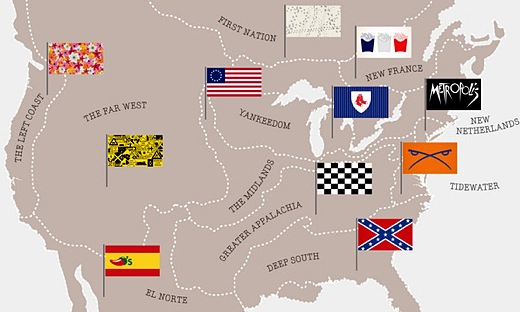
What I mean by those lines is described, brilliantly, in Colin Woodard's American Nations: A History of the Eleven Regional Cultures of North America (Viking Press, 2011), which is every bit as good as Hunter Wallace - the Southern nationalist - says it is. A succinct summary of its contents - including descriptions of the eleven "nations" - can be found here.


Some nations (like the former Yugoslavia or Czechoslovakia, or even Belgium, Spain and the United Kingdom today) are constructed on unstable, shifting tectonic plates, culturally speaking. North America is a continent of a similar character. There was no original, primordial unity, a unity constructed by the Founding Fathers, in American history: that is, a decision as to what sort of nation America would be. Instead, there were always warring nations within America: and the ten nations making up America have gone to war with one another, several times, and not just during the American Civil War. Secessionism, and political and cultural independence from an overweening (often Yankee-controlled) federal government, is written in to the American DNA. (From Woodard, we learn that the region of New Netherland (which contains New York and its surrounding boroughs) wanted to cede from the US and become a city-state).

The way to understand America, according to Woodward, is to see it divided up into nations which are almost like different planets - like the different civilisations the adventurers on the 1960s era Star Trek came across on their journeys. New Netherland is pure commerce, founded by Dutch, and bolstered by the presence of Jews and other European immigrants: this is the true 'nation of immigrants'. Yankeedom was founded by Puritans, who are communitarian, do-gooding and determined to interfere in other Americans' lives. The Midlands, founded by pacifist, easy-going Quakers, German Mennonites and Scandinavians, is a world populated by peaceful farmers who don't cause any trouble and indeed, are reluctant to take up arms to defend themselves against aggressors: they are the equivalent of Luke Skywalker's aunt and uncle on Tatooine in Star Wars. Tidewater was founded by English gentlemen who wore wigs and lived in English-style country estates, like out of a Jane Austen novel, and who were descendants of the Royalist English who had fled Cromwell after the end of the English Civil War. The Deep South is a slaver state, and really has more in common with the Caribbean - that is, the white Caribbean, the white West Indies slaver states - than anywhere else. Then there is the Greater Appalachian region, which is populated by the rambunctious, redneck, cracker 'Scots-Irish' and whose religion is Christian Revivalist Baptism and Methodism - of evangelicals, snake-handling and speaking in tongues.

Further afield is New France (New Orleans and Quebec), El Norte (northern Mexico) and the Left Coast, which is the coast of California, Oregon and Washington state - and contains the Pacific Northwest. The Left Coast is individualistic, idealist, and given to utopianism and self-actualisation - the true birthplace of beatnikism and hippie-ism. Missionary Yankees from New England attempted (unsuccessfully) to colonise it and save the inhabitants from themselves. I found this intriguing reference in Woodard:

The new Yankee "errand in the wilderness" got underway in fits and starts in the late 1820s. A delusional New Hampshire schoolmaster, Hall Jackson Kelley, tirelessly promoted an ambitious colonisation scheme for the Pacific Northwest, a region he'd never seen. His elaborate plans for a civic and religious republic never got off the ground, but his marketing effort - he plastered posters across New England, published books, and petitioned Congress for aid - did inspire others... [Woodard, p. 217]
Is the (purportedly schizophrenic) advocate of white colonisation of the Pacific Northwest, Harold Covington, the reincarnation of Hall Jackson Kelley?

The last of the eleven nations is the Far West, a sparsely populated, desolate area which is rich in resources and is effectively controlled by mining companies: it includes Idaho, Montana, Wyoming, Utah, most of Nevada, Arizona, Colorado, etc. It's probably the equivalent of Western Australia.

So, to revert to our science-fiction analogy of different civilisations on different planets: the Far West is the mining planet, the Midlands is the farming planet, the Deep South is the slave planet, New Netherland is the commerce planet, California is the hippie, environmentalist and New Age planet, Yankeedom is the, well, Puritan planet, Tidewater the 'replica 17th-century Anglican and English planet', and so on.

Most countries, including Australia, have pronounced regional differences - which are reflected in differences of accent, but also a pronounced competitiveness and even resentfulness. I've seen a recent article, in the German media, saying that Berliners resent the Swabians who have moved there. (The idiosyncrasies of the differing German regions are well-chronicled in Hitler, Nietzsche and other writers on German national life). But it's only a few rare instances - in the history of the West, anyway - that these antagonisms, differences and resentments become political, i.e., become calls for secession, and even go all the way up to armed conflict and war. America is one such rare case.

America is on the threshold of another break-up of the union, as the 'red' states (or rather, red nations) which voted for Romney will attempt to cede from the 'blue', which voted for Obama and the Obama program (inmagraciòn, gay marriage, marijuana legalisation, massive tax hikes, massive deficits, massive transfers of white wealth to Afro-Americans, currency devaluations, etc.). The Southern strategy is the correct one: the Dixie or neo-Confederate nations - Greater Appalachia, the Deep South, New France and Tidewater - need to cede from the northern states, Yankeedom, Midlands and New Netherland. (The Far West can be, in the event of a breakup of the United States, can be expected to side with the South; the Left Coast and El Norte with the Yankees).

One consequence of this is that the 'red' states will regain control of their own borders and the rapacious demographic advances of the Mexicans (and South and Central Americans) who emigrate to America from El Norte.

As well as that, the Southerners will regain control of their fiscal policies - particularly welfare policies. According to the Southern nationalists, the Afro-American population in the South are huge net consumers of welfare; once, however, the Southern secessionist states cut off the welfare supply, the Afro-Americans will flee the wicked white Southerners and go to the northern states, where they can except a warm welcome. New cities in the north will become majority Afro-American, just like Detroit, Chicago, St Louis and the like, cities which are renowned, the world over, as numbering among the most liveable in the world.

How would such a partition of the US affect Australia and Europe? America, as such, would no longer be a force to be feared. Germany and the rest of Europe can breathe easy, without the threat of American interference (and military intervention, which happened twice in the 20th century) and Australia would be thrown upon her own resources.

When it comes to immigration policy, it would be a case of anything goes. France, Greece, Italy, and then perhaps the entirety of the Western world, would perhaps gain the courage and daring to tackle their illegal (and legal) immigration problems. All because of the break-up, the balkanisation, of America.

Once the American boot is lifted off Europe's neck (it's been there since 1945), Germany can reassert its control of the Continent and weld it into a political and economic unity (this is already under way).

Secessionism, too, is already under way in the US - in thought, but not yet in deed. Obama is just the right man, at the right point of history, to help bring secessionism is about. He is a natural born polariser, who delights in setting different groups within American society against one another. The fact that he is nominating Chuck Hagel as a Defence Secretary, as opposed to a mediocre, establishment Jewish-American like John Kerry, is proof of this. I myself am delighted by the furore of the Jewish-American and Israel lobbies over Hagel, because I watching their rage (what's more, it's proof-positive that the Jewish lobby actually exists - when was the last time you saw France, Russia, Mexico or Germany putting pressure on the US government over its choice of a cabinet nomination?). But I can't help remarking at how Obama is unnecessarily antagonising an ethnic group which is one of his staunchest backers. The reason why he's doing this is that he enjoys it.

At any rate, he has permanently set the two halves of America - the 'red' and 'blue' states - at war against one another, and perhaps, by the end of his second term, we will see the second breakup of the Union.


Wednesday, November 7, 2012

Barack Obama, Political Zombie


Sometimes the worse thing you can do to a politician is give him a second term, and this is one of those times. Obama knows this. He didn't look like a winner on this campaign, and he didn't on victory night. His facial expression was, 'What the hell have I gotten into?'. Likewise, many an American voter will wake up tomorrow and say, 'What the hell have we done?'.

The problem is that Obama is out of ideas, and the economic and political problems which were there, at the start of the election, haven't gone away and won't go away. What will he do about unemployment? Anaemic growth? The weak dollar? Rising costs for food staples, oil and other commodities? Perhaps he'll try a program of 'stimulus', fuelled by public works and deficit spending - no, that's been done. Or devalue the currency some more: QE4, QE5, QE6... But that's been done.

The only thing left for Obama to do, when it comes to the economy, is to hike taxes - on income tax, capital gains, dividends, estate tax - and remove the tax loopholes on the Alternative Minimum Tax. Obama desperately wants this because of 'fairness'. But the House of Representatives isn't controlled by the Republicans, so, he won't be able to do that. He's the closest thing to a dead man walking: a lame-duck president who has a four-year term to sit out. Obama's second term will be 2008's mouldering corpse. Eventually - it will take a couple of days - even the dimmest liberal media commentator will see this...

(As we know, the big cuts on dividends, capital gains, income tax, etc., were introduced by Bush Jr., and they are set to expire - that is, be replaced by higher tax rates - in January 2013, unless Congress acts. If the higher rates take effect, it will be the biggest tax increase since Herbert Hoover's in 1931 - the tax hikes which, the supply-side commentators argue, caused the Great Depression. The markets are understandably jittery about such a prospect. With any luck, the legislators will muddle through, and come up with a compromise, as they did late last year. But it's just possible that Obama will get the 'fairness', i.e., the tax hikes, he's been asking for, simply because of the fiscal cliff).

Many reasons are being put forth as to why Romney didn't win. The supply-siders, such as John Tamny, will say that Romney didn't endorse a return to the gold standard (in fact, he did promise to set up a Gold Commission, which was more than Obama did); the 'liberal' Republicans - which is about 98% of the party leadership - will say that Romney should have reached out more to Mestizo voters (despite the fact that Mestizo voters didn't cast the deciding vote); American nativists, Far Rightists, racialists, white nationalists, will say that Romney should have campaigned against illegal immigration and thus 'energised the base' of white Republican Party voters more. Some blame the trade unions, and others make dark mutterings about taking the vote away from women, who, supposedly, voted for Obama in droves.

I don't have the answer. Except that I observe this: Afro-American voters vote for Obama because he's one of them - he's their man. The mainstream media notes this, and more or less acknowledges that the Democrats, and Obama, will take the black vote for granted. This is even though the Afro-Americans are suffering under Obama. (Similarly, black South Africans will vote for the ANC, even though life, for them, is bad under ANC; Mugabe's tribe voted, and continues to vote, for ZANU-PF...). Whites, though, are held to a different standard of morality: they aren't mean to vote for a Romney because he's white. No, they are morally obliged to vote for Obama.

In contrast to the liberal media, the right-wing media tells white Americans (and Hispanics and Afro-Americans) to vote for Romney because Romney and the Republicans will 'restore the republic as intended by our Founding Fathers', because they restore 'liberty and free markets, as intended by our Founding Fathers', and similar such nonsense. In other words, they are meant to vote 'conservative' on the basis of abstract and universalist principles. In reality, Afro-Americans, and Mestizos, don't abide by such principles. They play by the rules of tribalist politics, identity politics.

Supposedly, the white nationalists are meant to abide by a tribalist, ethnicist politics. By that reasoning, they should have endorsed Romney. The leaders of white nationalism and American Far Right nativism should have told their followers - and they do have a sizable following - to do all they can for Romney, to get out there and vote for their man Romney, and despite the fact that white Americans won't necessarily be better off under Romney.

But these leaders (and I won't name names) didn't. They smirked, they sneered, they talked Romney down, they told their following that 'Voting changes nothing', 'America and the white race are doomed', 'Things have to get worse before they get better', 'Democracy and politics are a farce', and on and on.

AFRO-AMERICAN: Votes for Obama because he's black;

WHITE NATIONALIST: Don't vote for Romney, he's not pure enough, 'Voting changes nothing', 'Romney and Obama are the same', race doesn't matter.

To repeat: Afro-Americans are suffering under Obama. They are suffering under his economic policies, and his immigration policies - immigrants are consistently snapping up most of the jobs created under the Obama Administration, and taking them from white and Afro-Americans. But they vote for their man. I can think of one or two of Romney's policies which would have had a positive effect on the lives of white Americans, but that's besides the point: someone who's white, and who promulgates racialist, ethnicist and identity politics, should have endorsed Romney, and done everything in their power to get him elected - because he was white.

Quite a few white American 'conservatives' vote Republican because of dog whistle signals - they pick up on, subconsciously, the fact that the Republican Party is the party of the married white person who owns a home or has a mortgage (as Steve Sailer points out). I'm sure that there's an enormous anger, among that segment of the American population (which is quite sizable), against the Obama voters and supporters: the college students, the Jewish-American hedge fund managers, the fat cat public sector unionists, the hipsters, the Hollywood actors and directors, the rock stars like Bruce Springsteen, the stupid soccer moms, the homosexual journalists at The New York Times, The Washington Post... Were I a white American 'conservative', my first impulse would be to approach one of these Obama voters and say, 'F*ck you, for making my life, and the lives of my countrymen, that little bit harder for the next four years'. The same goes for all the Australians, Canadians and Europeans who support Obama.

But really, I can't castigate these Obama-supporters: they are, after all, voting according to type, just as much as the African-Americans, who want their 'Obama phones', are. No, it's the white nationalists, the movement purists, in America, who deserve the anger.

White nationalism really is a contrived, ahistorical, abstract and universalist ideology. In a way, it's a form of Christianity: one is obliged to unconditionally love one's brethren, simply on the basis of their race, and ignore any unique ethnic, national and regionalist features. Such an enterprise is doomed to fail, of course, and historically, has never been enacted. Perhaps this is why white nationalism is so purist and aloof from the doings of the real world. Because it is so abstract, and doesn't take into account political realities, it counsels its followers not to engage in politics, in any shape or form.

America is a weak country under Obama, and for that, European nationalists should be grateful. Had Obama the gumption of a Franklin Roosevelt or a Winston Churchill, he would have invaded Greece and Hungary by now to 'stop fascism' by stamping out the Golden Dawn and Jobbik; he would have also loudly remonstrated with Germany and told it to stop bullying its fellow European nations (or perhaps, solicitously, offered those bullied nations some Marshall Plan-type aid - to get them on their feet again). But America (and Israel) have lost all interest in Europe, and will only pay attention if and when Germany starts inclining on the same path as Greece and Hungary. But by then it will be too late. We nationalists can pray and hope.

As for the American whites, well, they'll have to start looking at the political possibilities - outside of libertarianism, conservatism and white nationalism.


Sunday, October 7, 2012

The Undeserved: a Post-Mortem of the Obama Presidency


Nationalists and racialists, in general, don't pay much attention to elections. But I have been fascinated by the current presidential race, especially by the Obama-Romney debate. I read the transcript, watched the whole thing (one and a half hours long) and read every news article and piece of analysis on it... Why? Because the turning of the tide, in politics, is always interesting: how one can become a political winner - within the context of a US presidential race, or a Politburo leadership struggle - or a political loser, within the space of a few hours, reveals a lot about politics and the leadership process - and the masses who help put these leaders in power. In elections in which an incumbent is defeated, the masses - and the media - are infected by a sort of euphoria, especially when it becomes apparent that the victory of the challenger is assured. (I remember reading a biography of Carl Schmitt, describing the incredible scenes of jubilation, in the streets of Berlin, after Hitler's ascendancy to the chancellorship. In his diary, Schmitt wrote, wonderingly, how he saw a carnival atmosphere, and how everyone, from all works of life - including streetwalkers - were ecstatic...). It's hard for even a misanthrope like myself not to get caught up in the hype. I was very glad to see the back of John Howard, in November 2007, even though I didn't think much of Rudd; I was glad, too, to see McCain and the loathsome Republicans thrown out in November 2008, although I had doubts about Obama's economic program (I remember thinking to myself, 'But what's he going to do, once he gets into office?'). Even in 2000, I hoped that Bush Jr. would win over Al Gore, because I didn't think I could endure life on this planet with the prissy, sanctimonious and pompous Gore as President of the United States.

I'm sure that these are the same feelings as many in the American electorate, and one, after a while, develops a 'nose' to see how the Americans will vote. It was fairly obvious to me, at the time, that the 'young' and 'progressive' Bill Clinton would win over the elderly, stentorian George Bush Sr. in 1992; likewise, that Obama would win over the semi-senile John McCain in 2008. As for incumbents, it was fairly clear, at the time, that Bush Jr. would win over John Kerry (an ageing Jewish-American with a grey Beatle wig and a tedious manner of speaking); and that the (at the time) switched-on, pro-growth Bush Sr. would win over Michael Dukakis (a dull, grey little man). (Sometimes one has to wonder how the party machines, for both the Republicans and Democrats, throws up such mediocre candidates who are clearly unelectable: McCain in 2008, Bob Dole in 1996, Dukakis in 1988. The answer to that is: often it's the case that there's no-one else).

Since my last post, I've re-read the opening chapters of Wanniski's The Way the World Works (1978) to gain a better understanding of his political model, as well as some old articles of his (on the 1980 and 1984 presidential campaigns). I'm awestruck: I don't think anyone understood, as much as Wanniski, the mechanics of elections, leadership selection and the liberal democratic political process (and, by extension, the political process in non-liberal states - e.g., communist one). Although I'm repelled, of course, by Wanniski's liberalism, Afro-Americo-philia, anti-Germanism and anti-Nazism and the rest, I try not to let that get in the way. His models and theories don't explain everything about politics, race and culture, any more than Marx's do; but we must use them as a kind of overlay - that is, we have to ask ourselves, 'How can such-and-such a political phenomenon be revealed, in the light of Wanniski's model', and see what the answer is.

In the Wanniski model, the electorate has a wisdom greater than the sum of its parts: given the choice between two (often unpalatable) alternatives, it chooses the best one. It should be thought of as a deaf-mute, who can only communicate by sign-language and gesticulating (in the same way that one does in the party game of charades). It instinctively prefers a candidate of the A-type, but, when A isn't to be found, has to choose between two other candidates, B and C. Because B is a little more like A than C is, it goes with B. What if the two candidates in question are not B and C, but are the equally unpalatable D and E? Again, the electorate will make the right choice, all things considered: perhaps E shows signs of not being as unpalatable as D.

The job of the politician is to be the interpreter of the deaf-mute electorate's desires - which are signalled, to him, by, not only the results in elections, but by opinion polls, the reactions of audiences at rallies and speeches, letters to the editor, personal attacks on his character (leading all the way up to assassination attempts, which, according to Wanniski, can convey the desires of a certain segment of the electorate).

Wanniski explains the process by using the economic concept of marginality as an example. 'The last straw that broke the candidate's back' - that's the marginal straw. We could say that the addition of that straw was at the margin - the point where change takes place. Were that last, marginal straw endowed with consciousness, it wouldn't be able to understand why, precisely, its addition broke the camel's back. But were the previous thousand or so pieces of straw, plus the marginal one, all endowed with consciousness - then it would understand. As it is for the straws, so it is for the voters, who, together, form a 'group mind' (and which, like that marginal straw, doesn't recognise itself as part of a totality).

Wanniski's theories explain why it is that the House of Representatives, in the US, goes to the Democrats when the President is a Republican, and vice versa: the electorate is, through its voting, trying to balance things out. In the last (2010) Australian federal election, the Labor government was returned to power as a minority, with an electoral majority of just one seat. Wanniski would say that, obviously, the electorate was sending Prime Minister Gillard and Labor a message: we want you in, but don't make any radical changes, like Rudd (the former Labor Prime Minister) did with his mining tax proposal. With the Labor government hanging by a thread after the election, it was presumed (by the electorate) that Labor wouldn't feel as though it had the mandate to undertake any unpopular experiments.

We in Australia know what happened, of course: Labor went ahead and forced through the unpopular, environmentalist carbon tax through parliament and the senate (where the Greens had the deciding vote), despite promising, before the election, not to do so. As a result, Gillard's popularity plummeted and Labor is facing wipeout at the next election. Wanniski would say that the electorate wants to punish Gillard for her broken promises and for ignoring the message of the 2010 electoral results. (Had she shelved the mining tax, and ignored calls for a carbon tax, she'd be a lot more popular than she is now). Labor's only consolation is that the opposition leader, Abbott, who is the leader of the conservative Liberal-National coalition, is even more dislikable, on a personal level, than Gillard is. (Abbott has recently embarked on a media campaign to make himself more 'likable', to humanise himself in the eyes of the electorate: whether he succeeds or not (and nothing can make this odious little man likable or popular) is another story altogether. It's possible he may be deposed in a party coup).

I think most mainstream analysts get all this - how the electorate operates like a hive-mind (Wanniski, famously, said that Washington, and Congress and the Senate, represent the brain of America). What's more controversial is Wanniski's thesis that the electorate understands economics, perfectly, and what's more, is supply-side in its orientation. It wants a supply-side leader, but, if it can't have one, will choose a socialist who will focus on wealth distribution and shielding his constituents from the effect of economic calamity.

Wanniski's doctrine on this point helps explain the rise of Obama in 2008.

From the supply-side point of view, the financial crisis of 2008 can be explained by the phenomena of monetary deflation. In the lead-up to the summer of 2008, Bernanke flooded the markets with liquidity - US dollars - which led to a depreciation of the US dollar and a dramatic rise in the price of land and other commodities (including gold, which went up from $USD275 an ounce in 2001 to $1000 an ounce). All of this was redolent of the 1970s, when the US - and the world - went off gold and experienced a massive inflation. In that decade, the prices of gold, oil, land and other commodities rose into the stratosphere. Accompanying this was a big expansion in investment and lending (as banks tried to offload a rapidly-declining US dollar and pass it on to someone else, as though it were a hot potato). But the day of reckoning came. In both inflations - the 1970s inflation and the 2000s - there was a sudden reversal of course. In the early 1980s, the Fed suddenly withdrew liquidity - or didn't provide it at the rate it was being demanded - and, as a result, the price of gold, oil and other commodities collapsed. (Gold went from $USD850 an ounce to $US600 and then $USD300). The big oil-producing nations like Iran and Iraq, and the big commodity producers like Chile and Australia, went temporarily bust. Similarly, in the deflationary summer of 2008, commodity prices collapsed (gold went from $USD1000 an ounce to $USD700 an ounce) and so did the real estate speculators, mortgage holders and banks which had plowed enormous amounts of money mortgage-backed securities. All of this happened under the watch of a Republican, George Bush Jr. - who was a supply-sider when it came to tax cuts, but, when it came to monetary policy, was a Keynesian or a monetarist (in all fairness, he wasn't the one deciding monetary policy - Bernanke was).

The defeat of the Republican Party in 2008, then, was inevitable. Seeing that none of the candidates for the Democratic and Republican nominations, in 2008, understood - or appeared to understand - supply-side monetary policy, it was natural that the presidency should go to a socialist who would devote his attentions to welfarism and wealth redistribution.

The supply-side tax cuts, which the Republican Party traditionally specialised in, wouldn't help solve the problem: only supply-side monetary policy would. Seeing as the latter wasn't on offer, the US electorate, understandably, chose the lesser of two evils. Obama's economic platform demanded tax increases - a roll-back of the Bush Jr. tax cuts, and an increase of the capital gains tax rate from 15% to 28% - but the electorate discounted this, perhaps feeling that Obama would be unable to implement his tax hikes (in any case, it was right).

But, in the words of John Tamny, after the 2008 financial crisis, Bernanke 'doubled-down' on his inflationary monetary policy. Perhaps recognising that the problem was deflation, he set about to injecting huge amounts of liquidity into circulation. But he ended up over-compensating, stepping on the gas pedal too much. With QE1, QE2 and now QE3, gold has risen to hitherto unknown heights: last year it reached a record high of $US1889 an ounce.

Perhaps Bernanke wanted to trigger off another banking or real estate bubble. Wanniski observed that the economic model of the monetarists relies on something he calls 'money illusion'. The central bank engineers a devaluation, thus bringing about a rise in prices. The general public sees prices rise, and thinks that these are due to a real increase in the national wealth, a real boom; it thereby goes out and spends and produces more, and increases its economic activity. If the central bank tries the same thing twice, however, the general public will see through the deception and recognise the second round of price rises as being mere inflation. In other words, it will see that these rises are due to nominal, not real, factors: that is, that the rises come about from printing money, not economic growth.

At any rate, things have stayed rather flat since Bernanke began his 'quantitive easing', and none of it has had the desired economic effect. The same goes for Obama's enormous deficit-spending on public works, etc., deficit-spending for the sake of it, all designed to 'pump-prime' the economy in the Keynesian manner.

Obama is possibly the most anti-supply-side Democrat President of all time. Wanniski praised Carter for reducing the capital gains tax rate from 35% to 28% in 1978, and Clinton for cutting it from 28% to 20% in 1997 (and cutting taxes on Roth-IRAs). Kennedy, of course, was a supply-side icon for his huge Reaganesque tax cut plan of 1963, which saw a reduction in the top rate of income tax from 91% to 70% and in the rate of corporate tax from 52% to 48%. (Ironically, Kennedy's tax cuts were blocked by 'fiscal conservatives' in Congress, and didn't pass until 1964, after his death, at the urging of Lyndon Johnson). In other words, Kennedy, Johnson, Carter and Clinton were, in the words of Wanniski, 'pro-growth' and nascent supply-siders. Obama, on the other hand, has vociferously fought for huge tax increases - and may get his way soon (hence the upcoming 'fiscal cliff). Kennedy began his presidency with a mild leaning towards socialism, but, after encountering a stubborn recession, began contemplating supply-side remedies. Perhaps the electorate believed that Obama would undergo a similar conversion. But he didn't.

What does all this add up to? It adds up to a Democrat who, economically, is a clone of George Bush Jr. when it comes to monetary policy, but unlike Bush Jr. and Clinton, is anti-supply-side on fiscal policy.

What of the foreign policy? Again, it's a continuation of Bush's failed policies. Prior to the 1970s, the Anglo-Saxons ruled the Western world: America was the dominant power, with Britain acting as a 'junior partner'. The story of America, after the 1970s, is the displacement of Britain from the position of 'junior partner' by Israel, and then, finally, a reversal of 'senior' and 'junior' positions by the late 1990s: Israel became the senior partner, America the junior partner. Obama has continued in that vein, as will Romney, of course, if elected.

If we were to assess Obama from the Jewish-Israeli viewpoint - as a good little goyische tool of Jewish-Israeli and Jewish-American interests - we find that Obama hasn't done much good, foreign policy-wise. As a statesman of the Judeo-Anglo Empire, he was meant to have expanded American and Israeli hegemony, but didn't. (I don't consider the assassination of Bin Laden as a foreign policy 'success', because I don't think that that assassination was real - I think it was a hoax. Unlike Ghaddafi, we never got to see Bin Laden's body). Libya was a success story of sorts, but Libya, post-Ghaddafi, is highly volatile - as we have seen after the recent murder of the US Ambassador (who, ironically enough, posed for photographs next to Ghaddafi's corpse (no-one posed next to Bin Laden's corpse)). Obama has been criticised by "conservative" (that is, maniacally pro-Israeli) Jewish-Americans for not being sufficiently enthusiastic about bombing Iran. (The same "conservatives" have been mostly quiet on the withdrawal of troops from Iraq - even they see that the Iraq mission was a failure). This doesn't mean, however, that Jewish-Americans, on the whole, don't vote Democrat and won't vote for Obama this November.

In politics, one can't please everybody. Obama's foreign policy platform was more or less Bush-ite, but he managed to portray himself - to the liberals, pacifists and college students who voted for him - as a dovish anti-neo-con. Weren't they fooled! But, if you vote for a Democrat or a Republican in the 21st century, you're putting yourself in league with the devil. The Democrats and the Republicans are now the war party, just as Roosevelt and Churchill were in the 1930s, and, like Roosevelt and Churchill, they are willing to go to war for Jewish causes... (I couldn't give two hoots, of course, as to whether or not a grubby Afghan or Pakistani militant gets killed by a drone plane, or if Iran's reactors get bombed; but I do feel that the American voter, in 2012, should know what he's getting into).

But to return to the topic of the economy. The Bush Jr. years have reinforced the lesson that supply-side fiscal policy is no good without supply-side monetary policy. Carter signed off on a sizeable capital gains tax cut in 1978, but was undone by the Federal Reserve, which proceeded to devalue the US dollar all the way up to $USD850 an ounce of gold in 1980. Clinton was fortunate that, in 1997, when he signed off on his capital gains tax cut, the Reserve had been keeping the US gold dollar price more or less stable since 1982, and continued to do so (more or less) through his second term, which saw a huge economic boom. Bush Jr's tax cuts in 2003, however, weren't as effective as they could have been because, like Carter, he was undermined by bad monetary policy by the Federal Reserve. A state can have the best fiscal policy in the world - with low taxes which give incentives to produce, and, what's more, are easy to pay - but if that state has a central bank which wants to emulate Zimbabwe, or the early Weimar Republic, and embark on a destructive course - then that state will suffer.

Belatedly, the leadership élite of the US has begun to recognise this. Certain of the élite is beginning to express its disquiet with  Bernanke's 'quantitative easings'; some are even beginning to suggest that the answer to America's monetary problems may be a return to gold.

The trouble is, however, Obama, who may help deliver a fiscal whammy. The fact that Obama wants this so badly really makes him uncharacteristic. As can be seen from the US political history recounted here, for the most part, presidents - even Democrats - are biased towards supply-side tax-cutting, and the Democrat presidents tend to be centrist and pro-business. Obama isn't, though: he's well to the left of Bill Clinton.

The question is, why? Not why is he left-wing (as opposed to centrist), but why was he selected, by the Democrats, as a presidential candidate? Normally, the Democrat president would be a centrist type who, while probably not being able to do much, wouldn't have run up such a deficit and wouldn't have gone after the Bush Jr. and Clinton tax cuts with such zeal. Left-types like Obama exist in every liberal democratic party, and indeed, are necessary - they are a complement to that party. But they are usually kept in the background. Obama, of course, was pushed to the fore - by the Democrat party machine, and by the voters in the 2008 primaries.

Another remarkable thing is that Obama is such a non-entity, politically and intellectually speaking - as evinced by his performance in the debate, he doesn't seem to have much energy or enthusiasm for the top job - and really can't work with other people (during the debt deal in late 2011, Nancy Pelosi reportedly put him on mute during a conference call, so she and the other Democrat negotiators wouldn't have to put up with his droning voice). In other words, he doesn't have the necessary skills to be the leader of the United States (and, for his entire adult life, hasn't showed any evidence of much leadership in any capacity). On top of that, he doesn't respond well to criticism, mainly because - unlike Bush Jr., or Clinton - he's never received any, at least from the mainstream media.

The conservative blogger (who writes for the US anti-immigrant site VDare) Steve Sailer penned a biography of Obama, America's Half-Blood Prince: Barack Obama's "Story of Race and Inheritance" (2008), before Obama was elected (he wanted America to know what it was getting into). In it, he outlines these character traits of Obama's, which, finally, the mainstream commentators are beginning to pick up on. (We now see analyses with titles like, 'Does Obama really want this job?'). One of Sailer's theses is that Obama marketed himself, consciously, as a black politician white liberal voters would feel comfortable with. In the (perhaps apocryphal) words of Senator (later Vice-President) Joe Biden, 'He's the well-spoken one we've been waiting for'. Obama (along with his wife) got where they were mainly through affirmative action. What's more, he hasn't been criticised as roundly as prior presidents (or scrutinised) because journalists and commentators are terrified of being called 'racist'.

Wanniski had some good things to say on affirmative action. He believed that having ethnic minorities on the board of one's organisation could be useful, in that it exposed that organisation to the minority point of view. Which is reasonable enough. There are 34 million Afro-Americans in the US, and no president, or party, can afford not to take them and their interests into account. (In an ideal white nationalist world, there would only be white people in the US: but, as it is, any liberal democratic politician has to deal with this sizeable minority).

But, having said that, were it the case that Obama occupied his job only because of affirmative action - that would be an injustice. It's not that his being there prevents a good, more well-qualified, white person from doing the job: I don't really have any pity for any white, or Jewish, Democrat candidates who were passed over in favour of the black guy. No, it's that Obama received what he has without deserving it, he doesn't merit it. Sailer raises that point, again and again: had Obama not been black, and the 'right kind' of black (that is, a black politician acceptable to white voters), he wouldn't have gotten the job. (Obama is meant to be an 'intellectual', but the evidence shows that all he's ever written or thought about was race (as Sailer chronicles at length). He, like a good many other black 'intellectuals' (e.g., Touré), can't write on anything except race. The Jewish-American leftist, Leni Bremmer, observed that the great Jewish Zionist-nationalist Vladimir Jacobtinsky couldn't write on anything except Jewish matters. Given that only a small proportion of humanity is interested in such things, Jacobtinsky's thought was bound to have a small appeal. In other words, it was boring to most people. The same goes for the writing of the Obamas and Tourés).

After the debate, liberal commentators are beginning to realise that their idol has feet of clay. And it's possible that the 'first Black president' may be the last - at least for the time being. Sailer argues that Obama represents the zenith of Afro-American political power in the US: Obama will be the equivalent of David Dinkins (the mayor of New York from 1990 to 1993), who was the first and only Afro-American to hold that office (New York has only elected whites and Jewish-Americans since then). Sailer mischievously observes that liberal whites have become a little tired of having Afro-Americans as their favoured, pet minority, and may soon take up the cause of an even more suffering, put-down-upon people - gays (which helps explain the recent push, by liberals, for gay marriage). (Given that reasoning: Obama, according to rumour, is a homosexual - perhaps he could boost his political career by divorcing Michelle and coming out of the closet?).

But this brings us to the question why Obama isn't good enough. The subject of Afro-American incompetence is a touchy one, to say the least. In the liberal narrative, Afro-Americans have always been as good as whites, in any capacity, but have always been held back by racist whites, who don't regard Afro-Americans as equals, have built up myths of white racial superiority, and don't recognise the sterling virtues of Afro-Americans. But the recent debate performance has given this liberal narrative a drubbing. Not that, for liberal white commentators, it's beginning to unravel: no. But they are beginning to confront Obama's deficiencies, and perhaps are thinking, to themselves, the naughty thought: 'A white guy wouldn't have done as badly as that'. (One conservative blogger for The Washington Times remarked, sneeringly, that to say Obama was as bad as Carter in the debate of 1980 is an insult to Carter). Hence the amusing on-air breakdown of liberal journalist Chris Matthews over Obama.

I was struck, in watching the debate, by how Romney appeared to be a headmaster scolding a disobedient pupil (Obama) in his office (with Obama staring at his feet, glowering and nodding); or how Romney appeared to be a judge in court sentencing some malefactor. Other people have picked up on this - and the racial overtones. As the liberal commentator Henry Porter writes, in The Guardian (where else):

That the president is black, that he seemed dog tired and often glanced at his notes when Romney was speaking had an uncomfortable but rarely acknowledged resonance in the US. I am sorry to have mention this, but the contrast between the black guy, momentarily off his game and looking downwards, and the white guy, all crisp, clear-eyed and on top of things, will register in the subconscious of an electorate that is far from being free of racism. ['Has a disillusioned Barack Obama lost the will to win?', The Guardian, 07/10/2012].

The fact that millions of Afro-American politicians are prepared to vote for a candidate because of his race, is not "racist", of course: race-based voting is only racist when white people do it. But let's not go into that... We know how unfair and unjust the anti-white brigade (of which Porter, and the entire staff of The Guardian, are members) is.

John Tamny wrote an attack on Romney after the debate, chiding him for not being sufficiently neoliberal and supply-side (see 'Presidential Debate: Romney Started Slow, Then Thoroughly Beat Obama'), which missed the point. Romney sounded Wanniskian enough (especially when he declared that the only way to boost tax revenue was to boost growth, and employment, and he showed himself to be concerned about inflation, which he recognises - unlike Obama or Bernanke - as a problem). But the debate wasn't a lesson in supply-side economics, or a sermon on neoliberalism, markets and so forth: it was about (rather dry topics such as) Obamacare, Medicare, Bowles-Simpson, Dodd-Frank and waiving tax deductions (I found Romney's position on tax to be mostly incomprehensible, as did, I'm sure, most viewers). The main thing is that Romney repositioned himself, and had taken Wanniski's advice and started listening to the electorate - all of it. Porter sees this:

But whatever the subliminal traffic of the debate, there is no doubt that Obama conceded important territory by allowing Romney to stake a claim for the presidency as a unifying figure, the candidate who, despite his privileged background, tax records, offshore bank accounts and the export of American jobs to China, could heal the rift in American politics.
Romney sold his record as governor in Massachusetts, where he worked with a large Democrat majority, as the qualification for ending the logjam in Washington: he was the man to walk across the aisle and do business with the other side.
While incanting the creed that espouses individual choice and enterprise over big government and centralised authority, Romney shifted to the centre ground and simultaneously implied that Obama was, in fact, the divisive figure of US politics. A successful completion of this move may be as dangerous to Obama as the spooky invocation of Ronald Wilson Reagan. [Ibid.]

The point is that, to be a leader (in the US, or China, or wherever), you don't need to be a supply-side economist (like Tamny is), but a listener - and someone who can 'work with the other side' (that is, the representatives of the side of the electorate which didn't vote for you). One of the common complaints of average Americans (when interviewed on TV) is that Washington is full of obstructionism, logjam-ism, 'partisan gridlock', and so forth. A leader who can untangle that Gordian knot is far more desirable, and acceptable, to voters than one with an excellent fiscal and monetary policy. This is why the men with impeccable supply-side platforms - men like Herman Cain, Rick Perry, Tim Pawlenty - are passed over in favour of the Romneys. Americans, in 2012, will only vote for a Republican who is a bland centrist like Gerard Ford. Romney, with his recent repositioning, fits the bill nicely. Someone like Newt Gingrich, who antagonises people even within his own party, and who doesn't change (the way Romney does) in response to negative feedback, doesn't fit the bill.

What does all this mean for nationalism? Edward S. Rubenstein has been writing an interesting series at VDare.Com, suggesting that the majority of jobs created, since the start of the Obama administration, are being snatched up by immigrants and taken away from white and Afro-American people. He uses the official US Household Survey (which breaks down the data by ethnicity). His latest instalment, reflecting Friday's US unemployment numbers, is here. Romney will be under pressure, from both the Left and Right, to give a blanket amnesty to the 11.5 million illegals in the US, and to invite more legal immigrants ('skilled' immigrants, that is, Indians) to live there after they finish a degree (exactly the same system which led to a tripling of the Indian population in Australia after 2004). Not that Romney needs pressuring: he's a multi-culti maniac like the rest.

At present, the polls (which have been confused and confusing for this election) suggest a tight contest, like Gore and Bush Jr. in 2000, or Kennedy and Nixon in 1960, which could go either way. I would very much like to see Obama lose, because I want to see the back of him - and I would enjoy the outrage and disappointment of the white liberals who support him. (Indeed, the title of Porter's article implies that it's not that Obama wasn't good enough, it's that we weren't good enough for him. Obama, if he does depart the vale of tears which is the US presidency, will be yet another victim of white racism).

The well-being of a kingdom depends on its king. The demeanour, the persona, of a ruler has an effect on his subjects... Australia is part of the Judeo-Anglo Empire. One has to ask what the effects on the American national psyche (and the Western psyche) have been, for the past four years, of having a diffident, withdrawn, closeted homosexual as a ruler, whose 'soaring rhetoric' doesn't add up to that much, who looks down his nose when addressing people, and who is an Afro-American - an ethnic minority group which, traditionally, is not enamoured of white people like myself.

I often find, when interacting with Chinese, Indian and African immigrants - even ones my own age - is that their appreciation and understanding of the white Western culture is shallow. They can only discuss the most recent and superficial things - e.g., Twitter, Facebook, the sports game, the latest multiplex blockbuster movie - and, if they do like Western pop or rock music, they only know the very latest pop and R & B tunes (not for them the Beatles, the Stones or the Eagles). It's the same with the likes of Obama - I only have things in common with him that I do with Kanye West or Oprah Winfrey, which is not that much at all. Whereas other, past presidents, I have, at least, a shared cultural past: Clinton and Bush Jr. escaped, like my father, the draft, Bush Sr. was a WWII pilot, like my grandfather. Clinton's favourite band was Fleetwood Mac, Bush Jr's favourite song, Van Morrison's 'Brown-Eyed Girl'...

It's for this reason that I just can't warm to Obama. The fact that he's made a career of opposing himself, ideologically, culturally and intellectually, to evil racist whites, only reinforces this.