Showing posts with label English Defence League. Show all posts

Sunday, March 5, 2017

Operation Rex: Can the Anti-Islamics Be Saved?


I mentioned in my last post the subject of the 'chav' and 'bogan' nationalist who tends to gravitate towards the anti-Islamic 'patriot' movements. In Britain, these 'patriot' gangs comprise the EDL, the Pie and Mash Squad, the North-West Infidels, the South East Alliance, Pegida UK... The gangs serve as a street force, perhaps the equivalent of the mobs of Clodious and Milo in ancient Roman times, for the anti-Islamic populists, of whom Wilders is the most famous example. We can find a few chapters of the Wilders Anti-Islamic International: in Britain, the two most prominent of these are Paul Weston's Liberty GB and Paul Golding's Britain First (a thuggish organisation which itself veers towards being a street gang).

Many from the nationalist scene have looked at these groups - which are comparatively new - and asked if the members can be steered towards a more 'hard', traditional nationalism; the old-time nationalists don't regard the doctrine of the anti-Islamics, who subscribe to multi-culti, gay rights, civic nationalism, Zionism, as satisfactory. You could describe this distaste of the traditional nationalists for the anti-Islamics as an ecumenical rivalry: the patriot gangs are recruiting many working class men (who often have shaven heads) who would, if not for the 'patriots', be joining skinhead gangs and other neo-Nazi outfits. The problem then becomes one of how to rescue these wayward souls from the clutches of the Zionist civic-nationalists. They need to be (in Alt-Right parlance) 'red-pilled'.

To the Far Left and the political establishment, the 'patriot' gangs appear to be 'hard' nationalist enough as it is - fascist (or neofascist) in fact. The more raffish of these outfits - the EDL, for example - meet what liberal academics call the fascist minimum, a checklist of characteristic traits of a typical fascist movement. The EDL 'vilifies' ethnic and religious 'minorities'; it makes a practice of street confrontations with the Left; it uses flags, banners, pennants, symbols; it makes 'hate' propaganda, often apocalyptic in tone and evocative of strong, negative emotional reactions, against the liberal democratic establishment, the politicians, the internationalists, the liberals, the pacifists, the bankers... The members of the 'patriot' gangs don't wear uniforms and don't organise themselves along paramilitary lines, but they verge upon both. The 'patriots' in Britain owe a great deal to their antecedents the BUF, and the National Front and British National Party in their street-fighting days. Long time British nationalists look at the 'patriots' with suspicion, then: they see the 'patriots' as johnny-come-latelies who have appropriated much of the style and rhetoric of British nationalism but have watered it down to make it more 'acceptable'. Some even believe that the British 'Deep State', working in conjunction with the 'anti-fascists' of the Far Left, were responsible for setting up the EDL as a front group with the intention of stealing away the limelight from the BNP (which, at the time of the EDL's founding, was electorally successful and did pose a real threat to the British establishment).

I think that this allegation - that certain of these 'patriot' and anti-Islamic groups have been contrived by the 'Deep State' - possesses merit, and I myself have met at least two individuals (both of whom are members of the Australian 'patriot' movement) who I believe are informants who work for what Joe Owens calls the 'Secret State'. The British nationalist scene seems to be riddled with informants, spies, agents provocateurs, and one can't blame Joe Owens for being paranoid; at the same time, I see his line of attack as being counter-productive. You can't win over nationalists and 'patriots' over to your cause by denouncing the groups they belong to as contrivances of the 'Secret State' and the leaders of those groups as 'spies' and 'snitches'. It doesn't work that way. For one thing, you need to take pride and vanity into account: no-one likes to admit that they've been led by the nose by a con-man. Besides which, any debate becomes one of the virtues (or vices) of one's opponent - whether or not he is of low enough moral character to be a 'snitch' and a 'traitor' - and not his ideas. If enough people believe in the efficacy of an organisation's ideas, then that organisation - suspicious as it is in its provenance - will continue to survive and attract followers. Combat 18, which was most definitely a front group set up by the 'Secret State', continues to flourish, and its members don't seem to care that it was founded by agents provocateurs.

The ideal outcome would be to persuade the 'patriots' and anti-Islamics to join your side. The question then becomes: what's your side? How does your 'racial nationalism' or 'white nationalism' or 'National Socialism' or whatever you want to call it differ from the civic nationalism of the 'patriots' and 'anti-Islamics'? That question has become especially pertinent for the Americans in the movement, who daily fill up message boards and comments sections with musings on how to 'red pill' Trump supporters, Republicans and 'Alt-Lite-ists', Trump being the closest America has come - and ever will come - to a European-style civic nationalist and populist.

Once one undertakes this task, one is confronted with an intellectual puzzle. How do you distinguish your ideas from those of the anti-Islamics? How does your product differ from theirs?

I would argue that Wilders is a nationalist of sorts - he certainly rejects Moroccan immigrants, for example, on grounds of their nationality - and one can detect certain elements of fascism in him (just as one can find a trace of it in the EDL). Wilders would furiously reject the comparisons to fascism, just as the EDL did - they filmed their burning of a swastika flag to prove their 'anti-Nazi' and 'anti-fascist' credentials -but anyone with an ounce of objectivity can see the parallels. You may object, 'But Wilders loves the Jews, and he hates white nationalism' - true enough, but adherence to white nationalism and anti-Semitism alone doesn't make one a fascist.

At first sight, the difference between a conservative and a fascist lies in fascism's authoritarianism - just like the Marxists, the fascists reject classical liberalism and liberal democracy (while touting at the same time a more true version of 'democracy'). But history teaches us the contrary of this thesis that fascism equals right-wing authoritarianism. Franco of Spain and Salazar of Portugal do not qualify as fascists (according to the academic specialists in the subject), even though both their regimes exploited fascism - or rather, the energy and enthusiasm for fascism - at their founding. Both Franco and Salazar rose to power on the back of a fascist wave. But, in the end, history regards them as authoritarian conservatives, nothing more. We can obtain more clarity if we are to look at the example of two Latin American dictatorships of the 1970s which were in part Francoist and Salazarian in inspiration: Chile and Argentina. The rulers of both countries opposed communism and wielded a heavy hand against it, and overturned liberal democracy and replaced it with a right-wing dictatorship; but one can't classify them as 'National Socialist'. One cannot confuse a Pinochet with a Hitler, Mussolini, Mosley.

Imagine - as a thought experiment - a dictatorship in Europe or Australia which was conservative and, furthermore, civic nationalist and anti-Islamic: say, for instance, that the Zio-populist Australian Liberty Alliance took power in a coup (unlikely as that prospect seems) and then ruled like Pinochet. Could such a regime be considered fascist? Neofascist? My answer would be no. One of the distinguishing features of the classical fascism of the 1920s and 1930s was its 'totalitarian' aspect; like the communists, the fascists attempted to insinuate themselves into every nook and cranny of social, economic, intellectual and cultural life. The fascist doctrine had to pervade everything; it exerted itself in spheres which we would regard as non-political. This explains the resemblances between the National Socialist Germany of 1933-1945 and the German Democratic Republic of 1949-1989.

The conventional wisdom supports my point of view, and the distinction I have drawn here - between authoritarian and 'totalitarian' regimes - mirrors the one made by, among others, the neoconservative intellectual Jeane Kirkpatrick (see her landmark essay 'Dictatorships and Double Standards'). Today's nationalists who are self-proclaimed 'National Socialists' would not like it at all: they live in fear of words such as 'fascist' and 'totalitarian' being applied to them, even though their forebears wore those words as badges of honour. And I can see their point of view to a certain extent. Concepts such as 'fascism' and 'totalitarianism' don't evoke positive responses, even in civic nationalists and anti-Islamics (who are wont to compare Islam to 'fascism' anyway). One can't take the line with the civics that 'I want what you want, except that I want you to go further to the Right and become more "fascist" and "totalitarian"' - that will not go down well.

Nevertheless, the leap from ultra-conservatism to fascism can be made. Here is a description of the ideas of Leon Degrelle's Rexist Party (1935-1945) from Wikipedia:

The ideology of Rex, which was loosely based on the writings of Jean Denis, called for the "moral renewal" of Belgian society through dominance of the Catholic Church, by forming a corporatist society and abolishing liberal democracy.[7] Denis became an enthusiastic member of Rex and later wrote for the party newspaper, Le Pays Réel. The original programme of Rexism borrowed strongly from Charles Maurras' integralism. It rejected liberalism which it deemed decadent and was strongly opposed to both Marxism and capitalism, instead striving for a corporatist economic model, idealising rural life and traditional family values.[2]

In its early period — until around 1937 — Rexism cannot accurately be categorised as a fascist movement. Rather it was a populist,[2] authoritarian and conservative Catholic nationalist movement[8] that initially tried to win power by democratic means, and did not want to totally abolish democratic institutions. The party increasingly made use of fascist-style rhetoric, but it was only after Degrelle's own defeat in a by-election in April 1937 that it openly embraced anti-Semitism and anti-parliamentarism, following the model of German Nazism. The historian and fascism expert Roger Griffin only considers the Rexist Party during the German occupation of Belgium as "fully fascist", until then he considers it "proto-fascist".[9]

The interesting thing is that the Rex Party's transition to fascism came at the expense of its electoral popularity:

The Rexist Party was founded in 1935 after its leader Léon Degrelle had left the mainstream Catholic Party which he deemed too moderate. It targeted disappointed constituencies such as traditionalist Catholics, veterans, small traders and jobless people. In the Depression era, it initially won considerable popularity—mostly due to its leader's charismatic appearance. Its greatest success was when it won 11.5% of the votes in the 1936 election.[12] Therefore, the Rexist Party could take 21 of the 202 seats in the Chamber of Deputies and 8 out of 101 in the Senate, making it the fourth-strongest force in Parliament, behind the major established parties (Labour, Catholic, Liberal). However, the support for the party was extremely localized: Rexists succeeded in garnering over 30 per cent of the vote in the French-speaking province of Luxembourg, compared with just 9 per cent in equally French-speaking Hainaut.[7] Degrelle admired Adolf Hitler's rise to power and progressively imitated the tone and style of fascist campaigning, while the movement's ties to the Roman Catholic Church were increasingly repudiated by the Belgian clergy. Rexism received subsidies from both Hitler and Mussolini.[ citation needed]

Degrelle ran in the April 1937 Brussels by-election against Prime Minister Paul van Zeeland of the Catholic Party, who was—to avoid victory of the Rexists—supported by all other parties, including even the Communists.[13] The Archbishop of Mechelen and primate of the Catholic Church of Belgium, Jozef-Ernest Cardinal van Roey intervened, rebuking Rexist voters and calling Rexism "a danger to the country and to the Church". Degrelle was decisively defeated: he lost by 20 to 80 percent.[14]

Afterwards, Rexism allied itself with the interests of Nazi Germany even more strongly and incorporated Nazi-style anti-Semitism into its platform. At the same time, its popularity declined sharply.[15] In the 1939 election, Rex's share of votes fell to 4.4% and the party lost 17 of its 21 seats, largely to the mainstream Catholic and Liberal parties.[15]

A study needs to be made of what the arguments were, what rhetoric was used, by Degrelle to lead his fellow Rexists down the path towards fascism and away from conservatism.


Sunday, February 19, 2017

The lowdown on why we need the lumpenproletariat-nationalist


I've written a good many polemics against skinheads, 'chavs', 'bogans', lumpenproles and antisocial misanthropes in the nationalist and racialist movement over the years and I've sounded off against them in private conversation as well. I've gone through periods where I thought that skinheads - and 'bogans' - could be of some use to the movement, only to be disappointed afterwards (usually when such-and-such a prominent representative member of the nationalist-lumpenprole class has gone and done something really, well, lumpenprole, usually something criminal and destructive (and self-destructive) after a prolonged drinking bout). How wonderful it would be, then - and this has been my thinking - if one could wave a magic wand and make them all drop out of the movement, or at least grow hair, dress normally, remove their tattoos and start behaving like decent, respectable racial comrades (volksgenossen). An outcome which would follow from this would be that decent, respectable, educated middle-class folk (not to mention the working class blue-collars who have the discipline to hold down a job) would want to join us - in fact, they'd flock to us.

If you think that the above line of reasoning sounds like Joe Owens or Nick Griffin c. 2008, you're right, except that the problem doesn't lie strictly with the 'Nazis' in the movement but with all the freaks, misfits, criminals, eccentrics, alcoholics and lumpenproles in general. The trouble is, however, that this point of view starts from the ideal and works towards the actual, and not the other way around; it takes a position - on how things ought to be - and runs the risk of turning into a dogma, and then ignores or attempts to excise any part of reality that doesn't fit in with that dogma. Neo-Nazi skinheads and 'patriot' anti-Islamist 'bogans' make up at least 50% of the Far Right activists outside of those populist and civic nationalist Far Right parties which have enjoyed success in recent elections (Rise Up Australia, Australian Liberty Alliance, Pauline Hanson's One Nation, Derryn Hinch's Justice Party, Katter's Australian Party). Politics - especially Far Right politics - doesn't consist solely of running in elections, and if you are to participate in that politics, you are going to come across, sooner or latter, a 'skin' or a 'patriot'.

An old article in the British Weekly Worker tabloid, 'What the EDL is and how not to combat it' by the Trotskyite Eddie Ford, makes more or less the same point, in a roundabout way:

 The organisation’s main financial backing comes from the 45-year-old businessman, Alan Lake, a computer entrepreneur - who helped set up the EDL’s website and runs a whole series of far-right sites including 4freedoms.com. Significantly, he has talked about turning the EDL into a “street army” to strike against the what he and his supporters perceive as the “rising Islamisation” of Britain. To this end he recently addressed the far-right Swedish Democrats group, telling them of the urgent need to build an “anti-Jihad” movement across Europe.

Lake boasted in Sweden that he and his friends had begun to build alliances with “football supporters”. Expounding more on this point to a, no doubt horrified, Guardian reporter, Lake declared that “we are catching a baby at the start of a gestation”, and went to state: “We have a problem with numbers. We have an army of bloggers, but that’s not going to get things done. Football fans are a potential source of support. They are a hoi-polloi that gets off their backsides and travels to a city and they are available before and after matches”.

We nationalist activists need to redefine the political and expand its scope. Political activism can include, not just campaigning in elections, but marches, demonstrations, meetings in meeting halls, concerts, even barbeques. And, as Selznick writes in his Organizational Weapon (1952), it's those who show up to these events who determine the politics there. Imagine it were nice, decent, well-behaved and respectable folk who were the ones attending the skinhead concerts and the 'patriot' demonstrations in droves: they'd determine the character of the politics there fairly quickly, and the lumpenprole elements would be forced out by sheer weight of numbers.

But, as we know, the 'decent folk' in the main can't be found at these events, nor can they be coaxed into doing so in larger numbers. But the lumpenproles, and the weird, eccentric, misanthropic and anti-social types, are nearly always there: they can be counted upon, just like the hooligans who used to attend the EDL marches when that organisation was in its prime.

But one has to draw a distinction between the politically active and inactive lumpenproles. Plenty of skinheads, for example, are content to put on a concert once or twice a year or form a prison gang, and that's it; they would not dream of showing up to a demonstration. Likewise, many of the attendees of the 'patriot' rallies in Australia from 2015 to 2016 lost interest and dropped out - perhaps they followed Joe Owens' advice and stayed home and voted for One Nation. But apathy and inertia tends to separate the wheat from the chaff, so far as radical politics is concerned. The vast majority of young students who joined Trotskyite sects such as Socialist Alternative drop out after six months or so - this is what the American ex-communist Frank S. Meyer called 'churn' - but those who remain become hardened commies, the 'cadre'. We can find equivalents in the sphere of nationalist politics: those activists who deign to merely show up to a UPF or True Blue Crew event, or even to an Australia Day nationalist barbeque, and invest the time, energy and effort required for these events, go on to form a nucleus. You could say that they metamorphose into 'cadre'.

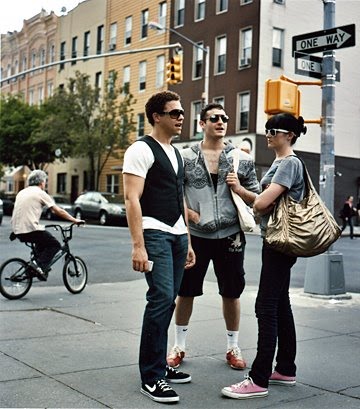
But one might say: what a 'cadre'! These are men who look like the two fellows in the photo above (in fact, these two men are perfectly representative: the one on the left is a 'chav', the one on the right a 'skin'). That fact, when you think about it at length, can prove to be depressing. Every high-minded and decent Australian ought to be concerned with the future of the white race, or at least the well-being of their immediate community, and so should be participating in nationalist (and racialist) politics; but that brand of politics only seems to attract misfits, losers, lumpenproles... These 'bad' people in turn scare away the decent folk, and so the nationalist scene, over time, encompasses a narrower and narrower sphere.

One then, by logic, is forced to choose between two options: one can either drop out, and join the ranks of the hundreds? thousands? of Australians who have burned out (mainly because of the antics of the time-serving misfits and lumpenproles in the nationalist movement) and left; or one can stay on and attempt, futilely, to use whatever power and influence one has in the movement to purge the ranks of the freaks, eccentrics and lumpenproles.

But a third alternative exists: one can accept the reality, learn to live with it and try and work with it. Firstly we need to acknowledge that lumpenproles, inside and outside the nationalist movement, exist, and that there is a fine line between the lumpenproletariat and the proletariat. In the comments section of an old article (from 2013) on the EDL, one commentator writes:

Tommy Robinson comes across pretty much as he seems.

A bit of a football hooligan who is ”fed up” with certain sections of people in the country taking the micky. And he and his followers react in that lumpen bone-headed way. Why people get so upset about the EDL I really have no idea. They are part of the lumpen working class. Maybe if you never mix with such people they seem so alien and horrid. But if you’ve ever worked on a building site (for example) you would have come across a lot of these kinds of people. Or if you went to football matches or went to the bookmakers shop.
They are Sun and Daily Star readers. We might wish they ceased to exist – but they have always been with us.

Indeed. But then, those of us in the nationalist movement who are inclined towards socialism and anti-capitalism ought to be happy. After all, record numbers of the European working classes are voting for Le Pen and Wilders, and in the UK, members of the British working classes are joining anti-Islamic groups (which are the equivalent of our own Australian 'patriot' gangs) such as the North-West Infidels, the South East Alliance and the Pie and Mash Squad. Doesn't this make our nationalism socialist? National socialist?

It goes without saying that a historical link exists between today's 'national socialists' and the German variety. In the aforementioned article by Eddie Ford, he writes: 'It is an eminently reasonable assessment of the EDL that it has steadily becomes less ‘respectable’ and developed more of the traits of a street-fighting paramilitary outfit, whose goal - no matter how far-fetched - is to physically, violently, smash the organised left and the working class movement [that is to say, the communist movement] as a whole'. He adds hopefully: 'Though, it is vital to add, at present the EDL is a pathetic piss-pot organisation with no more than a few hundred - thoroughly disorientated - members nationally'. The Left saw the connections between the EDL and the BUF, the Brownshirts, the Blackshirts, and sees the connections between today's 'patriot' and anti-Islamist gangs and those same fascist brawlers. (The fact that our civic nationalist and anti-Islamic friends furiously deny that such a connection exists makes no difference). The social base of the NSDAP itself rested on, at the outset, two groups: university-educated youth and 'hard men' (who were more often than not returned soldiers or dropouts from the German Communist Party (the KPD) or both). The Marxists have always alleged that the latter group formed part of the lumpenproletariat. Who knows. As stated before, a fine line exists between the lumpenproletariat and the proletariat. In defining the lumpenproletariat, today's Marxists rely on Marx's book The Eighteenth Brumaire of Louis Napoleon (1852) which was written a hundred and seventy years ago and may (one might think) have become outmoded.

In all respects - in all but one (which I shall detail in a moment) - the 'patriot' and 'skin' movements resemble the fascists of the 1920s and 1930s. This isn't to say, however, that both of them can't be criticised from a nationalist point of view. They direct most of their fire at what many of us in Australia consider to be the wrong targets. The 'patriots' concentrate overly much on Islam: the real threat to the white man's racial survival on this continent comes, not from the Middle Eastern countries (or even Islamic-Asian countries such as Malaysia and Indonesia) but from India and China. Likewise, the 'skins' and other Neo-Nazis (especially the American ones) are preoccupied almost solely with the Jewish question, whereas the Jew - while being no friend of the white man in Australia - doesn't here make himself as much of a nuisance (socially, politically, culturally, economically) as he did in the Germany of Hitler's time.

But all that can be debated later. The most glaring deficiency of both the 'skin' and 'patriot' movements is that, while both subscribe to fascist practice, if not fascist theory, both lack strong leaders, 'great men'. The NSDAP and the PNF were conceived as, among other things, a means of catapulting their respective leaders Hitler and Mussolini into power. The expectation of all the fascist movements of the time was that their leaders were prepared for, and sought, absolute political power - that they would not settle for being mere leaders of a cult (i.e., William Pierce) or a trend in popular music (i.e., Ian Stuart). We in the nationalist movement today lack men of action - the Hitlers, Mussolinis, Mosleys, Degrelles... I compare a fascism without a leader to an Islam without a Muhammad.

Having said that, in conclusion, we nationalists, especially those of us of a 'fascistic' and 'Nazi' bent, should be grateful to the lumpenproletarians among us; they alone in the seventy years since the war have kept the flame of nationalism alive.


Wednesday, February 8, 2017

Is it socialism? Socialism and the Civics, Patriots and the Pie and Mash Squad


A nationalist comrade sent me the following - from a Facebook thread - recently and asked if the below account of NSDAP social and economic policies was 'true':

Multi-national industries in occupied territory were particularly targeted for state ownership

* Large public works programs supported by deficit spending

* Disbanding of all private welfare institutions, in an effort to socially engineer society by selecting who was to receive social benefits

* The National Socialists provided a plethora of social welfare programs under Nazi’s concept of Volksgemeinschaft which promoted the collectivity of a “people’s community” where citizens would sacrifice themselves for the greater good. The NSV operated “8,000 day-nurseries” by 1939, and funded holiday homes for mothers, distributed additional food for large families, and was involved with a “wide variety of other facilities.”

* During the 12 years of the Third Reich, government ownership expanded greatly into formerly private sectors of strategic industries: aviation, synthetic oil and rubber, aluminium, chemicals, iron and steel, and army equipment. The capital assets of state-owned industry doubled during this same period, whereby the nationalization caused state-ownership of companies to increase to over 500 businesses.

* By the late 1930s, taxation, regulations and general hostility towards the business community were becoming so onerous that one German businessman wrote: "These Nazi radicals think of nothing except ‘distributing the wealth,'

A particularly interesting one for you history deniers:

* The Nazi social welfare provisions included old age insurance, rent supplements, unemployment and disability benefits, old-age homes, interest-free loans for married couples, along with healthcare insurance, which was not decreed mandatory until 1941.

Yes, I can say that all the above was true.

I came across my first account of German Nationalist policies in a beginner's textbook on Keynes, which described how Sweden and National Socialist Germany flourished throughout the Great Depression because of (what the author believed) was Keynesian policy.


At the time I read the book - the mid-1990s - rural and regional Australia was afflicted with great unemployment as a holdover from the recession of the early 1990s, a slump which was compared by many to that of the 1930s. So the German National Socialist and Swedish Social Democrat fiscal and monetary remedies proved to be attractive to me. (But I wasn't a fascist sympathiser at the time: I still believed in the Holocaust, and found Hitler, National Socialism and fascism abhorrent).

Another friend has added, to the above Facebook exchange:

The fact the Nationalist Socialist Germany is considered economically Left by many today, shows how far to the economic right we are.

Ive heard these before, they are more or less true (with important caveats, that being the intent of government ownership). This was the way the world was then. Before neo-liberalism and deregulated lassez-faire capitalism, these kind of policies were normal. Look at Post WWII tax rates in America. Positively wealth redistibutionary.

On the subject of high taxes: the Great Depression was caused by tax and tariff increases. It all started in the US:  Herbert Hoover imposed the 60% Smoot-Hawley tariff in 1929-1930 and then raised the top rate of income tax from 25% to 63% in 1932, and countries all across the world - including the UK, Australia, Japan and Germany - responded with their own Hoover-style super-tax and tariff hikes. The US recession went global as a result.

On coming into office, Hitler didn't cut income taxes, but he did, according to supply-side doyen Jude Wanniski, exempt shares in the top German companies from capital gains tax; he also cut taxes for companies that reinvested their profits. On the trade front, he negotiated trade agreements - or barter agreements, rather - with thirty countries, which circumvented the huge Smoot-Hawley tariff blocking off international trade. (His autarchy policies, which encouraged self-sufficiency, were intended to be another way of getting around Smoot-Hawley).

The West - and Japan - recovered after the war because of cuts to the enormously high Depression and wartime tax rates. Those post-war rates do look high to us today - the top rate of income tax in the US, even by 1980, was 70% for anyone making over $USD100,000 - but because of generous loopholes, rebates and deductions, hardly anyone paid them. In addition, by 1950, the gold standard and fixed exchange rates had been reintroduced. As for the tariff walls of the 1930s, these were knocked down after a series of free trade agreements, including the much-aligned GATT.

But I digress; I'm leading into a discussion of supply-side economics, when what I want to write about here is Hitler's socialism. The above Facebook quotation raises the question: what leads us to characterise certain politicians as socialist, even Marxist? Is it their social policies - like those of Hitler's, listed above - or is it something deeper... I believe the latter. What makes a politician socialist, even Marxist is his championing the cause of a particular class - the working class. For this reason, I view Trump as the most socialist - even Marxist - American president in the last hundred or so years. He has donned the mantle of saviour and protector of the (white) American working class, and so should rightly be considered socialist even if he doesn't see himself that way. The fact that Trump does not endorse Marxist-Leninism, and most likely never has read a word of Marx or any other socialist intellectual, doesn't matter; what does is that he has managed to present himself to the American workers as their representative.

In contrast, Sanders - who campaigned as a self-conscious socialist, that is, a socialist who recognised himself as such - did not succeed in winning the votes of the blue-collars in the Democrat primaries; he only managed to attract the middle-classes - the white collars - and the bohemians. That seems paradoxical, to be sure, but modern politics is filled with paradoxes.

Sometimes what a politician says matters more than what he does. Lenin claimed to be 'for' the working classes and the peasantry and yet starved them to the death and executed them in the millions; but we should still - in my opinion - see Lenin as a genuine Marxist and socialist and class warrior... By that criteria, Hitler, too, should be regarded as a genuine socialist - and even Marxist - regardless of whether his policies were, objectively viewed, 'for' or 'against' the working class and their interests (and in the end, who is it that judges, we may ask).

Fascism finds its political center in the working classes, just as Trumpism does (but this is not to say that both fascism and Trumpism are the same thing). Back in the 2000s, when the English Defence League first appeared, it succeeded in enrolling many British working class men; its base was located in the British working class. It was this element, in combination with others, that gave the EDL its 'fascist' character. The EDL leadership may have protested that the EDL was a multi-culti, philo-Semitic, 'pro-Israel' organisation, but this rhetoric hardly fooled anyone. The resemblances between it and earlier, overtly fascist formations - such as Mosley's BUF - were blindingly obvious to students of history. The doctrinal purists of the Far Right who opposed the EDL pointed, like the EDL leadership, to the 'Zionism' of the EDL and its multi-cultism, and they raised suspicions that the EDL may have been formed by agents of the British 'secret state', but all this ignored the implicit whiteness of the EDL and the implicit fascism.

In fascism, practice precedes theory, and part of that practice is the cultivation of a working-class base - doctrinal purity comes later. And so does any other form of purity. We must acknowledge that many of the followers of the EDL, and the Neo-Nazi 'skin' movements, came from the ranks of the lumpenproletariat, not the proletariat (but a fine line exists between the two). How much more beneficial, for the Far Right, it would be if these uncouth types could be discouraged from entering the movement and more clean-cut and well-presented types (like those overall-wearing, cloth-cap wearing proletarians in Soviet iconography) could be persuaded to join. But alas, in politics, things don't work out that way. You can't pick and choose; nor can you isolate and segregate certain factions of the Far Right from the other. Nor can you say that you only want 'good' working class people to join. (For the past thirty or so years, the Far Left has been keeping out of its ranks what it regards as the 'bad' members of the working class; as a result, it has gutted whatever working class membership it had and turned itself into a bourgeois, non-working class and non-socialist (in the true sense of the word) movement).

The EDL seems to have waned, but several anti-Islamist offshoots - such as the North West Infidels and the South West Alliance linger, and so do the Australian equivalents: the UPF, Reclaim Australia, True Blue Crew... This so-called Australian 'patriot' movement does boast a sizeable working class following, and could be said to be quasi-fascistic in some respects. Like the EDL, it has been corrupted by Zionism and civic nationalism, but, on the other hand, it does show fascist potential - more so than the political parties with which it is aligned (Rise Up! and Australian Liberty Alliance). In other words, they stand close to the socialism of the NSDAP variety, about as close as the skinhead formations. Ideological proximity to the tenets of the NSDAP doesn't equal identity, of course, but the skins and the patriots are the closest we'll get - for the time being - to an Australian neo-fascism.

The interesting thing about the UK scene is that the civic nationalist and the overtly fascist groups are prepared to work together: see an account of a 2016 Liverpool demonstration here, which saw the civic-nationalist, 'hooligan' outfits NW Infidels, SW Alliance and the Pie and Mash Squad standing alongside the (now banned) National Action, which was a self-proclaimed 'national socialist' group. I take this as evidence that the gap dividing the two tendencies in Britain has been bridged. Likewise, that gap could be surmounted here in Australia.

Tuesday, August 28, 2012

The Menace of Unity: To Uniform or not to Uniform?


Much of the nationalist political struggle isn't about impressing one's ideas on 'ordinary people' (however they may be defined), but about positioning oneself and one's ideology in relation to other nationalist groups. One does that in a number of ways. One can write articles and books explaining why one's 'line' is different from the other fellow's (in much the same way Lenin did for most of his political career, churning out endless treatises on why a rival Marxist theoritician's path was the wrong path, or why such-and-such a faction in the Russian socialist movement were bounders and blockheads). It's a useful and extremely important exercise - Lenin's diatribe writings have stood the test of time and are still used, by the contemporary Left, today. But there are other, more subtle, and more practical means: one of these is the multi-denominational event, when a bunch of nationalist individuals and groups turn up to listen to one another's speeches, or just socialise. The question is, how is one to stand out? Suppose you are hosting other nationalists at some venue, like King Henry VIII receiving some foreign dignitary (the King of Scotland, or the French Ambassador) in the TV show The Tudors (2007-2010). Your first duty is to impress upon them the power of your organisation. That means festooning the back wall with a giant banner with the logo of one's group, wearing a special, very distinctive t-shirt and cap with one's logo, and maybe even going so far as wearing tie-pins, belt buckles and rings with one's logo. That sounds excessive, but I can name at least three or four nationalist tendencies and groups which do a roaring trade in a range of nationalist, Far Right and racialist paraphenalia associated with their particular group. Skinheads will go to the extent of having jacket patches and even tattoos with their group symbols. All of this 'visual propaganda' serves the purpose of sending a variety of messages - unspoken messages - to the groups of the opposing tendencies.

As I wrote in my last post, the nationalist scene is awfully competitive in some Western countries. The question is, how does a group stand out? How does it leap ahead of the pack? Forget chopping and changing one's ideology to appeal to a mythical 'Joe Normal': how does one get noticed by Joe Normal in the first place? How does one distinguish one's group from all the other groups?

I'm not an expert, by any means, on Hungarian Far Right politics. But I'm willing to believe that, ten years or so ago, there were a variety of Hungarian nationalist groups and parties on the scene. Jobbik, for the time being, has crushed them all. Its ideology is uncompromising, extreme, inflammatory, unapologetically anti-Semitic and pro-fascist (that is, pro-Arrow Cross, the great wartime Hungarian fascist party). We all know the clichés of modern political science (first popularised by Hitler in Mein Kampf) to the effect that the masses only like blacks and whites, extreme polarisations: they don't like subtle politics. What's more, they want The Truth with a capital 'T': and, in Hitler's politics, that means saying downright inflammatory and offensive (usually offensive to x ethnic group) things which stand to get one in trouble, while lauding oneself for one's courage and even foolhardiness. ('There's just something about me: I must speak the truth, even if I go to jail for it'). The Hungarian masses, certainly, don't want soft soap from a Far Right Hungarian nationalist: they want to hear about how the Jews, homosexuals and gypsies are poisoning Hungarian life, and they expect to hear it from that nationalist politician alone (no liberal democratic politician, no matter how "conservative", will dare a word against Jews, gypsies and homosexuals). Similarly, while there must be "moderate" Islamist parties in Afghanistan, somehow it's the Taliban which rises to the top (in occupied Palestine, it's Hamas, in Lebanon, Hezbollah). And, on the Left, the Third World is littered with the wreckage of socialist (but not Marxist) parties which were passed over in favour of the communist ones. Fascism, Islamism, Communism: three brutally simple, and durable, doctrines.

But, in addition to having a frank, uncompromising, extremist ideology, Jobbik had another ace in the hole, and that was the Magyar Gárda. This was a militia - an unarmed militia - composed of men who wore uniforms resembling those of the Arrow Cross. The Magyar Gárda, to me, looked perfectly inoffensive: their get-up had a quaint Central European feel about it - except for the military boots, you could be forgiven for thinking that they were peasant herdsman who lived in the mountains... But their appearance drove the liberal media and politicians into a frenzy. Footage was shown, on TV, of the Magyar Gárda marching, with headlines like 'The Rise of the Far Right in Europe' - these were reports portending all sorts of calamities. Really it just a bunch of men marching in uniform (but not in the armed forces, or the police), but, to go by the liberal media, you could be forgiven that the sky had caved in.

We see the same phenomenon repeated elsewhere - e.g., with the treatment of the Patriots of the Ukraine, another paramilitary-type group. And, no doubt, if a similar uniformed (or half-uniformed) bunch of nationalists were to appear in Britain, the liberal establishment would go into a frenzy, and demand that the old 1936 law against the wearing of uniforms 'for political purposes' be dusted off and applied again. (Some nationalist commentators argue that the English Defence League does break the uniform law. In their view, the fact that the EDL hasn't been jailed only proves that the EDL are in collusion with the state).

Why is this? The reasons are twofold, in my view.

The first reason is the fact that there is a sort of uniform. White Western people aren't mean to wear uniforms of any kind: they are meant to, aesthetically, 'Do their own thing' and 'Be an individual'. Muslims, to be sure, are allowed to dress the same, or nearly the same. Hijabs, Chadors and Burkahs all help conceal a Muslim woman's individuality and mark her out as belonging to a particular ethnic and religious group. The same goes for the austere dress of the Haredim, the ultra-Orthodox Jews (then there are the moderately religious Jews, who wear kippahs but don't wear black 19th century clothes, like the Haredim). In the West, negating one's own individuality, by dressing the same way as the fellow next to you, is really, really dangerous - if the negator is white. This sort of self-negation suggests that you don't put your own unique tastes and preferences first: instead, you put them second, to something else - collectivism.

The second reason is the militarist discipline - the fact that these outfits, boots, etc., look military, and that the marchers are acting in a unified, disciplined way (which is what a march is). Again, the liberal establishment disdains this and abominates it as a sort of collectivism. Men (especially white men) concentrated on a single purpose, a single goal, subordinating themselves, like rowers in a rowing race, and acting in a unified, harmonious and even mechanical way: that's dangerous. It may even lead to socialism, and hence, following Hayek's book, The Road to Serfdom (1944), serfdom. Hayek's book was a impassioned, brilliant defence of 'Anglo-Saxon liberties' which were, at the time of writing, being challenged by the Communist and Fascist alternative. Hayek's fear was that the collectivisation and planning of the war effort would carry on in to peace time, after the successful conclusion of the war, in the Anglo-Saxon countries... What is socialism but the mechanisation and militarisation of peacetime activities, e.g., economic ones? Another, unspoken fear of the Hayeks is - what if such a system actually works? Now, in 2012, we have plenty of evidence that it doesn't work: if the East Germans - the most disciplined, self-subordinating, efficient and 'Prussian' of all the peoples of Europe - couldn't make communism and the planned economy work, well, no-one can: certainly not Cubans or North Koreans! But you never know...

Aside from that angle - that 'Fear of marching white men is really a fear of socialism' - it's also a reaction that is purely aesthetic. The typical establishment liberal finds the sight of Jobbik-style marchers more disgusting than, say, the sight of two gay men kissing.

At any rate, fighting against the white man's desire to subordinate oneself to a group is a lost cause. We have plenty of subcultures - Goth, Emo, skinhead, metal, and so forth - based on a visual and aesthetic conformity. But even outside that, there's the trade unions...

The latter example is a particularly illuminating one. For around about two weeks now, construction workers in the CFMEU and other unions have been blockading the building site of a department store building in the Melbourne Central Business District: among their litany of complaints is that the construction company - Grocon - won't let union members identify themselves, on site, by allowing them to wear union patches on their jackets or stickers on their helmets. Symbols (and the feeling of belonging that these symbols give them) are important to these men - important enough to lose pay over. This morning, acting upon a court order brought against the strikers, by Grocon, mounted police attempted to break the blockade. (See the picture above). Some poor horses were punched, and some of the strikers were pepper-sprayed... (The TV news footage shows a bemused Chinese immigrant woman staring out of a McDonald's window at the goings-on: all the strikers, and the policemen, were white). The media gleefully recounted that it was like the 'good old days' of the industrial militancy of the 1970s and early 1980s. (I saw two bearded student types, one of them waving an Industrial Workers of the World flag: anarcho-syndicalists, trying to associate themselves with this episode of militancy?).

I pass the building site, and now the strikers, every day on my way to work (I had a union flier thrust into my hands one day). These men are real blue-collar: they seem to be of a particular type - Aussie, middle-aged, often overweight, and they smoke and swear a lot. But what is striking is that they dress more or less alike: they wear a kind of semi-uniform. It's a long way from neofascism, but we have to remember that fascism emerged, originally, from anarcho-syndicalism (which in turn was based on 'spontaneous' worker's socialism sprouting out of trade union militancy).

At any rate, I didn't get to see the riot this morning. But it's good to pay attention to such things: they haul you out of the incestuous confines of nationalist politics. If we were to put all the members of the various racialist, nationalist and Far Right Australian groups together in Lonsdale Street in Melbourne - there wouldn't be half the number of union strikers that were there, in that same street, that day. Granted, the unionists had a strong economic incentive to be part of the union and participate, but, at the same time, they are losing money every day of the strike. (Not as much as Grocon, which claims it is losing $370,000 a day). All of that unified effort, collectivism, self-sacrifice and abnegation of one's own individuality - on behalf of white men. Gives one pause, doesn't it? Why can't nationalism do the same?

My advice to any nationalist group is: do what Jobbik did, and get some gear together, get it on, and give the appearance (appearance is the operative word) of renouncing your identity and subordinating yourself to the group. It doesn't have to be a military-style uniform: it could be a t-shirt, a belt-buckle or a tie-pin.

'To uniform or not to uniform?' is a question which has been asked, countless times, in post-war nationalist circles. There is a whole thread, on the neofascist forum IronMarch.Org, about it, with many intelligent arguments, for and against, on both sides. Reading it makes one aware of the role played by the uniform in politics, whether it be on the Far Right or the Far Left.

I found this comment, from Benjamin Noyles, particularly insightful:

It depends on your aim, In some cases it may be that being militant and threatening, alienating and frightening may just be the only way to get anyone to pay attention to you. Certainly almost nobody in the group below would have been known if they did not activly go out of their way to offend everyone - it got them speaking venues in university events across america, tv interviews, radio shows, full media coverage, the works. The Uniform was just a tool to get people to change their perceptions so in this sense they were artists rather than a sincere political movement. They knew that the american right wing was going to be dead unless it learned to embrace it's shadow. what does it look like when an artist of all people babbles in an interview about how they are not this or that and they don't want to upset anybody.

Like with a musical subcluture being marginalised can also be the appeal for some, and can in time make itself acceptable.


- Really it all depends what your aim is at the time and the task you are doing.

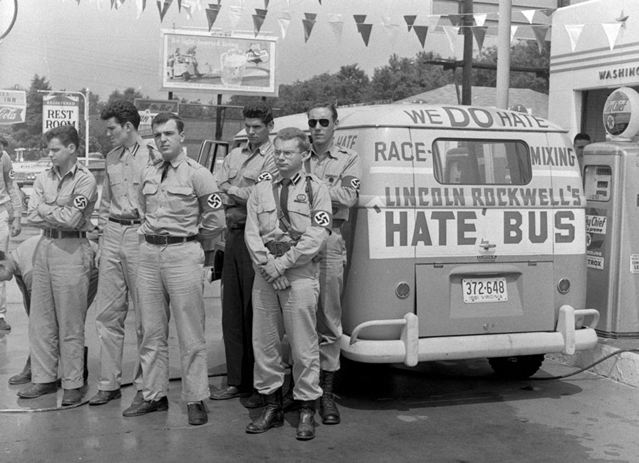
He's right, he makes a good point. We have to consider the political and intellectual context of the times, of course. America was in the period of the early 1960s, so ably depicted in the TV series Mad Men (2007-2012), when the WASP hegemony of America (and the West) was at its full height) and the New Left was just beginning to cast its dark shadows over Western lands. The American Far Right, at the time, was starving. The likes of Rockwell just couldn't break through to mainstream America in order to warn them of 'The Negro and Commie Jew-fink menace'. He had tried, unsuccessfully, to work with respectable Far Right conservative organisations, and even front groups for (what he called) National Socialism; but he came away burned each time. He recounts the story in his autobiography This Time the World (1961) (I re-read parts of it tonight for the first time in years, and I still find it as brilliant and demented as ever). One can say he went too far, but one has to laud his courage for doing what he did in the first place. His theory may have not been that sound, but in his actions, he showed himself to be a real fascist and a real showman - an heir to Goebbels...

Am I counselling nationalist groups to dress like the Rockwellian Nazi bad guys in The Blues Brothers (1980)? No, and even the mere suggestion of such a thing brings out some strong opposing reactions from nationalists - even nationalists who post on a neofascist message board like IronMarch.Org. I'm making the point that Rockwell (who was well aware of it) broke the media embargo against Far Right nationalism and racialism with his methods, and, I'm sure, for a time, blew every single rival nationalist and racialist group out of the water.


Monday, August 20, 2012

Back to the Basics: Hardcore Neofascism for Britain

Poor old Nick Griffin! The Guardian has written a piece on Fatty Nick's denunciation (in a "report" authored by him, and released last week) of the English Defence League for excessive "Zionism". There's also a 48-minute speech, by Griffin, which, according to Counter-Currents, is 'An excellent exposé of the English Defence League and the Counter-Jihad movement as a Jewish-controlled false opposition'. Wait a moment: 'Jewish-controlled'? Doesn't that sound... "Nazi"? Isn't it the case that "Anti-Semites" who peddle zany "conspiracy theories" about Jews are dragging the British nationalist movement down? Aren't they all "Nutzis"? These were the Griffinite positions of five or so years ago; anyone who remembers the Griffinite line from then must be chortling now...

I must confess I have a personal stake in the matter. Five or so years ago, there were quite a few nationalist activists on the Australian scene who preached the Griffin doctrine (which I now call 'Breivikism'): the movement, in Australia, would only take off if all the "Nutzis", crazy anti-Semites - including me - could be purged. Continental Far Right-style, anti-Islamist populism was the order of the day. In all fairness, Far Right populism has done well on the Continent - especially on the Western side (or Europeans closely related, by dint of culture, to the Western side - e.g., the Scandinavian nations Finland, Norway and Sweden). It was a reasonable assumption that the same type of tactics could be applied, and meet with similar success, in Britain. Given that the nationalist movement had been, for the thirty or so years prior to the advent of Griffin, doing so badly, five years ago I was inclined to give Griffin the benefit of a doubt and wait and see if his new approach would work. But I was certain that Breivikist, populist anti-Islam wouldn't take off in Australia, simply for the (obvious) reason that we don't have a large Muslim population (unlike Britain, France or Holland). Yes, we have plenty of Chinese, Vietnamese, Filipinos, and a burgeoning Indian population: but not that many Muslims. Europe, on the other hand, is in danger of being Islamised and Africanised out of existence (although the Breivikist anti-Islamics take care not to mention the Africans - that would be "racist").

We all know how the Griffinite project turned out. He went as far as he could go towards Ziophilism of the Breivik and Wilders type: but then two other groups - the English Defence League and the new British Freedom Party - went even further. The EDL had great success in mobilising British working-class people, especially (previously apolitical) soccer hooligans and chavs, and leading them on exciting, Mosley-type, BUF-type marches, and into confrontations with the police and activists for Islamism and "anti-racism". Just like the old days of the 1930s - or the 1970s, when the National Front did more or less the same thing.

As to why Griffin's project failed - I could blame the man himself (he's turned into a British version of Pauline Hanson, and is quite clearly in it only for the money now). But, more than that, nationalist political parties have a short shelf life. They are conceived, as political units, in certain historical and cultural circumstances which are unique to them and their time. The National Front came into existence in the turbulent 1970s, when the first wave of mass non-white colonisation of Britain was getting started; the British National Party, in the early 1980s, when that first wave became a solidly-established, and stoutly-defended, bridgehead. Now, of course, in 2012 - to use a WWII metaphor - the invaders have broken out of their bridgehead, have seized Paris and Brussels, and are now standing at the Rhine. The killer blow to Britain is about to administered. Or perhaps it won't be over quickly: Britain will suffer a slow, agonising death, the death of the thousand cuts (one such cut we saw at the Olympics opening ceremony). In any case, British nationalists are in a different position than they were in 1974 or 1982. They have to adopt new tactics, a new ideology, a new charter. Which means that old warhorses like the British National Party, or the National Front, have to be put out to pasture. (The same thing could be said of that relic from Australia in the late 1990s - Pauline Hanson's One Nation).

At any rate, the Guardian reports that there are now (by nationalist standards) a massive number of British nationalist and Far Right parties on the market:

The most striking aspect of this year's elections was the number of far right parties competing alongside the BNP. In England, local elections were contested by 149 candidates from far right groups other than the BNP, and in some areas these out-performed the 30-year-old party. In Dudley, for example, the BNP was forced to watch its old and more ideologically extreme rival, the National Front, attract more votes. This owes much to a series of personality clashes and ideological splits that have spawned an increasing number of groups, including Britain First, British Freedom, British People's party, England First, National Front, English Democrats, Democratic Nationalists and the Britannica party. Most lack resources and members, but their emergence reflects a scene that is in transition and has not yet decided on its destination.
This really gave me pause. How the devil is a British nationalist group to distinguish itself from the competition? How is to become, in the jargon of business, a 'market leader'?

The answer, I think, is this. The British groups - or the leading ones, such as the EDL, British Freedom Party and the British National Party - have swung as far as possible to the 'left' of the Far Right, that is, towards Wilders and Breivikism. Now it's time to swing back the other way - towards Mosley, Lord Haw-Haw and John Amery, some of the most decent and principled men British politics in the 20th century has ever produced.

As for visuals, nothing conveys power and punch like this:


This is, of course, Jobbik, who revive the ideology, and appearance, of the wartime Hungarian Arrow Cross, but aren't a revivalist party as such: they have their own look and own ideology (unlike John Tyndall and Colin Jordan's 1960s-era group, the National Socialist Movement):


Nothing wrong with uniforms as such, just make them original uniforms.

But wait, aren't paramilitary uniforms banned in Britain, under the infamous 1936 Public Order Act? Well, that Act is open to interpretation. In any case, to judge by the evidence (and I am willing to be contradicted on this point), the Act's provisions against 'uniforms for political purposes' weren't used to arrest the members of the National Socialist Movement: other provisions were used instead. (The Act has been used, quite a few times, since then, and not always against nationalists: e.g., the Act was supposedly used against the British miners during the miner's strike of 1984). Most arrests, detentions, prosecutions, of nationalists since the 1960s have come about through the breaking of laws forbidding freedom of speech on race. An excellent article, on the history of the "anti-fascist" and "anti-racist" laws and their applications to British nationalists and fascists, can be found here: 'British Fascism and the Measures Taken Against It by the British State' (1998) in the Libertarian Alliance journal. (I advise all nationalist activists, especially nationalists with a bent for law, to read it).

I'm inclined to believe that the National Front, which used many of the street tactics of fascism (just as the EDL does today) refrained from outfitting its members in uniforms because it wanted to distance itself from the fascism of the 1930s and 1940s, and the uniformed clowning of the 1960s NSM (and other related Rockwellian groups) - not out of a fear of being shut down by the provisions in the Public Order Act.

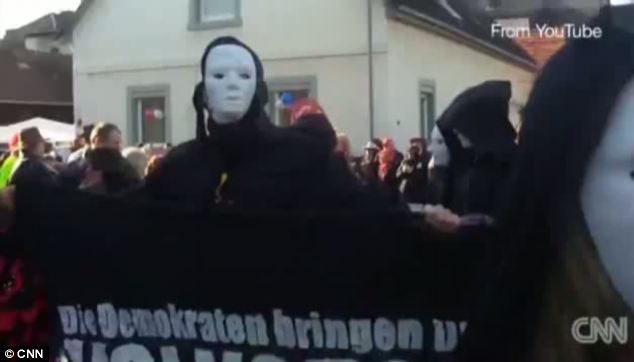
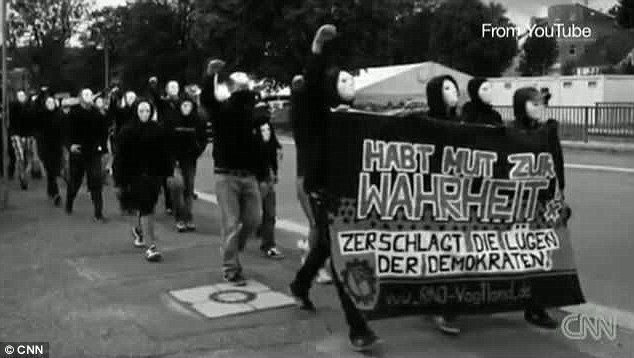
Let's, for the moment, go to the Continent, where even more repressive "anti-fascist" laws apply. The German constitution expressly forbids the wearing of uniforms. But what of this? Here are pictures of the latest offshoot of the German Freie Nationalisten / Autonomous Nationalist tendency. They are a nationalist 'flash-mob' called The Immortals. They wear freaky V for Vendetta masks:

Dr Hajo Funke, a professor at the Free University of Berlin, told CNN he believes the tactics employed by the Immortals are designed to attract young people to their cause.

The Immortals, a German neo-Nazi group wearing masks and carrying torches, is flash mobbing cities

NEONAZIS15N_2_WEB

In truth, I find these plastic masks very frightening. They remind of the Autons from Doctor Who:


Or worse, that Michael character from John Carpenter's Halloween (1978):


I think this is pretty terrible. Masks, of course, have their own power; in classical theatre, they allowed actors to assume the personalities of the characters they played on stage. The impression conveyed the Immortals' mask isn't exactly positive.

The fascists of the 1920s, 1930s, 1940s, didn't wear masks, of course. Fascism is about, among other things, naked publicity, drawing attention to yourself and your cause. The showing of one's face, in public, is a dangerous enterprise for someone on the Far Right, considering that so many communists in Europe were prepared to harm or even kill you, or, at the very least, apply pressure to have you removed from your place of employment, your home, etc. The showing of one's face was an indication of one's courage, foolhardiness, and pride.

But as for uniforms, especially paramilitary uniforms - that's a different thing altogether. I'm sure that reams of material have been written on the psychological effects of seeing large numbers of men march by, in paramilitary uniform; or being part of a group of men in paramilitary uniform. Academics (who specialise in writing treatises on fascism) will say that uniforms confer, on their wearers, a feeling of belonging, cohesiveness, identity, and of status, power and authority - which is all correct. But, simply put, men like uniforms, because they make men feel, and look, good. And there's a feeling of safety in numbers, too, when the group is primarily of uniformed men: and a nationalist needs that feeling, when he is facing down a crowd of hundreds, if not thousands, of Trotskyites, anarchists, Antifa, who are literally baying for his blood. (Wearing a suit and tie - the 'uniform' of the conservative - just doesn't cut it in those circumstances). The militant Left, too, believe in safety in numbers: they indulge in foolhardy acts of provocation and violence because they are part of a large group, and large groups tend to be less inhibited about these things.

At any rate, aren't the Immortals, pictured above, wearing uniforms 'for political purposes'? Granted, the German law doesn't use that phrasing, but the intent is the same. When you think of it, there are plenty of groups and subcultures - e.g., anarchists, skinheads, even 'Gay Pride' protesters who wear identical pink shirts - who are political and who adopt uniforms of one sort or another. What makes the fascists unique is that they use paramilitary uniforms.

I think that the Public Order Act, in Britain, really needs to be tested, pushed to its limit, by British nationalists who wear paramilitary outfits. We need to see what the definition of a 'uniform for political purposes' is. Granted, the British state will use any excuse to ban a march or arrest members of a nationalist group. But...

I've come to the conclusion that, for a country like Britain, things have deteriorated too far to be arrested by a mere, reflexive and reactionary British Far Right conservatism. The old institutions don't have to be preserved, they must be destroyed (and they are being destroyed, by the anti-white clique that controls Britain, anyway). Perhaps only a Libyan-style uprising could work. At any rate, the British parliament needs to be shut down, and elections suspended for at least ten years. Britain, too, needs to become a republic and to exile, permanently, the Windsor family.

As regarding policy: the white man has to reclaim sovereignty, in his own lands, before one can make the really big, important decisions - on the nationalisation of property, on which immigrants to keep and which ones to expel, and so forth. The communists in Russia, Cuba and China understood this: they seized power first, and made up policy later, improvising, and responding, to a large extent, to the unique circumstances their individual countries faced.

So political power, for nationalists in Britain, can only be achieved by a white, working-class and radical political party, with a Marxist and anarcho-syndicalist base (in other words, a party like the old fascist parties). The old 'preservationist' brand of Enoch Powell Far Right conservatism just won't cut it.

As it is, if present trends continue, there won't be a Britain in fifty years: there'll be, instead, a new country - Afro-Indo-Islamistan - where Africans, Indians and Muslims are the dominant ethnic groups, and the 'old' British are relegated to a minority.

Ideologically, of course, the Lord Haw-Haws, Mosleys, Amerys, and, by extension, the Hitlers and Mussolinis, have to be embraced, not spurned. The words "Nazi" and "Fascist" shouldn't be rejected: they should be seen as badges of honour. Isn't there something clean, clear cut, appealing and reassuring about the 'old' ideologies? One knows what one is; one knows where one stands. I'm sure that the Indian Maoists - one of the few genuinely Marxist groupings around today - feel the same about their simple, clear-cut ideology. It's not a case of fetishism or nostalgia; no, it's a case of, to paraphrase Nietzsche, 'How one becomes what one is'. That is, acknowledging and embracing one's true self. Which is quite a change from the British nationalist movement of today, which has become schizophrenic under the influence of the Nick Griffins and Tommy Robinsons.